Written by Daylogue Editorial Team. Published September 1, 2026. Reviewed and updated September 1, 2026.
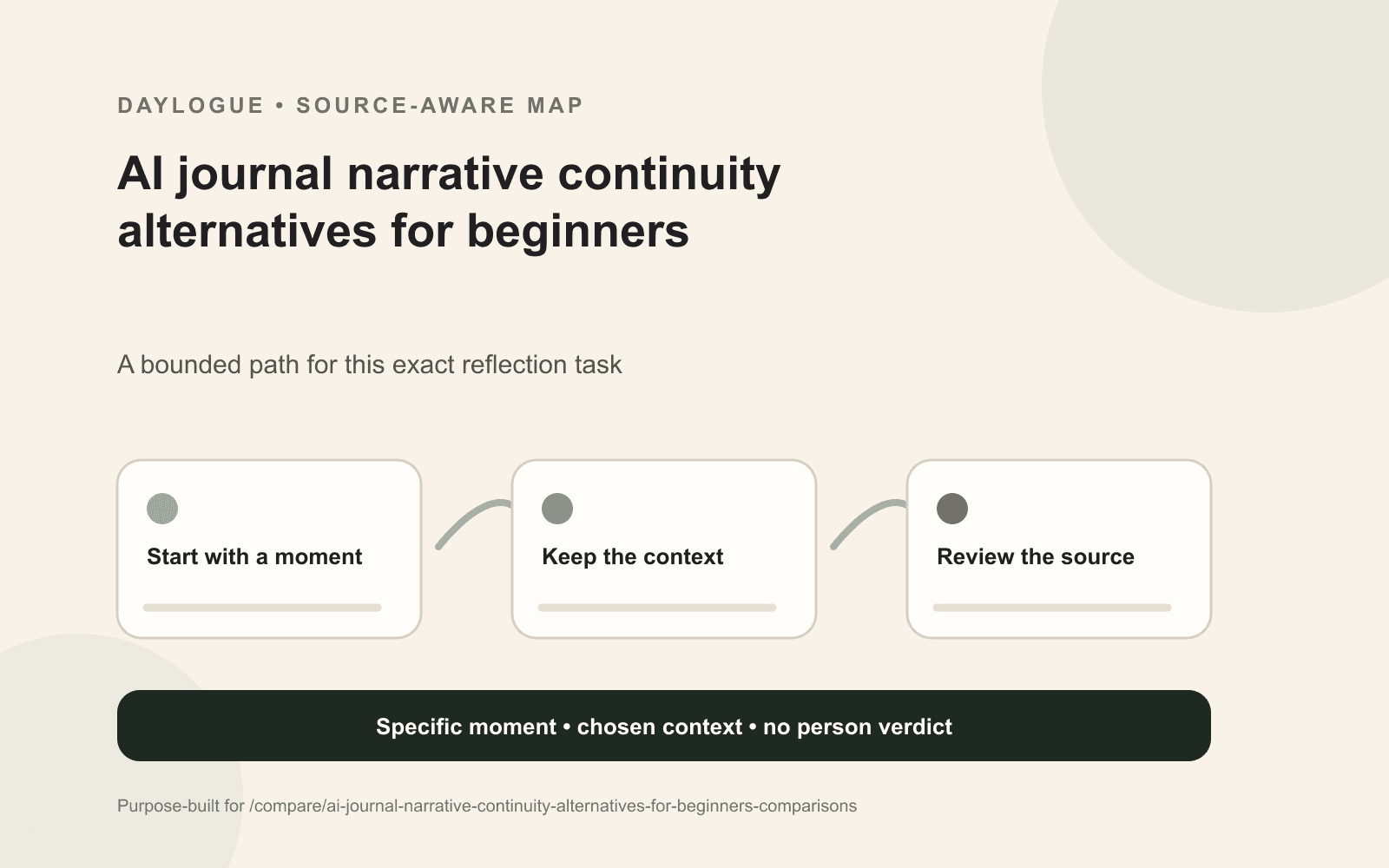
For beginners, the best AI journal narrative continuity method is usually a small set of recurring topic links with dated source entries. Manual tags offer the most control. Pinned context is useful for facts that should remain visible. A source-based narrative read can connect related moments across time, but it should preserve contradictions, show where each detail came from, and allow old labels to change. Continuity should help a person find a thread, not turn an early entry into a permanent identity.
A continuing thread is not a permanent verdict
A journal thread might follow a new role, a friendship, a creative project, or a recurring Sunday routine. Continuity makes later entries easier to understand because the relevant earlier moments remain available. The risk appears when an old label becomes fixed. A person who wrote “I hate this project” in one difficult week may feel differently after the scope changes. The archive should preserve both moments.
A useful continuity system links dates and source words, then lets the person decide what still fits. It does not need a single polished story. Contradiction is evidence that something changed, not an error to smooth away. Beginners benefit from a method that keeps the thread visible while making revision normal.
Tags, pinned context, links, and narrative reads
Manual tags are direct and easy to understand, but a tag can become too broad. Pinned context keeps a small fact visible, such as the start date of a project, though it can grow stale. Explicit links connect one entry to another and preserve sequence. A generated narrative read can find recurring language across many entries, but it needs source links and a way to disagree.
The right route depends on scale. Five entries about a move may need one tag. A year-long project may benefit from a short timeline. A recurring relationship topic may need distinct threads for events, feelings, and later reinterpretation. More automation is useful only when it reduces search without hiding how the connection was made.
| Method | Best use | Strength | Risk |
|---|---|---|---|
| Manual tags | Small archives and clear topics | Direct writer control | Tags can become broad or stale |
| Pinned context | Facts that should stay visible | Reduces repeated explanation | Old context can be mistaken for current |
| Entry-to-entry links | Projects and events with sequence | Source chain remains inspectable | Manual linking takes effort |
| Source-based narrative read | Large archives with recurring language | Reduces scanning time | Generated thread can overstate coherence |
Every continuing thread needs dates and revisions
A context note should say when it was true. “Starting a new role” may be current in March and historical in September. Without dates, a system can carry old context into a new entry as though nothing changed. The person should be able to revise or retire a label without erasing the earlier record.
Corrections need a visible source path too. If a generated recap links two entries that the person sees as unrelated, the correction should affect future reads while leaving the original entries intact. This keeps the archive accountable to the writer instead of forcing the writer to adapt to the archive.
- Topic has a clear name
- Source entries remain dated
- Pinned context has an as-of date
- Old labels can be revised or retired
- Contradictions remain visible
- Generated links can be challenged
- Free-form chat is not assumed to be source material
Related does not mean everything belongs in one thread
A broad tag such as “work” can connect most of an adult archive and reveal very little. A narrower thread such as “Tuesday planning meeting” or “portfolio review” creates a more inspectable set. The person can still connect those threads later without collapsing them from the start.
Source boundaries matter when a product has several input types. Typed entries, voice check-ins, imported records, and structured fields may enter a pattern system differently. Free-form chat should never be assumed to feed a journal narrative unless the product explicitly says so. The current first-party explanation should name what is read.
A three-entry continuity test
A beginner can create a small thread with an opening event, a contradictory middle entry, and a later update. The method should keep all three dates visible. It should not rewrite the middle entry to make the ending feel inevitable. A generated summary should name the change rather than pretending the person held one view throughout.
The test becomes stronger after the thread is renamed. Search, links, and summaries should still find the original sources while showing the current label. That reveals whether the system stores a flexible organizing layer or turns the first tag into permanent context.
01
An opening event
The first entry establishes a dated source rather than a timeless profile.
02
A contradictory entry
A different view tests whether the method preserves change.
03
A later update
The thread continues without rewriting earlier meaning.
04
A renamed topic
The organizing label changes while source entries remain intact.
05
A source-based summary
Any narrative sentence points back to the entries that support it.
A useful thread is narrower than a life category
“Relationships,” “work,” and “health” are broad shelves, not necessarily useful threads. A thread such as “weekly call with my brother” or “launch planning meeting” points to a repeated situation that can be inspected. Narrow topics reduce false connections and make it easier to notice when the thread ends.
Broad categories can remain as navigation, while narrower links carry continuity. This two-level structure keeps the archive browsable without asking one label to explain too much. A beginner can start with one thread and add another only when a real retrieval need appears.
Continuity language should describe entries, not define a person
“Several entries describe avoiding the project” stays close to the record. “You are avoidant” turns behavior in a context into a person-verdict. An AI journal should use the first kind of language and leave interpretation open. This boundary matters more as the archive grows because repeated generated labels can begin to feel authoritative.
The same care applies to positive labels. “You are resilient” may sound kind, but it still assigns a broad identity from selected records. A source-based narrative can instead name the specific return, decision, or change the person wrote about.
Pinned context needs an expiration habit
A pinned note can save repeated explanation during an active project. It becomes misleading when the project ends and the note remains current. An as-of date, review reminder, or simple archive state helps keep old context from shaping every later entry.
The review should remain optional and neutral. It is not another streak. A quarterly check of pinned facts may be enough. The person can keep the historical note while removing it from active context, preserving both continuity and change.
Different input formats need one visible source map
A voice check-in, typed entry, photo caption, and imported note may all refer to the same project. The thread can connect them if each item retains its format, date, and authorship. Converting every source into one smooth paragraph would make the story easier to read and harder to audit.
A source map can remain simple: date, type, short excerpt, and link. The generated layer can summarize across those items while the person remains one tap away from the original. This structure makes continuity useful without hiding the archive’s texture.
A thread can end without being deleted
Projects finish, relationships change, and old concerns stop appearing. A continuity system should allow a thread to become dormant or complete without removing its entries. That state helps search and prevents the product from repeatedly surfacing old context as though it remains active.
A dormant thread can still reappear when the person intentionally searches or reopens it. The archive should not decide that an ending is permanent. It simply records that the topic has not been active in the current window and lets the person change the state later.
Daylogue reads a story without closing it
Daylogue is a system for self-understanding. Pattern journaling is how it reads you. For continuity, that means a recurring thread can be noticed across what a person chose to write or say without turning it into a fixed description of the person. A rough first week on a project and a satisfying later week can both remain true in the archive.
Researchers examining narrative coherence in 395 American young adults cautioned that its relationship with well-being may be more complicated than earlier accounts suggested. The study does not prove that carrying a narrative thread forward causes a personal outcome. Continuity is useful because it preserves context and change, not because a coherent story guarantees a benefit.
Worksheet
AI Journal Narrative Continuity decision sheet
A thread continuity map for preserving dated sources, contradictions, revised labels, dormant context, input types, and the limits of generated connections.
- Thread name is narrow
- Opening source dated
- Contradiction preserved
- Later update dated
- Pinned context has an as-of date
- Tags can be revised
- Generated links can be challenged
- Input types named
- Free-form chat excluded unless stated
- Summary links to sources
Common questions
What is narrative continuity in an AI journal?
It is the ability to keep related entries, dates, and changing context connected over time. A strong method shows the source trail and preserves contradiction. It does not turn an early note into a permanent conclusion about the person.
Are tags enough to keep a journal story connected?
Tags can be enough for a small archive and a narrow topic. They become less useful when labels are broad or stale. Dates, entry links, and the ability to rename or retire a tag make the thread easier to trust.
Should an AI journal remember everything?
No. The relevant question is which input types the product says it reads and how the person controls them. A useful continuity system keeps chosen source material visible and should not imply that every chat or interaction becomes part of the narrative.
How should a journal handle contradictions over time?
It should preserve both source entries and name the change. A later view does not erase an earlier one. Contradictions often make a thread more informative because they show that context or interpretation shifted.
Can narrative continuity prove personal growth?
No. It can show that language, context, or choices changed in the available entries. That record may support reflection, but it does not prove a broad outcome or assign a permanent label.
Sources
Sources were checked on the dates shown. Product details and policies can change.
- Daylogue evidence and methods · Daylogue · checked September 1, 2026
- Narrative identity and psychological well-being research · National Library of Medicine · checked September 1, 2026
Keep exploring
Daylogue Knowledge Center
Browse practical guides for reflection, journaling, patterns, and privacy.
Read moreHow Daylogue shows patterns
See how candidate patterns stay connected to evidence and correction.
Read moreWhy Daylogue exists
Read the principles behind a system for self-understanding.
Read moreDaylogue is not therapy and is not a replacement for professional care.