Written by Daylogue Editorial Team. Published August 26, 2026. Reviewed and updated August 26, 2026.
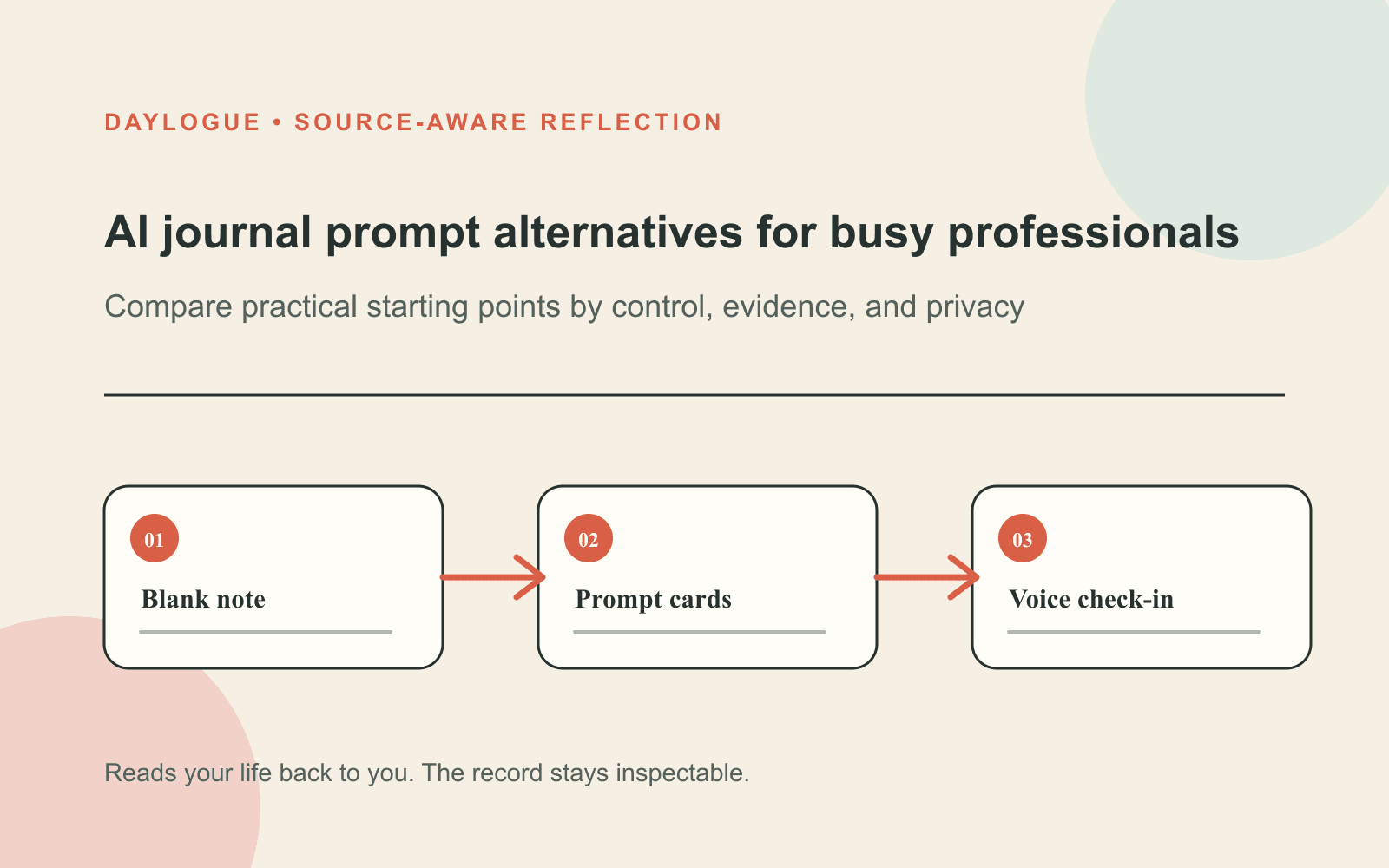
AI journal prompt alternatives for busy professionals include a fixed three-field check-in, a paper prompt card, a private voice note, a calendar cue, and a weekly scene review. Choose by the job you need done. Use a fixed check-in for comparable fields, paper when an offline boundary matters, voice when typing creates friction, a calendar cue when timing is the key detail, or a weekly review when daily prompts feel like one task too many.
Start with the reflection job, not the cleverest question
A fresh AI prompt can help when the blank page is the main obstacle. It can also ask for more thought than a packed transition allows. Before choosing a format, name the job. You may want to preserve one scene, separate a fact from an assumption, mark what took energy, prepare a question, or notice what repeated across several days. Each job needs a different amount of context.
A useful alternative removes decisions at the moment of capture. The same three fields can wait at the end of every workday. A paper card can hold one question for the week. A voice note can preserve natural wording. A calendar cue can mark when something happened without becoming the journal itself. The point is not to reject AI. It is to keep the format proportional to the moment you have.
Compare five alternatives by fit and limitation
The fastest option is not automatically the best one. A one-line calendar cue preserves timing but little meaning. A voice note keeps phrasing but requires a place where you can speak without exposing someone else's story. A fixed check-in supports comparison across days, though its fields may miss an unexpected detail. Paper keeps the entry offline, while later review remains manual. A weekly scene review gives several days context, but smaller moments can fade before you sit down.
Coexistence is often the practical answer. Keep a neutral calendar marker during the day, add a private voice or text note when you have space, then bring selected scenes into a weekly review. An AI prompt can still help when you are stuck. It does not have to become the gate you pass through before every reflection.
| Alternative | Best fit | What it preserves | Main limitation |
|---|---|---|---|
| Fixed three-field check-in | Two-minute closeout | Comparable answers | May miss the unusual detail |
| Paper prompt card | Offline reflection | A focused handwritten scene | Patterns require manual review |
| Private voice note | Typing feels slow | Natural phrasing and sequence | Needs a safe place to speak |
| Calendar cue | Timing is the key context | A moment and its place in the day | Shared calendars can expose detail |
| Weekly scene review | Daily prompts create pressure | Connections and exceptions across days | Small moments may be forgotten |
Use a fixed check-in when choice is the friction
A changing prompt creates novelty, but it also asks you to decide how to answer a new question. A fixed check-in trades novelty for continuity. Try three fields: the scene I want to keep, what I noticed in my response, and what remains open. One sentence in each field is enough. On a rushed day, answer only the first field and stop.
The value of a fixed format appears during review. Similar fields make it easier to compare like with like without turning the record into a score. You might notice that the same slot in the week keeps appearing, then return to the source scenes and look for an exception. The entries support a question. They do not prove why the pattern happened or what it says about you.
01
Keep one scene
Write the specific exchange, decision, interruption, or quiet moment you want available later.
02
Name your response
Record what you noticed in your own words without assigning a fixed trait to yourself or anyone else.
03
Leave one opening
Add a question, uncertainty, or counterexample instead of forcing the entry to end with a conclusion.
Choose paper or voice for different kinds of friction
Paper works when the desired boundary is physical and offline. Put one prompt on an index card rather than opening a large blank notebook: “Which moment deserves one more look?” The card can stay beside a bag, kettle, or nightstand. It has no automatic search or readback, so add a weekly margin note if you want to see repeated scenes. The manual effort is part of the tradeoff, not a hidden flaw.
Voice works when the sentence arrives faster than your fingers. Begin with a cue such as “The part I do not want to lose is...” and stop after two minutes. Use a setting where you can speak safely and privately. A commute may sound convenient, but recording should wait whenever driving needs full attention or other people can hear. Check whether a voice tool stores audio, a transcript, or both before using it for personal material.
Use a calendar cue as an index, not a personal record
A calendar already holds the shape of a busy professional's week. A neutral marker can help you retrieve the right scene later: “handoff,” “late change,” or “quiet hour.” Keep private reactions, names, customer details, and confidential facts out of a work calendar or shared account. The cue should point back to your memory without becoming a shadow record about colleagues or clients.
At review time, move only the context you need into the reflection space you chose. Ask what happened in that slot, what else was competing for attention, and which comparable day went differently. Calendar timing can make a question more precise. It cannot establish motive or causation, and an empty slot does not prove that nothing important happened.
Move the prompt to Friday when daily reflection feels heavy
A weekly scene review separates capture from interpretation. During the week, collect two or three neutral markers. At the review, choose one demanding scene, one steady scene, and one exception. Describe each in ordinary language before asking what connects them. This keeps a hard Monday from speaking for the whole week and gives the quiet counterexample equal space.
Review can end without an action plan. The useful result may be a clearer question, a boundary you want to name, or simple recognition that two similar days landed differently. Busy professionals already carry systems that demand output. A reflection practice can preserve experience without producing another deliverable. If the review repeatedly feels intrusive, shorten it, change the day, or pause.
Keep the writing evidence modest
A 2025 systematic review included 51 studies covering seven positive writing techniques. The authors found more consistent benefits for wellbeing and positive affect than for negative affect, psychological health, or physical health outcomes. They also rated all included studies as poor or fair in quality. The methods and results varied, so the review calls for more rigorous work rather than offering a guarantee for a particular prompt format.
That review did not compare AI journal prompts with paper cards, voice notes, fixed check-ins, or weekly scene reviews for busy professionals. A separate 2019 study examined narrative coherence in 395 American young adults and found that its relationship with wellbeing was more complex than originally assumed. Neither source shows that a specific product will improve work, relationships, or health. Use the research to keep expectations in proportion while you judge a format by burden, clarity, and fit.
Compare the data boundary before the prompt style
Prompt quality is only one part of the choice. Paper can be lost or seen by someone nearby. A work calendar may be visible to administrators or coworkers. A general voice recorder may keep audio or sync it to an account. An online journal may process readable text to provide requested features. Read the current storage, processing, sharing, export, and deletion disclosures for the exact tool and mode you plan to use.
Daylogue reads the entries you choose to sync to create narratives and surface patterns. Entries are not end-to-end encrypted. That boundary may fit when later readback matters and the disclosed processing works for what you plan to write. Paper may fit when an offline record matters more. Leave credentials, legal material, restricted workplace facts, and unnecessary details about another person outside any general reflection tool.
Where Daylogue fits beside the alternatives
Daylogue is a system for self-understanding. Pattern journaling is how it reads you. It can sit beside a paper card, calendar cue, or short voice capture rather than replacing every format. A marker can help you remember a moment, while a selected check-in gives the later readback enough context to stay connected to what you actually recorded.
Choose Daylogue when a conversational check-in and later pattern readback match the job, and when its disclosed server-side processing fits the material. Choose paper for an offline boundary, a fixed template when consistency matters more than conversation, or a weekly scene review when daily input feels excessive. The strongest choice is the one you can use honestly without giving it more authority than the record supports.
Decision Table
Two-minute reflection format picker
Choose one line that matches the job, setting, and boundary you have today. A different format can fit tomorrow.
- Need comparable answers: use a fixed three-field check-in.
- Need an offline boundary: use one paper prompt card.
- Need natural phrasing: record a private voice note when it is safe.
- Need timing only: add a neutral calendar cue without personal detail.
- Need several days of context: collect markers for a weekly scene review.
- Need help getting unstuck: use one AI prompt, then stop when the useful detail appears.
- Need less pressure: pause daily capture and review only selected moments.
- Need a sensitive official record: use the approved system, not a personal journal.
Common questions
What is the simplest alternative to AI journal prompts?
Use a fixed three-field check-in: one scene, your response, and one open question. Answering only the scene field is valid when time is short.
Can paper and an AI journal work together?
Yes. Paper can hold private or offline notes, while selected moments can move into an online journal when you want later readback and accept its processing terms.
Are voice notes faster than written journal prompts?
They can remove typing friction, but the setting and storage boundary matter. Speak only where it is safe and private, then check whether the tool keeps audio, text, or both.
Do AI journal prompts have proven benefits for busy professionals?
The assigned research does not establish that claim. The writing review covered varied positive writing techniques, not AI prompt products or workplace outcomes for busy professionals.
How often should a busy professional review journal notes?
Choose a rhythm that keeps burden low. A weekly review of two or three selected scenes can work when a daily prompt feels like another obligation.
What should stay out of a workday reflection?
Leave out credentials, customer information, restricted workplace facts, legal material, and identifying details about another person that your own reflection does not need.
Sources
Sources were checked on the dates shown. Product details and policies can change.
- Daylogue evidence and methods · Daylogue · checked August 26, 2026
- Daylogue privacy policy · Daylogue · checked August 26, 2026
- Positive expressive writing systematic review · PLOS One · checked August 26, 2026
- Narrative identity and psychological well-being research · Frontiers in Psychology · checked August 26, 2026
Keep exploring
Daylogue Knowledge Center
Browse practical guides for reflection, journaling, patterns, and privacy.
Read moreHow Daylogue shows patterns
See how candidate patterns stay connected to evidence and correction.
Read moreWhy Daylogue exists
Read the principles behind a system for self-understanding.
Read moreDaylogue is not therapy and is not a replacement for professional care.