Written by Daylogue Editorial Team. Published August 31, 2026. Reviewed and updated August 31, 2026.
AI journal prompts features for beginners are most useful when they reduce blank-page effort without replacing the writer's account. A reader might look for an opening question that fits a real scene, follow-ups tied to words already shared, visible source entries, editable generated language, understandable memory, and an easy stopping point. A reader might test with a low-stakes entry whose meaning would be obvious if a follow-up invented context.
The first prompt needs a door, not a destination
A useful opening question gives the writer something concrete to enter. What changed the pace today is easier to answer than tell me about yourself. The first can lead to a delayed train, an unexpected call, or ten quiet minutes after lunch. The second invites a polished identity statement before the product has any context.
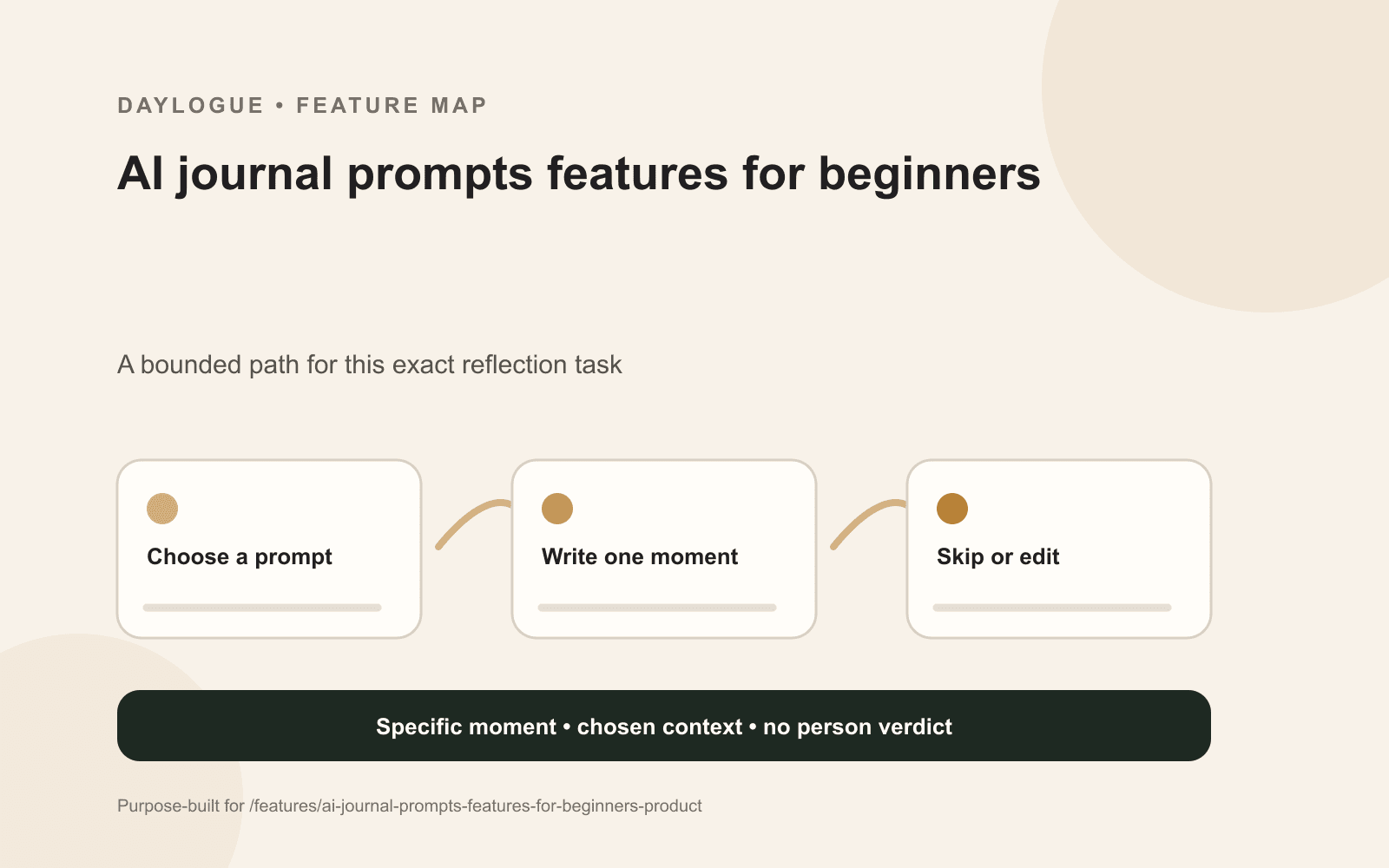
A reader might test several openings with the same ordinary scene. The strongest option makes the scene easier to describe without telling the writer what it means. It also allows a one-line response to stand on its own. More questions remain available, but completion never depends on answering them.
Audit each follow-up against a source ledger
A reader might create two columns after a sample exchange. In the first, a reader might copy the words the writer supplied. In the second, a reader might copy the follow-up. Draw a line between the detail and the question it supports. If the entry says the room became quiet after the agenda changed, a grounded follow-up may ask what changed in the room. A question about hidden fear has no source line.
The ledger makes adaptation inspectable. It also reveals repetitive questions dressed in personalized language. A follow-up may repeat the writer's noun while still steering toward the same lesson every time. Real adaptation changes the next question because of the scene, not merely because a name or phrase was inserted.
| Writer supplied | Possible follow-up | Source status |
|---|---|---|
| The agenda changed at noon | What became different after noon? | Directly grounded |
| I waited outside before calling | What made you choose to wait? | Grounded but optional |
| The room was quiet | Were you hiding anxiety? | Invents a feeling and motive |
| I am not sure what mattered | Would one detail be easier to keep? | Preserves uncertainty |
Source text and AI readback belong in separate layers
A smooth readback can sound more certain than the entry it came from. The product can keep the original wording visible, label generated text, and allow a correction without silently changing the source. If the writer said maybe twice, a summary that removes uncertainty has changed the account even when every fact appears accurate.
A reader might try editing the generated layer while leaving the entry untouched. Then edit the entry and see whether the old readback remains distinguishable from a new one. This small test shows whether the system preserves authorship and chronology or blends several versions into one authoritative-sounding paragraph.
- Original entries remain identifiable as the writer's words.
- Generated questions and readbacks are labeled by function.
- Corrections can attach to a readback without erasing source history.
- Uncertain wording stays uncertain unless the writer changes it.
Useful memory comes with a receipt
AI journal products use the word memory for different behaviors. Some remember a topic within one exchange. Others retrieve older entries, save a profile field, or generate a summary that appears later. A beginner comparison can ask what is remembered, which source created it, where it appears, and how it can be corrected or removed.
A reader might use a harmless fact such as I take the green bus on Thursdays. A reader might start a later entry and inspect whether the fact returns, whether the date and source are available, and whether a changed schedule can replace it. A remembered detail without a source or correction path can create confident but stale context.
01
Plant a harmless fact
A reader might use an ordinary detail that is easy to recognize and carries no sensitive personal information.
02
A reader might return in a new entry
A reader might notice whether the product retrieves the detail and whether that behavior was explained beforehand.
03
A reader might open the receipt
A reader might find the dated source, saved memory object, or other explanation for where the detail came from.
04
Correct the record
Change the fact and confirm that old context does not silently remain the only version.
Prompt quality and data handling share the decision
AI prompts may process source text, generated questions, summaries, and saved context through different paths. A feature comparison can ask which objects sync, which provider handles a request, what appears in export, how deletion works, and which content remains available to future features. A broad privacy label does not answer those separate questions.
A low-stakes sample lets someone test prompt behavior and account controls before adding a personal archive. The result may be a broad yes, a narrow use for ordinary check-ins, or a decision to keep certain topics offline. Feature fit can vary by entry rather than requiring one permanent choice.
A reader might keep the product promise close to the record
Daylogue describes itself as a system for self-understanding, and pattern journaling is how it reads what a person chooses to record. That source boundary matters in AI prompting. The system can ask and organize, while the writer remains the source of lived context and the final editor of interpretation.
A 2019 study of 395 young adults examined narrative coherence alongside identity functioning and well-being, and its results did not support a simple universal benefit. Generated polish is therefore not evidence that a readback is better. A rough entry, conflicting detail, or rejected summary can remain part of an honest record.
Checklist
AI prompt source and memory audit
A beginner product checklist for testing grounded follow-ups, source visibility, generated readbacks, memory receipts, correction, stopping, and processing boundaries.
- Opening: a reader might test whether one ordinary scene is enough to begin.
- Follow-up: connect each question to words the writer actually supplied.
- Source layer: a reader might confirm the original entry remains visible and distinct.
- Readback layer: edit or reject generated wording without erasing the source.
- Memory sample: a reader might save one harmless fact and revisit it later.
- Memory receipt: a reader might find the date, source, and correction path.
- Stopping point: a reader might end after one response without a required conclusion.
- Data path: a reader might inspect syncing, processing, export, deletion, and retention.
Common questions
What makes an AI journal prompt genuinely adaptive?
Its next question follows a detail the writer actually supplied and changes with the scene. Repeating a noun inside the same generic question is weaker adaptation.
Why keep the original entry beside an AI readback?
The source shows what was actually written, including uncertainty and exceptions. It lets the reader inspect, revise, or reject generated wording.
How can I test AI journal memory safely?
A reader might use a harmless, temporary fact, return later, inspect its source, then correct it. This reveals retrieval and editing behavior without using intimate material.
Does more follow-up always make a prompt better?
No. One grounded question may be enough. Useful products let a short entry end cleanly and keep every follow-up optional.
What data questions belong in an AI prompt comparison?
A reader might ask about syncing, model and provider processing, saved memory, account access, export, deletion, retention, and whether generated objects follow different paths.
Sources
Sources were checked on the dates shown. Product details and policies can change.
- Daylogue evidence and methods · Daylogue · checked August 31, 2026
- Narrative identity and psychological well-being research · National Library of Medicine · checked August 31, 2026
Keep exploring
Daylogue Knowledge Center
Browse practical guides for reflection, journaling, patterns, and privacy.
Read moreHow Daylogue shows patterns
See how candidate patterns stay connected to evidence and correction.
Read moreWhy Daylogue exists
Read the principles behind a system for self-understanding.
Read moreDaylogue is not therapy and is not a replacement for professional care.