Written by Daylogue Editorial Team. Published August 31, 2026. Reviewed and updated August 31, 2026.
The best daily reflection prompts features for beginners make one ordinary moment easy to capture and easy to revisit. A reader might look for a short opening question, optional follow-ups, visible dates, editable wording, and a review view that keeps the original entry nearby. A useful prompt can hold a late bus, an unexpectedly kind email, or a quiet change in energy without demanding a grand conclusion.
The hard part is noticing a day that looked uneventful
Big events arrive with their own headline. Ordinary days rarely do. By evening, the details that changed the texture of a Tuesday may already feel too small to write down. A good daily reflection feature lowers that threshold. It might ask for the first moment the pace shifted, the easiest part of the afternoon, or one loose end still occupying attention. Those openings give the writer somewhere concrete to begin.
The feature earns its place when a three-sentence entry remains useful later. A note about moving a meeting, eating lunch outside, and feeling less rushed after 3 p.m. is more recognizable than a generic report that the day was fine. Specificity matters more than length. The prompt can end once the scene is clear, even when no lesson appears.
Run a four-day prompt trial before judging the library
A long prompt catalog can look impressive while producing repetitive entries. A smaller trial reveals more. On one day, a reader might use a scene prompt. On another, a reader might use a contrast prompt. Then try a practical loose-end prompt and a question about something that became easier. This sequence shows whether the product offers genuine variety or simply changes the nouns in the same question.
A reader might keep the test entries intentionally small. Monday might preserve a rushed handoff at work. Tuesday might contrast a quiet morning with a crowded afternoon. Wednesday can name the grocery errand still taking up attention. Thursday can record the friend who made a task lighter. If all four entries sound interchangeable, the prompt system is adding polish rather than range.
01
Day one: anchor the scene
A reader might choose one place, time, or exchange that would help you recognize the day a week later. A reader might keep the first wording visible.
02
Day two: a reader might capture a contrast
A reader might record two parts of the day that felt different without forcing either one to explain the other.
03
Day three: a reader might move the loose end
A reader might name what still occupies attention, then decide whether it belongs in reflection, a task list, or nowhere at all.
04
Day four: a reader might record an exception
A reader might keep something that went differently from the usual pattern, especially when it complicates an easy conclusion.
Prompt control is visible in small interactions
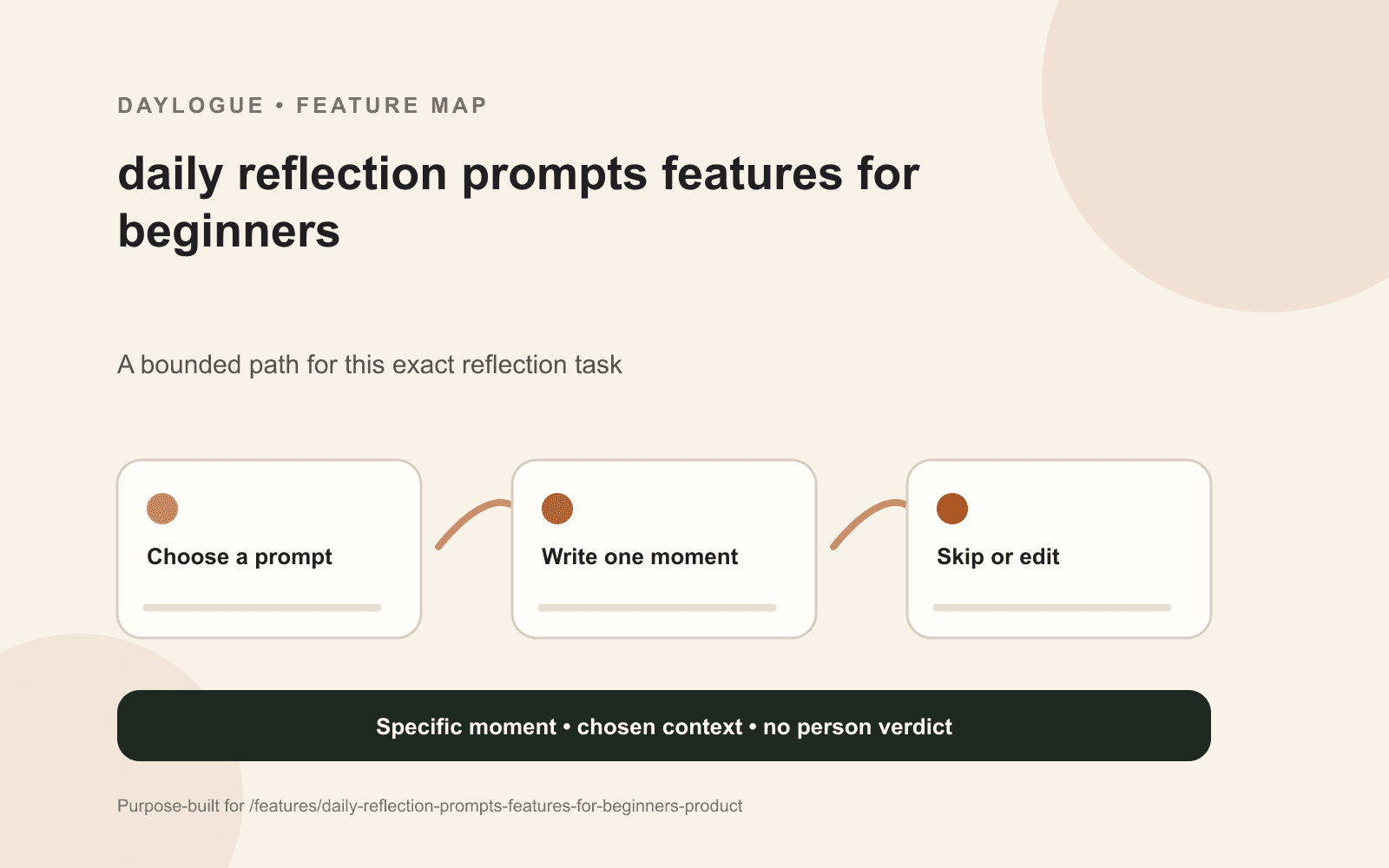
Beginners often learn more from the skip, edit, and stop controls than from the wording of the first prompt. A follow-up may be useful when it refers to a detail already shared. It becomes intrusive when it pushes for an explanation the writer has not offered. The product can make every question optional, allow a response to be revised, and keep a short entry complete without a required closing screen.
A useful rotation also remembers that daily life has different shapes. Some days invite a fuller account. Others only have room for one sentence. The product can offer a quick scene, a practical inventory, a relationship moment, or an open question without treating one format as the correct way to reflect. Returning after a gap can begin with the present day rather than a recap of the gap.
- A prompt can be skipped without replacing it with another demand.
- Follow-ups refer to words already entered rather than inventing context.
- The writer can revise generated wording while the source entry remains visible.
- A one-sentence check-in can end cleanly without a completion score.
Weekly review works best as a return to scenes
A weekly view can group entries by date and make repeated language easier to find. It can also preserve the difference between observation and interpretation. If the word rushed appears on three afternoons, the useful next step is opening those entries. One may involve a late start, another a crowded calendar, and another a noisy room. The repetition is an invitation to compare context, not proof of one cause.
Good review design also keeps exceptions nearby. Perhaps Friday contained the same crowded calendar but felt manageable because one meeting ended early. That detail protects the record from becoming a verdict about the whole week. The reader can add a note, change an earlier interpretation, or leave the difference unresolved. A review has done enough when it makes the source material easier to inspect.
A feature scorecard based on behavior
The useful comparison is not the number of prompts. It is what happens from the first question to the later reread. A simple notes app may win when capture speed is the only job. A guided journal may earn its place when rotation, retrieval, and correction help separate several days that would otherwise blur together. The right choice can vary by the kind of entry being kept.
| Feature moment | Useful behavior | Reason it matters |
|---|---|---|
| Opening question | Starts with one observable part of the day | Reduces blank-page effort |
| Follow-up | Uses details already shared and remains optional | Keeps the writer in control |
| Saved entry | Shows date, source wording, and later edits | Makes rereading trustworthy |
| Weekly view | Opens repeated words back to their original scenes | Keeps context and exceptions visible |
What reflection evidence can and cannot settle
Daylogue describes itself as a system for self-understanding, and pattern journaling is how it reads what a person chooses to record. That framing keeps the source record central. The product can organize entries and surface a repeated phrase, while the person decides whether the repetition matters and what else belongs beside it.
A 2019 study of 395 young adults examined narrative coherence alongside identity functioning and well-being, and its results did not support a simple universal benefit. That nuance belongs in a beginner guide. A polished story is not automatically a better or truer one. A fragment, contradiction, or changed interpretation can be the most honest form of the entry.
Decision Table
Four-day daily reflection feature trial
A compact product test that compares prompt variety, writer control, source visibility, and the quality of a later reread across four ordinary days.
- Scene day: preserve one place, time, or exchange.
- Contrast day: a reader might keep two different parts of the day side by side.
- Loose-end day: a reader might separate reflection from the task that belongs elsewhere.
- Exception day: a reader might record what went differently from the usual expectation.
- Control check: a reader might skip one follow-up and notice how the product responds.
- Source check: reopen an entry and compare the original words with any readback.
- Return check: a reader might leave a gap, then begin again with the present day.
- Decision: a reader might name the one feature that made rereading clearer.
Common questions
How many daily reflection prompts are useful at one time?
One opening question is often enough. A second question can help when it follows a detail already entered, but a crowded sequence may turn a small check-in into homework.
What counts as a useful daily reflection entry?
A useful entry preserves something you may want to recognize later, such as an exchange, change of pace, small relief, or unfinished thought. It can remain brief and unresolved.
Can a daily reflection feature explain a repeated pattern?
It can make repeated words or situations easier to compare. A personal record alone cannot establish that one event caused another, so source scenes and exceptions remain important.
What makes returning after several days feel easier?
A welcoming return starts with the current moment. It leaves the time away unscored and offers a short prompt that works without reconstructing every day in between.
Is a weekly summary more useful than the original entries?
They serve different jobs. A summary can point toward a repeated theme, while the dated entries hold the details that let a reader confirm, revise, or reject that interpretation.
Sources
Sources were checked on the dates shown. Product details and policies can change.
- Daylogue evidence and methods · Daylogue · checked August 31, 2026
- Narrative identity and psychological well-being research · National Library of Medicine · checked August 31, 2026
Keep exploring
Daylogue Knowledge Center
Browse practical guides for reflection, journaling, patterns, and privacy.
Read moreHow Daylogue shows patterns
See how candidate patterns stay connected to evidence and correction.
Read moreWhy Daylogue exists
Read the principles behind a system for self-understanding.
Read moreDaylogue is not therapy and is not a replacement for professional care.