Written by Daylogue Editorial Team. Published August 31, 2026. Reviewed and updated August 31, 2026.
Evening journal prompts features for beginners work best when they close a small loop rather than demand a complete account of the day. A reader might look for a short mode, separate space for tasks and reflection, optional prompts for lingering scenes, visible source entries, and a clear stop. The product can help preserve what matters tonight without insisting that every day produce a lesson.
An evening prompt can serve three different jobs
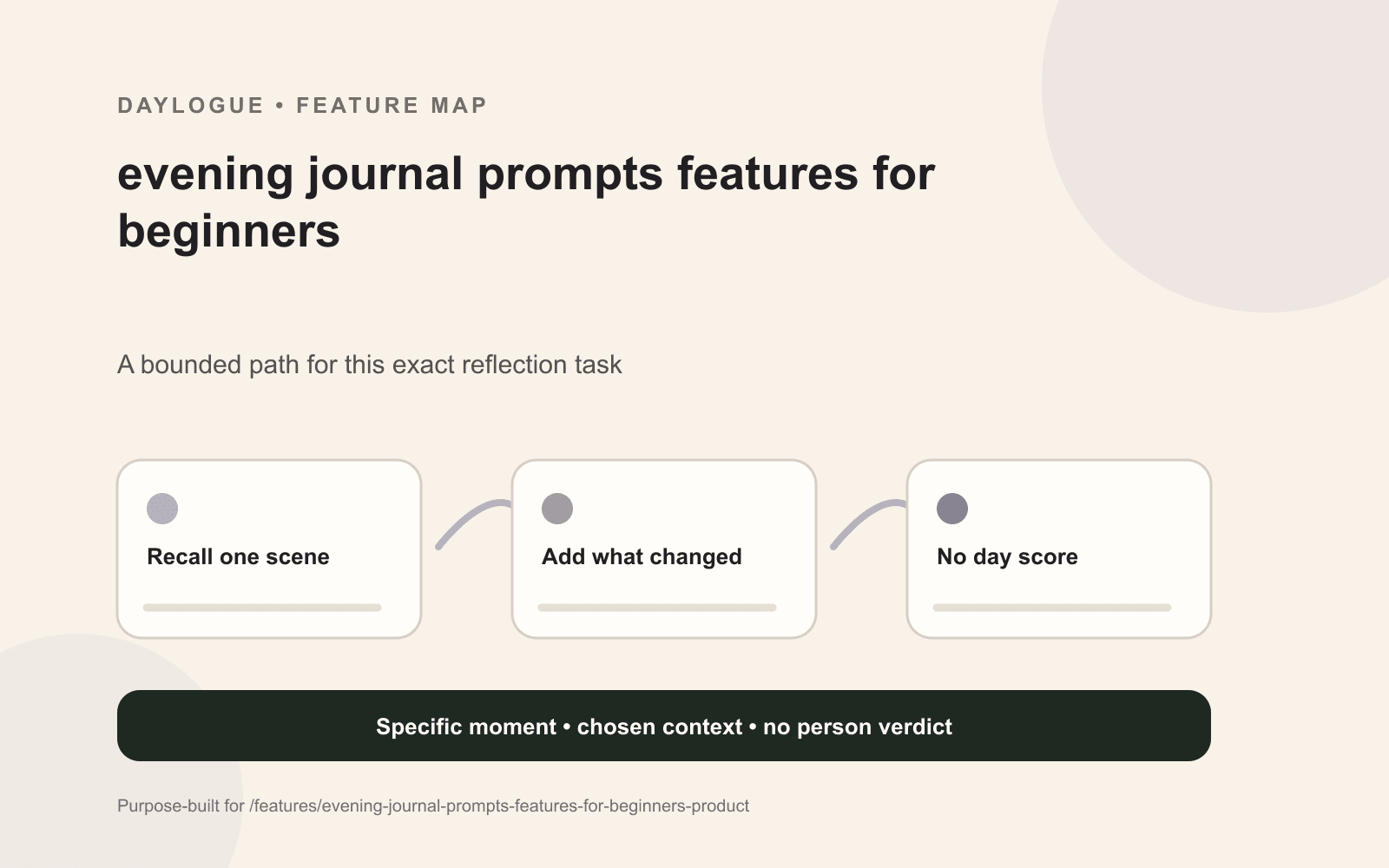
Some evenings need capture: one scene keeps replaying and may be worth preserving. Others need routing: the thought is really a task, date, or question for tomorrow. A third kind needs a stopping cue: nothing requires more writing, but a final line helps mark the day as closed. Products become clearer when these jobs are separate rather than folded into one long sequence.
A reader might test the opening screen after three different days. On a crowded day, a reader might choose the lingering scene. On a practical day, a reader might move a loose end. On a quiet day, a reader might end with a timestamp or one detail. A useful product lets each path feel complete without sending the writer through every other prompt.
Short mode needs to be genuinely complete
A thirty-second path might ask what is still taking up attention and whether it is a scene, task, or open question. The answer can be one fragment: unclear owner after the meeting. The product may offer a follow-up, but saving does not depend on expanding the fragment into a paragraph.
The test is whether the interface respects the exit. Can the writer save and leave after one line? Does a completion meter imply that more is required? Does the next reminder refer to unfinished prompts as if something were neglected? A short mode works when it reduces effort in behavior, not only in its label.
- One line can count as a complete evening entry.
- Follow-ups remain optional after the first saved detail.
- A blank field does not create a warning or completion penalty.
- The final screen offers an obvious stop instead of another question.
A reader might separate scene, task, and question before saving
The sentence I keep thinking about the email may contain three things. The scene is reading it in the hallway. The task is replying by noon. The question is why the wording felt abrupt. A useful feature can separate these pieces so the task moves to a reliable destination and the question stays uncertain.
This separation protects evening reflection from turning into another productivity list. It also prevents an open question from masquerading as an action item. The writer may decide that the task belongs in a calendar, the scene belongs in the journal, and the question belongs nowhere yet.
| Type | Example | Useful destination |
|---|---|---|
| Scene | The hallway was empty when I read the message | Dated journal entry |
| Task | Reply before noon | Calendar or task list |
| Question | What did the sender intend? | Open note or later conversation |
| Detail | The walk home was quiet | Optional keepsake line |
A closing prompt can hold more than one kind of day
The loudest event does not have to own the whole entry. A difficult call can sit beside a warm dinner, and neither has to explain the other. Products can offer an optional second window for a quieter detail rather than asking what made the day good. That wording keeps appreciation available without forcing it.
Mixed entries are also easier to review honestly. If every evening summary ends on the same positive note, later pattern review may reflect the prompt design more than the days themselves. A tool that permits frustration, relief, boredom, beauty, and no clear feeling produces a more varied source record.
Weekly review should reopen nights, not grade them
A weekly view may show that unresolved ownership appeared in several evening notes. The useful action is opening those dated scenes. One involved a work approval, another a family plan, and another a delivery problem. The shared phrase may be worth noticing, but the situations remain different.
A strong review also keeps nights with no entry neutral. The absence may mean nothing stood out, time was short, or writing was not useful. The product cannot know. Search, source links, editable tags, and exceptions offer more value than a consistency score.
01
A reader might choose one repeated phrase
A reader might open the source nights instead of relying only on a weekly label or generated summary.
02
A reader might compare the situations
A reader might notice timing, people, tasks, and setting without assuming the repeated phrase has one cause.
03
A reader might keep one exception
Preserve a similar evening that unfolded differently so the review does not become a verdict.
04
A reader might close the review
A reader might save a question or correction, then stop without producing a grade for the week.
Evening entries deserve clear processing boundaries
Daylogue is a system for self-understanding. Pattern journaling is how it reads you. Evening entries often contain names, copied work details, family context, or memories written when attention is low. A product can make editing, syncing, provider processing, export, deletion, and retention easy to review before that record grows.
Daylogue does not use personal entries to train its own models. That narrow statement answers one question and leaves others separate. Writers can minimize names, test controls with a low-stakes entry, move tasks to their proper system, and keep certain material offline when the processing path does not fit.
Decision Table
Evening prompt three-job product test
A product comparison artifact for testing capture, task routing, clear stopping, mixed moments, weekly source review, and processing boundaries.
- Capture job: a reader might save one lingering scene in a single line.
- Routing job: a reader might move one task or date to the system where it belongs.
- Closing job: a reader might end with a timestamp or simple final phrase.
- Mixed record: a reader might keep one quieter detail beside the loudest event.
- Exit test: a reader might stop after one response without a completion penalty.
- Weekly test: a reader might open a repeated phrase back to its dated scenes.
- Exception test: preserve a similar evening that unfolded differently.
- Data check: a reader might review syncing, processing, export, deletion, and retention.
Common questions
How short can an evening journal entry be?
One line can be enough. A scene fragment, task handoff, open question, or timestamp may close the entry without reconstructing the full day.
What is the difference between a loose end and a task?
A task has a concrete action or date. A loose end may be a scene, uncertainty, or question that has no useful action tonight.
Can an evening prompt include difficult and pleasant moments together?
Yes. The moments can sit beside each other without requiring the pleasant detail to redeem or explain the difficult one.
What makes a weekly evening review useful?
It opens repeated phrases back to dated source scenes, keeps exceptions visible, and allows correction without scoring nights that have no entry.
How can an evening prompt protect other people's details?
A reader might use roles or initials, avoid copied private messages, and keep only the context required to recognize the scene. Some material may fit better offline.
Sources
Sources were checked on the dates shown. Product details and policies can change.
- Daylogue evidence and methods · Daylogue · checked August 31, 2026
- Daylogue privacy policy · Daylogue · checked August 31, 2026
Keep exploring
Daylogue Knowledge Center
Browse practical guides for reflection, journaling, patterns, and privacy.
Read moreHow Daylogue shows patterns
See how candidate patterns stay connected to evidence and correction.
Read moreWhy Daylogue exists
Read the principles behind a system for self-understanding.
Read moreDaylogue is not therapy and is not a replacement for professional care.