Written by Daylogue Editorial Team. Published August 31, 2026. Reviewed and updated August 31, 2026.
Gratitude journal prompts features for beginners work best when they move beyond a repeated list of three good things. A reader might look for rotating lenses, room for mixed feelings, and retrieval that brings a specific source of support back into view. A useful entry might remember the coworker who clarified one sentence, the shaded bench that made lunch easier, or the old charger that worked when needed.
A reader might use a specificity ladder instead of a longer list
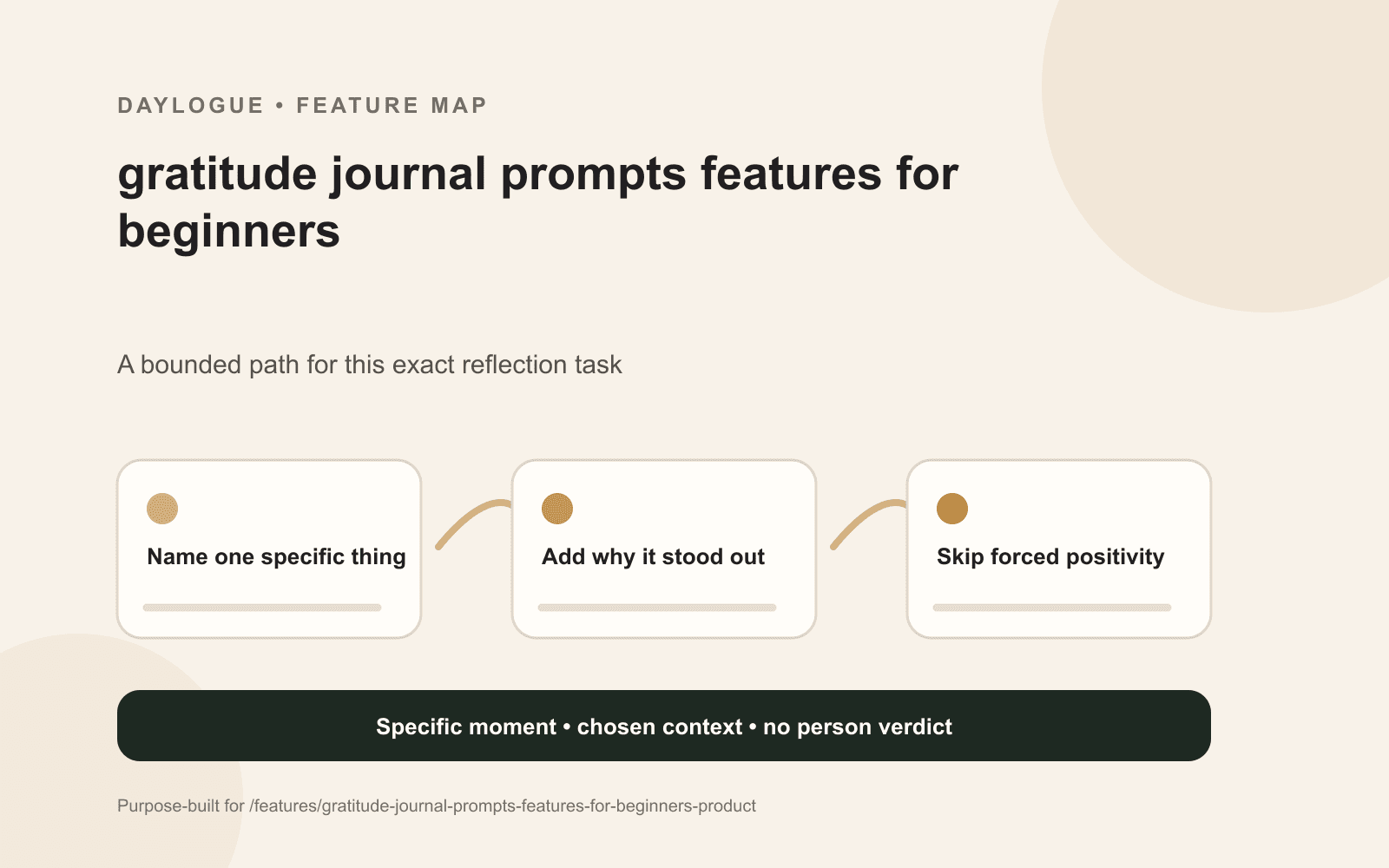
The phrase grateful for my friends may be true and still disappear during a later read. A prompt becomes more useful when it helps move one rung lower: which friend, what happened, where were you, and what became lighter? The answer might be that Noor sent the meeting address before anyone asked, which removed ten minutes of searching. That scene is small, but it is easy to recognize.
A good feature supports that movement without making the entry feel like an interview. One optional follow-up may be enough. It can ask what the person noticed or what changed in the moment. If the writer only wants to save the first line, the entry remains complete. Specificity is an available path, not a requirement to disclose more.
01
A reader might name the source
A reader might choose a person, place, object, action, or ordinary convenience rather than a broad life category.
02
Locate the moment
A reader might add the scene where the support appeared, using only the detail that feels comfortable to keep.
03
A reader might notice the effect
A reader might describe what became easier, warmer, clearer, or simply less inconvenient in that moment.
04
A reader might keep the mixed part
A reader might add any difficult context that remains relevant so appreciation does not erase the rest of the day.
Prompt rotation prevents gratitude from becoming copywork
A library can rotate through six useful lenses: people, effort, places, objects, timing, and small conveniences. Monday might hold the person who checked a confusing instruction. Tuesday might preserve the laundromat chair near an outlet. Wednesday could name the effort someone made even though the outcome stayed imperfect. The shift in lens changes what becomes visible without demanding a different emotional state.
A reader might look for rotation that feels intentional rather than random. A product may remember which lens appeared recently, offer an alternative, and let the writer choose the one that fits. It can also avoid presenting gratitude as a daily quota. Some days the honest entry is that nothing comes to mind yet. That blank can remain blank without a corrective message.
- People: a specific action that made one moment easier.
- Effort: care that was visible even when the result was incomplete.
- Place: a setting that offered comfort, quiet, or useful distance.
- Object: something ordinary that worked at exactly the right time.
- Timing: an interruption, delay, or opening that happened to help.
- Convenience: a small system that reduced friction without becoming a life lesson.
A gratitude feature has to survive a mixed day
A reader might test the product with a day that was genuinely difficult. Perhaps a train cancellation created a long wait, and a stranger held the elevator while you carried two bags. A useful prompt can preserve that kindness without rewriting the cancellation as a gift. Appreciation and frustration can occupy the same entry. Neither has to cancel the other.
The wording matters. Questions such as what made everything worth it can force a conclusion the scene does not support. A more open question asks what offered even a little help. The writer can answer with one concrete detail, skip the question, or state that the helpful moment did not change the larger difficulty. That range protects honesty.
Repeated support becomes useful through retrieval
Over several weeks, source-based entries may reveal that certain forms of support keep appearing. Perhaps clear directions repeatedly reduce friction. Perhaps quiet public places appear whenever afternoons feel crowded. Retrieval should open the dated scenes behind those repetitions. A category label alone is not enough because it hides what happened and how different examples varied.
A strong review view lets the writer search a person's name, a place, or a phrase such as made it easier. It also allows correction. One entry may later feel too generous, another may gain context, and a third may contain identifying detail that belongs elsewhere. The record becomes more trustworthy when editing and deletion are easy to understand.
Research variation argues for modest product promises
A 2025 systematic review found substantial variation across studies in writing topics, protocols, comparison groups, and measured outcomes. That is a reason to look closely at what a product actually asks people to do. A gratitude prompt, an open expressive entry, and a narrative exercise are not interchangeable simply because each involves writing.
Daylogue is a system for self-understanding. Pattern journaling is how it reads you. In this context, the practical value is a record that can be revisited, not a promised emotional outcome. The feature can help organize the moments a person chooses to share while leaving interpretation, mixed reactions, and the decision to continue with the writer.
Privacy questions belong in the feature comparison
Gratitude entries often include other people's names, health details, work situations, or family context. A product comparison can therefore include account access, syncing, provider processing, export, deletion, and retention alongside prompt quality. Testing with a low-stakes entry can show whether those controls are understandable before a long personal history is added.
Daylogue does not use personal entries to train its own models. That statement is deliberately narrow. It does not answer every question about provider processing, storage, account access, or retention. Those boundaries require their own disclosures. Clear products name each path instead of letting one reassuring sentence stand in for the entire data lifecycle.
Prompt Pack
Six-lens gratitude feature test
A product-evaluation prompt pack that tests specificity, mixed-day language, retrieval, editing, and voluntary stopping across six gratitude lenses.
- Person lens: who made one task lighter, and what did they do?
- Effort lens: whose care was visible even when the result stayed imperfect?
- Place lens: where did the day offer a little room or ease?
- Object lens: what ordinary item worked when you needed it?
- Timing lens: what happened at a useful moment without being planned?
- Convenience lens: what small system reduced friction today?
- Mixed-day check: what remained difficult beside the appreciated moment?
- Retrieval check: can the saved detail be found and corrected later?
Common questions
What makes a gratitude prompt specific enough to remember?
A person, action, place, or object tied to one scene is usually easier to recognize later than a broad category. The entry can stay short once that detail is clear.
Can gratitude journaling include frustration or disappointment?
Yes. A helpful moment can sit beside a difficult one without explaining it away. Products can make room for both instead of steering every entry toward positivity.
How can prompts avoid becoming repetitive?
Rotating among people, effort, places, objects, timing, and ordinary convenience changes the field of attention. An alternative prompt can remain optional when a lens does not fit.
What is worth checking in a gratitude journal review view?
A reader might look for dated source entries, search, visible edits, and the ability to open repeated themes back to their original scenes. A label without context is less useful.
Does a gratitude feature have to produce a takeaway?
No. The saved moment may be enough. A note can remain mixed, quiet, or unfinished, and the writer can return only when another detail feels worth keeping.
Sources
Sources were checked on the dates shown. Product details and policies can change.
- Daylogue evidence and methods · Daylogue · checked August 31, 2026
- Daylogue privacy policy · Daylogue · checked August 31, 2026
- Positive expressive writing systematic review · PLOS One · checked August 31, 2026
Keep exploring
Daylogue Knowledge Center
Browse practical guides for reflection, journaling, patterns, and privacy.
Read moreHow Daylogue shows patterns
See how candidate patterns stay connected to evidence and correction.
Read moreWhy Daylogue exists
Read the principles behind a system for self-understanding.
Read moreDaylogue is not therapy and is not a replacement for professional care.