Written by Daylogue Editorial Team. Published August 14, 2026. Reviewed and updated August 14, 2026.
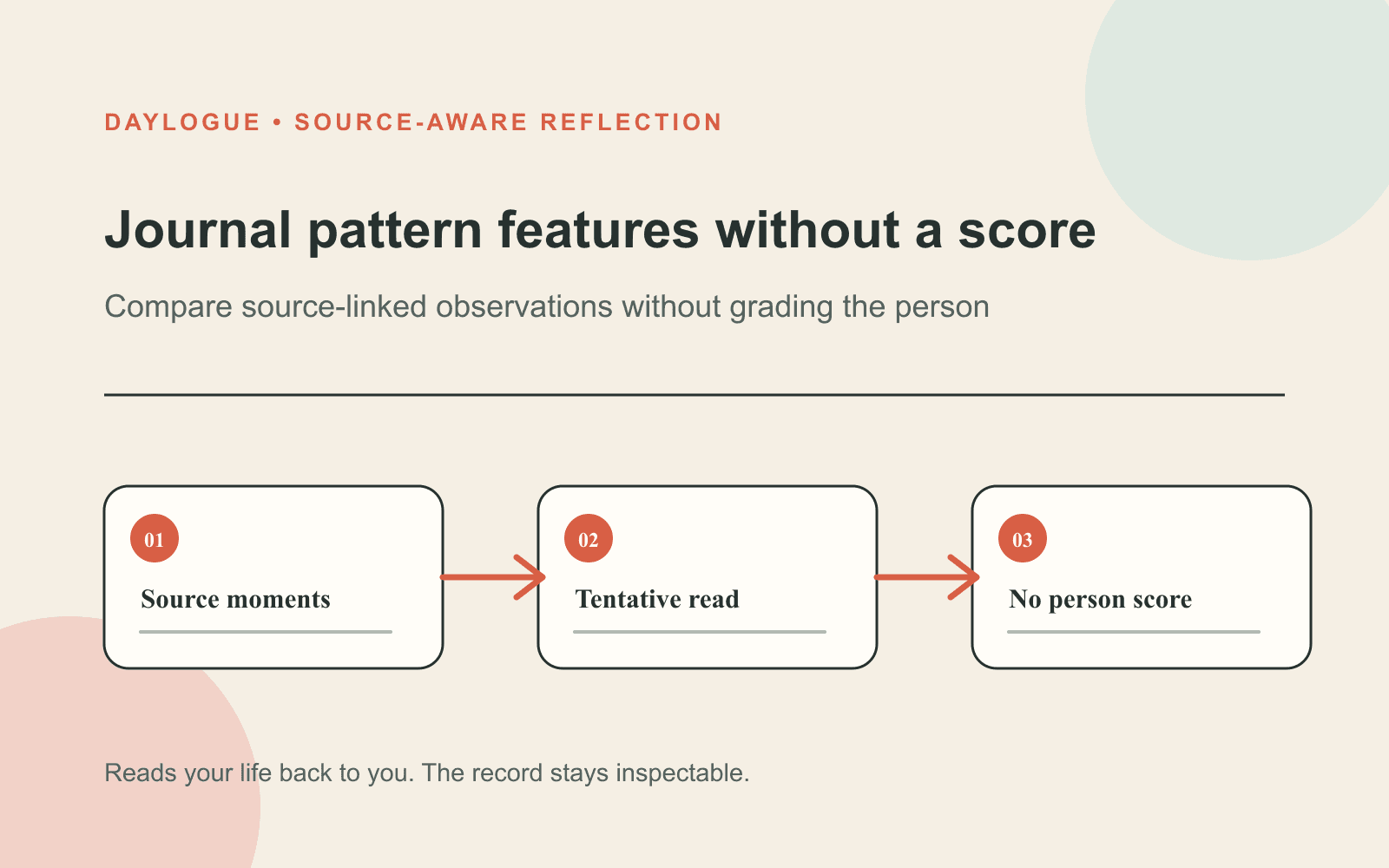
Beginners evaluating Daylogue as a journal app that finds patterns can verify that it surfaces pattern examples from recorded check-ins, uses structured fields such as mood, energy, stress, and sleep, and keeps most journal text readable on its servers. The assigned sources do not establish source links, visible exceptions, or correction and dismissal controls. Those remain buyer questions, not shipped-feature claims. A useful pattern product keeps causes, predictions, emotion inference, and person-level scores out of the read.
Feature one: source-backed observations
Every pattern card should open into the entries and selected fields behind it. A beginner should be able to answer: which dates, which repeated words, which situations, and how many entries? Without that route back, an observation may sound personal while remaining impossible to verify. Source links make the product easier to learn and easier to challenge.
Test this with a pattern that feels obvious. Open the cited entries and confirm that the wording fits. Then test a pattern that feels wrong. Check whether one long entry dominated the result or two different situations were grouped together. The feature should help you inspect both cases, not reward agreement and hide disagreement.
| Feature | Basic test | Warning sign |
|---|---|---|
| Source links | Open every cited entry | No dates or evidence shown |
| Plain wording | Restate it without a label | Claims about who you are |
| Exceptions | Find a similar day that differed | Only confirming examples appear |
| Corrections | Edit, dismiss, or regroup | The read cannot be changed |
| Privacy controls | Trace text from input to deletion | Storage terms stay vague |
Feature two: wording that stays tentative
Useful wording describes the record: "Workload came up in four entries" or "stress was higher in check-ins where you logged under six hours." It does not say that work causes your stress or that you are bad at boundaries. A journal app sees selected entries, not the whole person. Its language should preserve that limit in every observation.
Daylogue states that its observations are designed for reflection, not diagnosis, prediction, treatment, or clinical decision-making. It also states that a recurring overlap does not show that one thing caused another. Those are practical evaluation rules. If another product moves from repeated notes to certainty, the wording has exceeded the evidence on the screen.
What Daylogue's assigned sources establish
Daylogue's evidence page gives a concrete pattern example: stress running higher on the nights a person logged under six hours. Daylogue's privacy policy says structured mood, energy, stress, sleep, tags, timestamps, and device identifiers power dashboards, trends, and product features. These sources establish pattern detection from recorded check-in context without establishing why the overlap happened.
The assigned sources do not establish that Daylogue currently shows a source link for every observation, surfaces comparable exceptions, or provides correction and dismissal controls in the pattern view. Those capabilities remain evaluation criteria in this page. A current product walkthrough or support document would be needed before describing them as shipped Daylogue features.
Feature three: exceptions and missing context
A pattern becomes easier to judge when the product shows where it did not hold. If three rushed afternoons share the same calendar slot, find a similar afternoon that felt different. The contrast may narrow the question to timing, preparation, role, or another detail. It may also reveal that the initial grouping was too broad.
Missing entries should stay visible too. The app should not assume an unrecorded day was calm, difficult, or average. Beginners need to see the limits of the archive before reading a trend. A pattern based on four entries can still be useful as a question, but it should not present itself as a complete account of the month.
- Show comparable moments that did not fit the observation.
- Keep unrecorded days visibly unrecorded.
- Name the date range and number of supporting entries.
- Avoid filling gaps with averages or generated assumptions.
Feature four: correction and dismissal controls
The person who made the entry needs a way to say the app grouped it badly, misunderstood a transcript, or used wording that does not fit. Look for edit, regroup, correct, dismiss, or hide controls. Feedback should change the experience without punishing the user or turning disagreement into another personality signal.
Try the controls during evaluation, not after months of writing. Correct a tag, edit a sentence, and delete a test entry. Then see whether the pattern updates. A responsive record keeps insights as revisable readings of your archive. A fixed reading turns software output into a verdict.
Feature five: privacy controls you can understand
Pattern features require access to entries or selected fields, so inspect the full data path. Read what is stored in readable form, which providers process it, whether audio and transcripts follow different rules, and what deletion removes. Check advertising and model-training terms. A privacy label is not enough when the product cannot explain how the feature reads the journal.
Daylogue says journal entries and check-in notes are stored on its servers in readable form so it can write narratives and surface patterns. Daylogue is not end-to-end encrypted. Its privacy policy says it does not sell personal data, use entries for advertising, or train models on personal entries. Beginners should compare those specific terms with their own comfort level before adding sensitive material.
Run a small test before moving your archive
Create several low-stakes entries around one repeatable situation. Include one exception, one missing field, and one edited entry. Wait for the feature to produce an observation, then open the sources, inspect the language, find the exception, and try the correction controls. This test reveals more than a polished product screenshot.
Starting with ordinary test material can make the decision easier before someone chooses what else belongs in the archive. Study sessions, commute timing, or recurring chores can reveal how the product groups entries. If the observation stays tentative and the privacy terms fit, the person can decide what belongs next. A small test archive is also easier to remove when the product does not fit.
Decision Table
Beginner pattern feature scorecard
Use these pass-or-pause checks before trusting a pattern feature with a larger private journal archive.
- Every observation opens into exact source entries and dates.
- Wording describes repetition without a cause or person label.
- Exceptions and missing entries remain visible.
- Edits, corrections, dismissals, and deletions update the record.
- Separate fields remain separate rather than becoming one score.
- Privacy terms explain processing, readable storage, and providers.
Common questions
What is the most important journal pattern feature for beginners?
Source links come first. You should be able to open the exact entries and fields behind every observation before deciding whether the pattern is useful.
Can a pattern-finding journal app explain why I feel something?
No. It can organize what you recorded and show repeated situations or overlaps. It should not assign a cause, hidden motive, forecast, or person label.
Why should a pattern feature show exceptions?
A comparable exception helps you test whether the grouping is too broad and which surrounding details may matter. It keeps repetition from becoming a rule.
Should I import old journals before testing the feature?
Start with a small, low-stakes test archive. Check sources, wording, corrections, deletion, and privacy terms before moving years of personal writing.
Does Daylogue use end-to-end encryption for journal patterns?
No. Daylogue says most entries remain readable on its servers because the service reads them to write narratives and surface patterns. Review the current privacy policy before using it.
Sources
Sources were checked on the dates shown. Product details and policies can change.
- Daylogue evidence and methods · Daylogue · checked August 14, 2026
- Daylogue privacy policy · Daylogue · checked August 14, 2026
Keep exploring
Daylogue Knowledge Center
Browse practical guides for reflection, journaling, patterns, and privacy.
Read moreHow Daylogue shows patterns
See how candidate patterns stay connected to evidence and correction.
Read moreWhy Daylogue exists
Read the principles behind a system for self-understanding.
Read moreDaylogue is not therapy and is not a replacement for professional care.