Written by Daylogue Editorial Team. Published August 31, 2026. Reviewed and updated August 31, 2026.
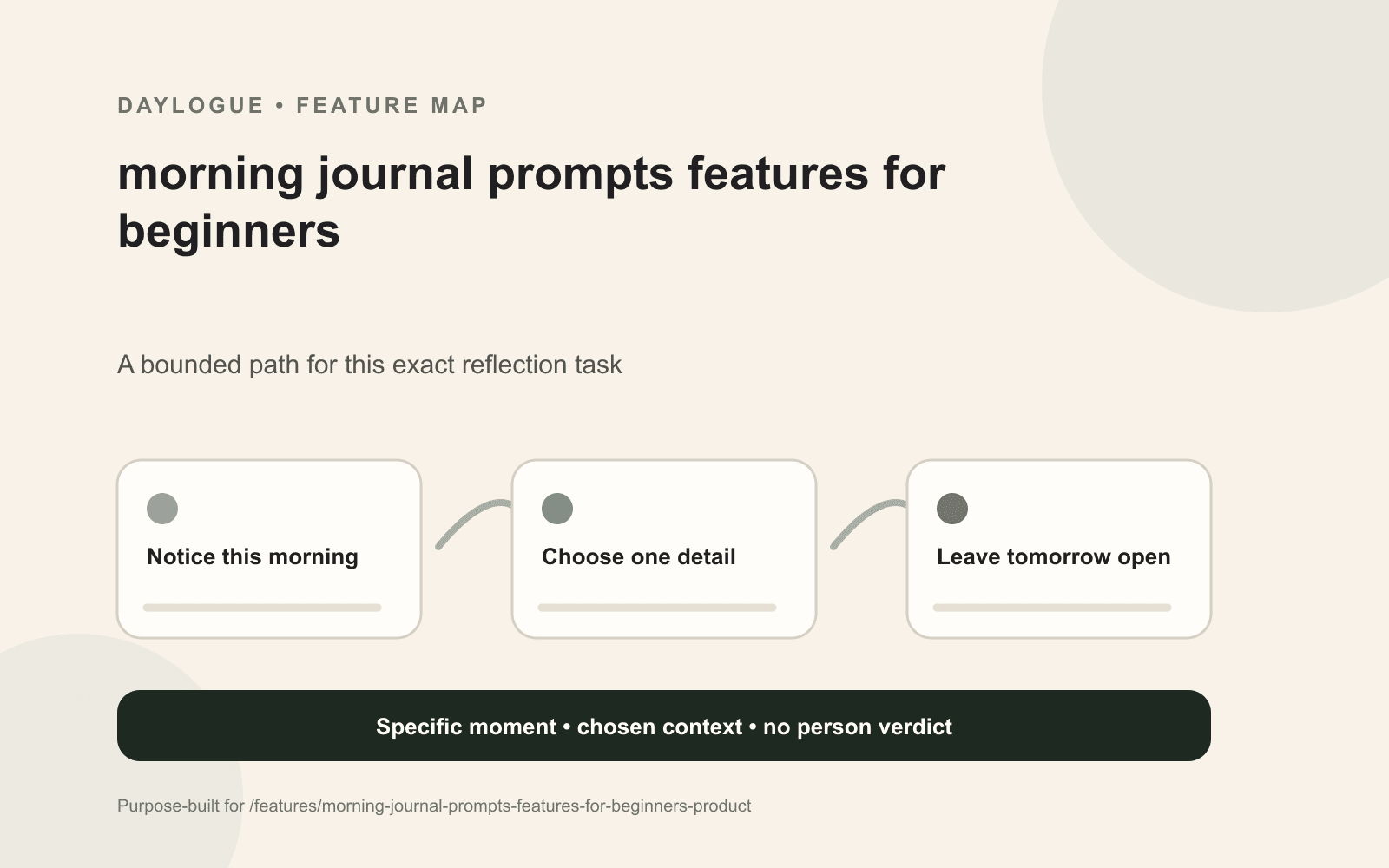
Useful morning journal prompts features for beginners separate what is already known from what is only a forecast. A reader might look for questions that acknowledge the calendar, name one current condition, and help set a flexible intention. The strongest products also make the morning note easy to revisit later, so a prediction like this meeting will drain me can sit beside what actually happened without becoming a verdict.
A reader might start with conditions before adding an intention
A morning entry begins in a particular room, schedule, and amount of available time. A useful product asks about that reality before inviting a plan. The answer might be that the first appointment starts in forty minutes, breakfast is still unfinished, and one conversation is already taking up attention. Those facts create a more honest starting point than a broad question about becoming productive or positive.
Current conditions also keep the entry from overreaching. The writer may feel slow after waking, eager to begin a project, or uncertain about an afternoon call. Each description belongs to this morning, not to the whole person. A prompt that stays close to now creates room for change. It also gives a later review something concrete to compare.
A two-column test: known now and forecast for later
Morning writing often mixes facts with predictions. The calendar says a presentation begins at ten. The thought that it will go badly is a forecast. The train is delayed. The idea that the entire day is ruined is another forecast. A good feature can help keep those categories visible without correcting the writer or deciding which reaction is reasonable.
A reader might try the same entry in two columns. Under known now, record the appointment, the travel time, and the unfinished slide. Under forecast, record the fear of rushing, the hope of a quiet lunch, and the guess that the presentation will be tiring. The distinction makes an evening return more useful because the writer can see what changed, what held, and what never became relevant.
| Known now | Forecast for later | Flexible response |
|---|---|---|
| The first meeting begins at 9:30 | I may feel rushed before it starts | A reader might open the notes ten minutes earlier if useful |
| One errand sits between appointments | There may not be enough time | A reader might move it without making the day a failure |
| A difficult conversation is scheduled | I expect to lose my train of thought | A reader might keep one question available to return to |
An intention can be directional without becoming a contract
A realistic intention describes how someone would like to enter a moment, not how every moment has to go. Listen before replying is more flexible than stay calm all day. A note such as leave ten minutes between calls is more observable than protect my energy. The product can help narrow the wording while keeping the person free to edit it, ignore it, or discover that the original intention no longer fits.
The feature test is simple: change the schedule after saving the entry. If a meeting moves, can the intention move with it? If the morning becomes unexpectedly quiet, can the note be updated without framing the change as failure? Morning prompts work better when revision becomes new context rather than evidence that the plan was wrong.
- The intention names one situation instead of governing the entire day.
- The wording describes a possible action rather than a person trait.
- A schedule change can revise the entry without erasing the first plan.
- The day can end differently without turning the morning note into a scorecard.
Morning is a window, not a timestamp
A useful feature does not assume that reflection happens at sunrise. A parent may have five minutes after school drop-off. A shift worker may write before leaving home at 4 p.m. Someone else may speak a short note while waiting for coffee. The relevant moment is the beginning of that person's active day. Flexible reminders and easy manual entry matter more than a rigid morning label.
The shortest version can ask three things: what is already true, what deserves attention, and what can wait. That sequence produces a small map without pretending to control the route. Longer follow-ups can remain available for mornings with more space. The quick version remains complete on its own.
The evening return tests the morning feature
A morning prompt becomes more informative when the original note can be reopened after the day unfolds. The later question is not did you succeed. It is what changed. Perhaps the feared presentation was straightforward, but the unplanned hallway conversation took more attention. Perhaps the quiet lunch happened, yet the errand remained undone. These differences help the writer refine future expectations without judging the day.
Products vary in how they preserve that comparison. Some overwrite the first entry. Others keep an edit history or attach a later note. The clearer design keeps morning language and evening context distinguishable. It also lets the reader search for similar situations, such as early meetings or travel days, without treating one comparison as a universal rule.
01
Reopen the morning note
A reader might read the original conditions and forecasts before adding the evening perspective. A reader might keep the first wording intact.
02
A reader might mark what changed
A reader might add one event that altered the plan, especially when it was not visible in the morning.
03
A reader might keep one surprise
Preserve a forecast that did not happen or an easier moment that complicates the expected story.
04
A reader might close without grading
A reader might end with a fact worth carrying forward, or leave the comparison open when the day offers no clear conclusion.
Why source context matters in a morning record
Daylogue describes itself as a system for self-understanding, and pattern journaling is how it reads what a person chooses to record. For a morning entry, the original forecast is part of that source. Keeping it visible allows a later interpretation to show its work rather than silently replacing what the person actually expected.
A 2019 study of 395 young adults examined narrative coherence alongside identity functioning and well-being, and its results did not support a simple universal benefit. Morning writing therefore has no obligation to become a polished account. A list, an unfinished sentence, or two conflicting expectations may be the most accurate record of the moment.
Framework
Known now, forecast later morning framework
A beginner-friendly structure for separating current conditions from expectations, choosing one flexible intention, and optionally returning after the day changes.
- Known now: a reader might record one fixed appointment or responsibility.
- Known now: a reader might name one current limit on time or attention.
- Forecast later: a reader might write one hope without turning it into a promise.
- Forecast later: a reader might write one worry as a possibility, not a fact.
- Flexible intention: a reader might choose one situation and one possible response.
- Can wait: a reader might move one nonessential task out of the morning frame.
- Evening return: a reader might note the event that changed the original map.
- Exception: a reader might keep one expectation that turned out differently.
Common questions
How early does a morning journal prompt have to happen?
There is no universal hour. The useful window is near the beginning of your active day, when current conditions and expectations are still easy to distinguish.
What is a realistic morning intention?
It names one direction for one situation, such as asking a clear question in a meeting or leaving room between errands. It remains editable as the day changes.
Can a morning prompt include worries about later?
Yes. Keeping a forecast separate from a known fact makes the note easier to revisit. The forecast can remain uncertain rather than becoming a claim about the future.
Is an evening follow-up required for morning journaling?
No. A later comparison is an optional feature test. The morning note can stand alone, and an evening return can happen only when something feels worth comparing.
What if the morning plan changes before noon?
A useful product lets new context sit beside the first plan. Revision can record the change without scoring the original intention or treating flexibility as failure.
Sources
Sources were checked on the dates shown. Product details and policies can change.
- Daylogue evidence and methods · Daylogue · checked August 31, 2026
- Narrative identity and psychological well-being research · National Library of Medicine · checked August 31, 2026
Keep exploring
Daylogue Knowledge Center
Browse practical guides for reflection, journaling, patterns, and privacy.
Read moreHow Daylogue shows patterns
See how candidate patterns stay connected to evidence and correction.
Read moreWhy Daylogue exists
Read the principles behind a system for self-understanding.
Read moreDaylogue is not therapy and is not a replacement for professional care.