Written by Daylogue Editorial Team. Published August 31, 2026. Reviewed and updated August 31, 2026.
Private AI journal features for beginners are easier to compare when privacy is broken into separate questions. A reader might find out where an entry is created, whether it syncs, which services process it, what the account can export, how deletion works, and what remains under stated retention limits. A low-stakes sample entry offers a safer way to test those paths than trusting a lock icon or a broad promise.
Privacy is a map of paths, not one feature
An entry can begin on a phone, sync to an account, pass through a model provider, produce a summary, appear in search, enter an export, and follow a separate deletion timeline. Each step answers a different question. A product that protects data in transit may still process readable content on a server. A no-training statement may still involve provider processing for a requested feature.
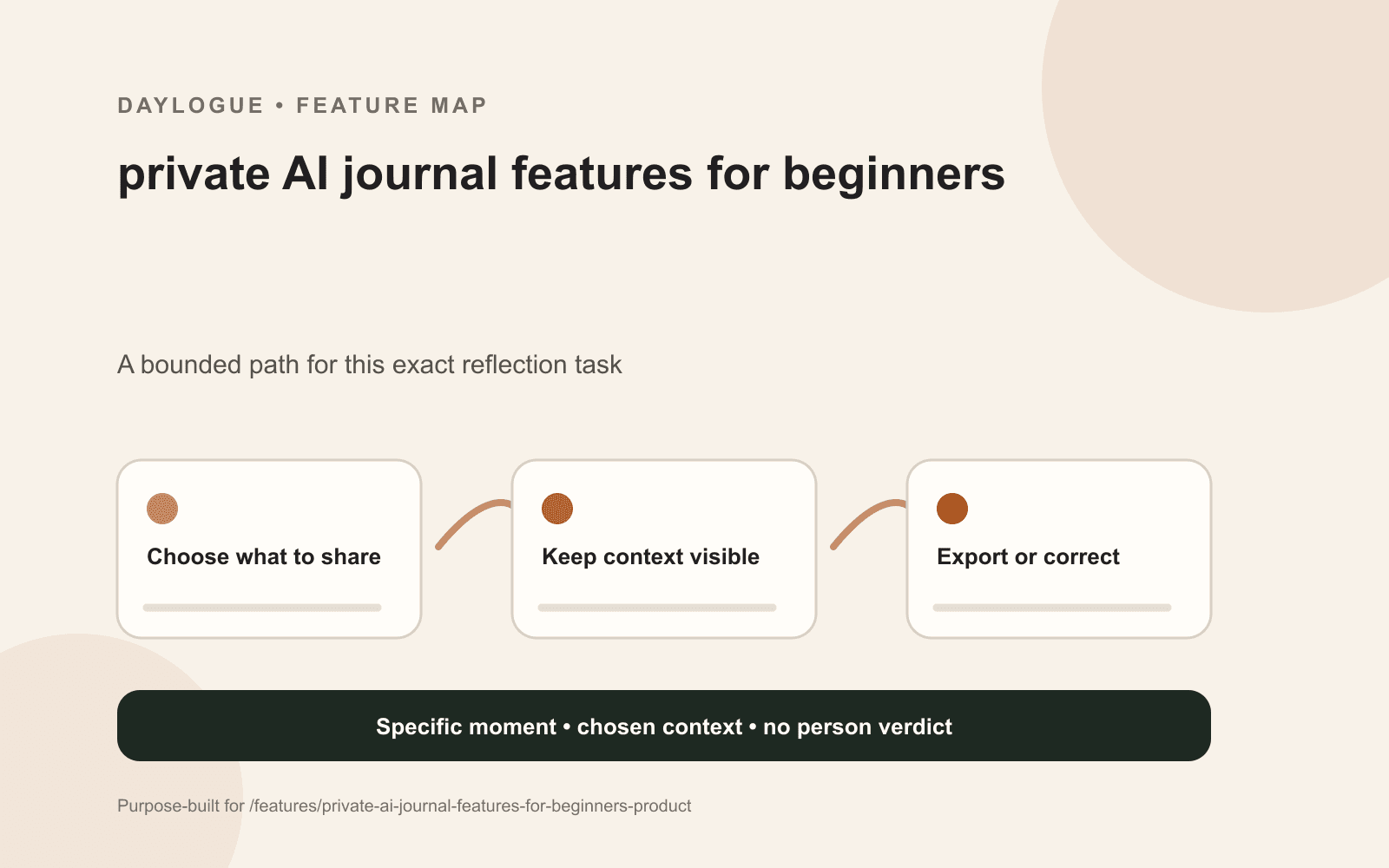
A beginner comparison can draw the path before judging the promise. A reader might start with capture and list every object that may be created: source text, attachments, transcript, generated response, summary, tags, and account metadata. Then connect each object to storage, processing, access, export, and deletion disclosures. Missing answers remain visible rather than being filled with reassuring assumptions.
A reader might use a low-stakes sample to test the account
A reader might create an entry that contains no sensitive names or events, such as the chair by the window was comfortable at lunch. Edit one word, attach a tag, request any generated feature, search for the phrase, and inspect account history. This sample reveals what the product creates without asking the person to begin with intimate material.
Next, open export and deletion controls. The point is not to complete a destructive account action during a trial. It is to see whether the product explains the available request, timing, exceptions, and resulting files before the person relies on it. A clear data path can support an informed choice to continue, narrow the type of entry, or use another place.
01
A reader might create the sample
A reader might use an ordinary sentence with no private names, work records, health details, or third-party information.
02
Trigger one feature
A reader might try search, a tag, or a requested readback and record which new objects appear in the account.
03
A reader might inspect account controls
A reader might find export, deletion, consent, linked service, and sign-in controls before adding a longer history.
04
A reader might compare the disclosure
Match the product behavior with its written statements and keep unanswered questions on the decision list.
A reader might keep seven privacy questions separate
The seven useful categories are device access, account access, syncing, model processing, service providers, export, and deletion or retention. A strong answer in one category does not erase a limitation in another. Biometric device lock, for example, says little about server processing. Downloadable export says little about what happens after an account deletion request.
Comparison tables can make this separation visible. Each row can quote the product's current disclosure, identify the setting or policy where it appears, and note what remains unknown. The table becomes less useful when it turns controls into a privacy score. Different people may make different choices based on shared devices, workplace accounts, travel, family context, or the kind of writing they plan to keep.
| Category | Question | Where to verify |
|---|---|---|
| Account | Who can sign in or recover access? | Account and recovery settings |
| Processing | Which services receive source text or generated content? | AI and subprocessor disclosures |
| Export | Which source and generated objects appear in a download? | Export sample and documentation |
| Deletion | What starts the request and which limits are named? | Deletion flow and retention policy |
| Syncing | Which content leaves the device and when? | Product settings and privacy policy |
Model training and requested processing are different questions
A company can say that personal entries are not used to train its own models while still sending content to a model service to produce a requested response. Those statements describe different activities. A careful comparison preserves the subject of each sentence: whose model, which content, for what purpose, under which configuration, and with which disclosed provider.
The same care applies to words such as encrypted, local, anonymous, and deleted. Each word requires scope. Which data, at which stage, under whose key, linked to which account, and for how long? A product may have several modes with different behavior. The current mode and current platform matter more than a broad label attached to the brand.
Evidence should narrow a claim, not decorate it
Daylogue describes itself as a system for self-understanding, and pattern journaling is how it reads what a person chooses to record. That mechanism makes data handling part of the product decision. The record is useful because it persists and can be read back, which makes clear processing and retention boundaries especially important.
A 2019 study of 395 young adults examined narrative coherence alongside identity functioning and well-being, and its results did not support a simple universal benefit. A longer, smoother archive is not automatically better. People can keep entries short, use selective topics, revise old wording, export what matters, or choose an offline place when the data path does not fit.
Checklist
Private AI journal data-path audit
A beginner checklist for tracing one low-stakes sample through capture, syncing, processing, storage, account access, export, deletion, and retention disclosures.
- Device: a reader might check lock, notification preview, and shared-device behavior.
- Account: a reader might review sign-in sessions, recovery methods, and email ownership.
- Sync: a reader might identify which objects leave the device and when.
- Processing: a reader might list model and service-provider roles for requested features.
- History: a reader might separate source entries from generated summaries and tags.
- Export: a reader might test the format and contents with a low-stakes sample.
- Deletion: a reader might read the request steps, timing, exceptions, and retention limits.
- Decision: a reader might choose which topics fit the service and which remain elsewhere.
Common questions
What does private mean for an AI journal?
The word alone is incomplete. A reader might look for separate statements about device access, account access, syncing, model processing, service providers, export, deletion, and retention.
Is a no-training statement the same as no AI processing?
No. Training and processing a request are different activities. The disclosure can identify whose model, the purpose, the provider, and the current configuration.
Why test export before building a long journal history?
A sample export shows which source entries, generated outputs, tags, dates, and attachments are portable. It also reveals file format and missing objects.
What can a deletion statement leave unclear?
It may omit grace periods, backups, processors, billing records, legal limits, or separately shared copies. Clear language names the process and its boundaries.
Can some journal topics stay offline?
Yes. A person may divide topics by sensitivity, use a low-detail entry, remove identifying information, or choose paper or another offline method for certain material.
Sources
Sources were checked on the dates shown. Product details and policies can change.
- Daylogue evidence and methods · Daylogue · checked August 31, 2026
- Narrative identity and psychological well-being research · National Library of Medicine · checked August 31, 2026
Keep exploring
Daylogue Knowledge Center
Browse practical guides for reflection, journaling, patterns, and privacy.
Read moreHow Daylogue shows patterns
See how candidate patterns stay connected to evidence and correction.
Read moreWhy Daylogue exists
Read the principles behind a system for self-understanding.
Read moreDaylogue is not therapy and is not a replacement for professional care.