Written by Daylogue Editorial Team. Published August 31, 2026. Reviewed and updated August 31, 2026.
Relationship journal prompts features for beginners are useful when they slow down the story without deciding who was right. A reader might look for separate space for remembered words, surrounding context, your reaction, your guess about meaning, and the question that still belongs in the real conversation. The feature can help prepare language while leaving the other person's motives and inner experience unknown.
Build a five-line record before writing an interpretation
A reader might start with the words you remember, the place, the timing, what happened immediately before, and what happened immediately after. This small record gives the scene edges. For example: we were putting away groceries, I asked about Saturday, they said I already told you, the phone rang, and we stopped talking. None of those lines settles tone, intent, or who carried more responsibility.
A product can make this sequence easy to capture without turning it into a formal report. Short fields, optional voice input, and editable order all help. The writer may remember another detail later or realize a quote was approximate. A visible correction protects the entry from sounding more certain than memory allows.
A reader might keep fact, story, and question in different places
The fact may be that a message received no reply for six hours. The story may be that the other person was avoiding the conversation. The question may be whether they saw the message or needed more time. All three are real parts of the writer's experience, but they have different status. A helpful feature can display them separately rather than blending the guess into the event.
This structure also leaves room for more than one story. Perhaps the delay felt dismissive. Perhaps the other person was working. Perhaps the meaning remains unclear. Writing alternatives is not an exercise in excusing anyone. It is a way to prevent private writing from becoming false certainty about another person's mind.
| Layer | Example | What remains open |
|---|---|---|
| Remembered event | The reply arrived six hours later | What happened during that time |
| My reaction | I felt brushed aside and stopped drafting | How the reaction may change |
| My first story | They were avoiding the topic | Whether that story fits their context |
| Conversation question | Did you see the message earlier? | The answer belongs to the other person |
Useful prompts help the writer own a reaction
Owning a reaction means describing it as yours rather than using it as proof about someone else. I went quiet after that sentence is observable. You made me shut down skips over the space between the event and the response. A prompt can ask what the writer noticed doing, what they wanted to say, and what they were trying to protect in the moment.
The wording can remain ordinary. There is no requirement to name a perfect feeling or produce a polished statement. I kept reorganizing the counter because I was not ready to answer may be enough. That detail helps prepare for a later conversation because it names behavior and timing without assigning blame or pretending the writer has solved the disagreement.
- What exact words or actions are remembered with reasonable confidence?
- What did the writer notice doing immediately afterward?
- Which interpretation appeared first, and how certain does it feel now?
- What question requires the other person's answer rather than a private conclusion?
Relationship entries can protect context through minimization
A detailed relationship entry may include another person's name, workplace, family history, health information, or messages copied from a private thread. More detail is not always more useful. A product can make pseudonyms, selective quoting, local drafting, editing, and deletion understandable. The key scene often survives after identifying details are removed.
A reader might try replacing names with roles and copying only the sentence that matters. If the entry still supports the later question, the extra detail may not belong in the record. Products also vary in syncing, account access, provider processing, export, and retention. Those boundaries can be reviewed before intimate entries become a long archive.
The best output may be one question, not a conclusion
A journal feature can help move from I know what this means to I know what I want to ask. A workable question is specific, answerable by the other person, and connected to the scene. When you said you had already told me, what were you remembering? opens a different conversation than Why do you never listen? The first question may still be uncomfortable, but it does not contain its own verdict.
The product can offer a draft while making its source visible. The writer can soften, sharpen, or discard the language. Generated wording is not automatically wiser than the first attempt. A good feature helps compare options, then gets out of the way so the actual conversation remains between people.
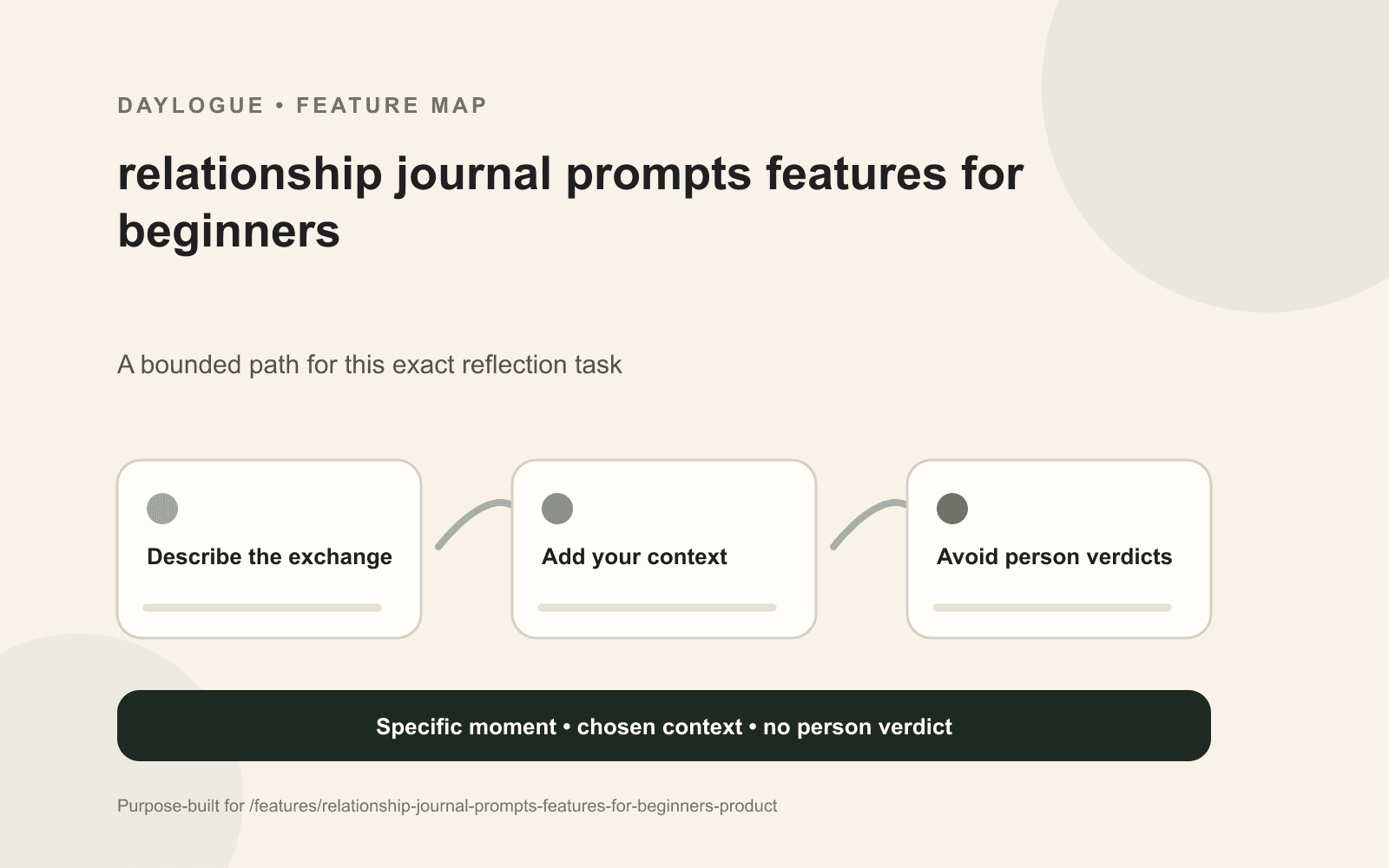
01
A reader might return to the scene
A reader might read the remembered words and timing before turning the entry into a question.
02
A reader might remove the verdict
A reader might replace claims about motive or character with the event that created uncertainty.
03
A reader might name the missing information
A reader might identify what only the other person can clarify, correct, or describe from their side.
04
A reader might choose the level of detail
A reader might keep the question specific enough to recognize while leaving unrelated private context outside it.
A relationship record remains partial
Daylogue describes itself as a system for self-understanding, and pattern journaling is how it reads what a person chooses to record. In a relationship entry, that means the record begins with one person's chosen words and context. It cannot supply the other person's unspoken motive, memory, or perspective.
A 2019 study of 395 young adults examined narrative coherence alongside identity functioning and well-being, and its results did not support a simple universal benefit. A neat relationship story is not necessarily a more accurate one. Uncertainty, competing accounts, and later corrections can remain visible because they are part of the record rather than flaws to smooth away.
Framework
Fact, story, question conversation frame
A relationship-journaling frame for preserving remembered events, owning a reaction, holding interpretations lightly, and preparing one answerable question.
- Event: a reader might record the words or action you remember.
- Edges: a reader might add what happened immediately before and after.
- Reaction: a reader might name what you noticed doing in response.
- Story: a reader might write the first meaning you assigned to the event.
- Alternative: a reader might keep one other explanation possible.
- Missing information: a reader might identify what only the other person can answer.
- Question: draft one specific sentence without a built-in verdict.
- Privacy pass: a reader might remove names and details that are not necessary.
Common questions
What belongs in a relationship journal entry before a conversation?
The remembered event, your reaction, the first interpretation, and one open question are enough. Identifying or unrelated details can stay outside the entry.
Can a relationship prompt tell what another person meant?
No. It can organize what you remember and the interpretations you considered. Meaning that depends on the other person's experience remains a conversation question.
What if I remember the wording differently later?
A useful feature allows a correction or note while preserving that the first quote was approximate. Memory can change as more context returns.
How can a journal question avoid blame?
It can point to one event and ask for missing information. Removing words such as always and never often makes the question easier to answer without erasing the issue.
Is it useful to write several possible interpretations?
It can be. Alternatives keep one early story from becoming certainty. They may remain unresolved until another person adds their own account.
Sources
Sources were checked on the dates shown. Product details and policies can change.
- Daylogue evidence and methods · Daylogue · checked August 31, 2026
- Narrative identity and psychological well-being research · National Library of Medicine · checked August 31, 2026
Keep exploring
Daylogue Knowledge Center
Browse practical guides for reflection, journaling, patterns, and privacy.
Read moreHow Daylogue shows patterns
See how candidate patterns stay connected to evidence and correction.
Read moreWhy Daylogue exists
Read the principles behind a system for self-understanding.
Read moreDaylogue is not therapy and is not a replacement for professional care.