Written by Daylogue Editorial Team. Published August 31, 2026. Reviewed and updated August 31, 2026.
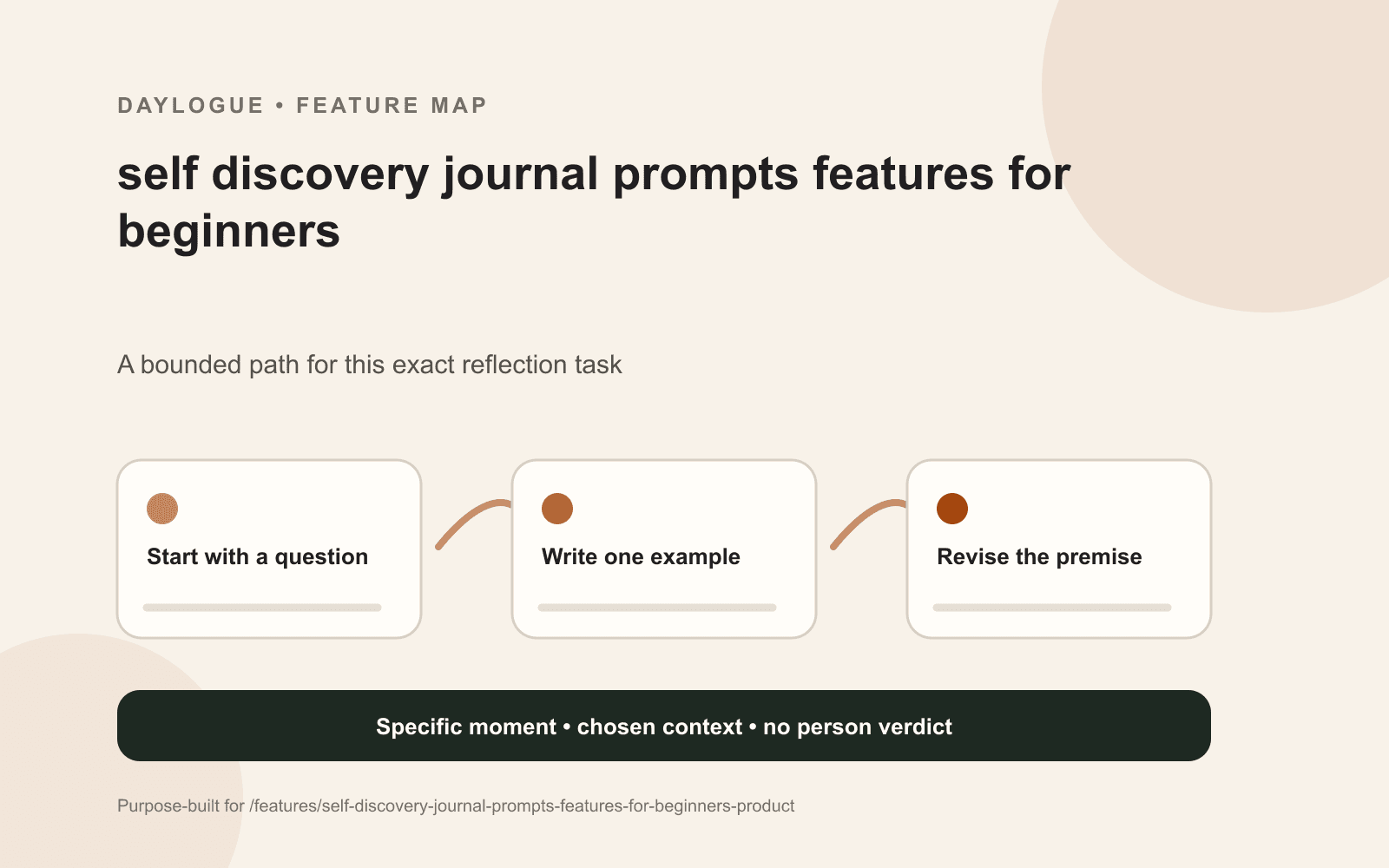
Self-discovery journal prompts features for beginners are most useful when they begin with something that happened, not a sweeping question about who someone is. A reader might look for prompts that connect a choice to its conditions, keep competing values visible, invite counterexamples, and allow later revision. A scene such as agreeing to one more task after a rushed meeting offers more to inspect than a personality label.
Treat one choice like a case, not a quiz result
A broad prompt such as what kind of person are you invites a polished answer. A scene prompt asks what you chose, what else was happening, and what mattered in that moment. A reader might consider agreeing to help with a late request. The choice may have involved generosity, time pressure, unclear authority, a desire to avoid conflict, or simple convenience. The scene contains several possibilities without assigning a fixed identity.
A strong feature keeps those possibilities separate. It can preserve the exact request, the time available, the first reaction, and the eventual reply. Later, the writer can add that the same choice would have felt different on a quiet day. Context does not excuse or condemn the decision. It makes the record more precise.
Break a recurring choice into four observable parts
The useful anatomy is situation, options, pressure, and result. Situation names the setting. Options record what seemed available at the time, including choices noticed only later. Pressure captures deadlines, expectations, money, fatigue, or another practical condition. Result describes what happened next without deciding what the choice proves about the person.
Testing a product with this structure reveals whether follow-ups stay grounded. If the entry says there were five minutes before the call, a relevant question might ask which options were visible in those five minutes. A leap to why do you always avoid conflict invents a pattern and a motive. The product can remain curious without turning one scene into a verdict.
| Part | Question | Example |
|---|---|---|
| Situation | What was happening? | A request arrived just before another call |
| Options | What choices seemed available? | Accept, ask for time, or redirect the request |
| Pressure | What narrowed the choice? | The sender was waiting and the next call was starting |
| Result | What followed? | The task was accepted and finished later than planned |
Competing values are more revealing than a single ideal
Many choices are difficult because two reasonable values pull in different directions. Reliability may compete with rest. Honesty may compete with privacy. Curiosity may compete with limited time. A useful prompt makes space for both sides. It does not reduce the entry to which value won or suggest that one option reveals the authentic self.
A reader might try a prompt that asks what each option protected. Saying yes may have protected a relationship. Asking for another day may have protected an existing commitment. Naming both creates a richer record for later comparison. It also allows the writer to notice that the balance changes by setting, person, or available time.
- A reader might name the two priorities that were active in the scene.
- A reader might record what each available option might have protected.
- A reader might keep the practical constraint beside the value language.
- A reader might leave room for the same value to look different in another setting.
The counterexample is a core product feature
A reader might suppose several entries show difficulty declining last-minute requests. A counterexample might be the afternoon when the writer asked for more time because the request arrived in writing and the deadline was clear. That scene may reveal a condition that made the boundary easier. It does not prove a universal rule, but it keeps the record from hardening into I can never say no.
Products can support this by linking an interpretation back to its source entries and offering an easy way to attach an exception. Search, tags, and editable summaries matter here. A smooth paragraph that omits the counterexample is less useful than a rougher view that shows both the repetition and the day that differed.
Self-discovery copy needs research humility
A study of 395 young adults found that links between narrative coherence and well-being were more complex than a simple more-is-better rule. That finding pushes against products that promise clarity merely because an entry becomes more coherent. People can tell smooth stories that omit uncertainty, and they can write fragmented notes that preserve important truth.
Daylogue is a system for self-understanding. Pattern journaling is how it reads you. The useful product behavior is therefore inspectable pattern journaling: dated sources, revisable language, visible exceptions, and no person score. The software may organize a record, while the writer keeps authority over what the record means.
A reader might choose what belongs in the record
Self-discovery entries may contain names, workplace details, family history, or other context that feels different once it is saved. A product can make editing, export, account deletion, and processing disclosures easy to find before the writer builds a long archive. A low-stakes sample entry offers a practical way to test those paths.
Daylogue does not use personal entries to train its own models. That exact boundary answers one question. Provider processing, server readability, account access, retention, and sharing are separate questions. A feature guide becomes more useful when it keeps those categories distinct and leaves space for an offline notebook or a narrower entry when that is the better fit.
Framework
Choice anatomy feature test
A scene-based framework for comparing how journal products hold options, pressure, competing values, results, and counterexamples without assigning identity labels.
- Situation: a reader might record where and when the choice appeared.
- Options: a reader might list only the alternatives that seemed available at the time.
- Pressure: a reader might name the deadline, expectation, or practical limit in the scene.
- Priorities: a reader might identify two values that pulled in different directions.
- Result: a reader might describe what happened next without turning it into a trait.
- Counterexample: a reader might find one similar scene where the choice differed.
- Revision: a reader might attach new context while keeping the first wording visible.
- Boundary: a reader might decide which details belong offline or outside the record.
Common questions
What is a good first self-discovery journal prompt?
A reader might begin with a recent choice and ask what was happening around it. A scene offers details that can be checked later without requiring a conclusion about identity.
Can repeated choices reveal a fixed trait?
They can show a repetition in the recorded situations. They do not settle what the whole person is like, and exceptions or missing context may change the interpretation.
Why include competing values in an entry?
A difficult choice often protects more than one reasonable priority. Naming both sides keeps the record from turning one option into the morally correct answer.
What makes an interpretation easy to revise?
Visible source entries, dates, editable wording, and attached counterexamples let a reader see why the first interpretation appeared and what later changed it.
Can a self-discovery prompt remain unanswered?
Yes. An open question can be the most accurate ending. The feature can save the scene without requiring a lesson, label, plan, or completed identity statement.
Sources
Sources were checked on the dates shown. Product details and policies can change.
- Daylogue evidence and methods · Daylogue · checked August 31, 2026
- Daylogue privacy policy · Daylogue · checked August 31, 2026
- Narrative identity and psychological well-being research · National Library of Medicine · checked August 31, 2026
Keep exploring
Daylogue Knowledge Center
Browse practical guides for reflection, journaling, patterns, and privacy.
Read moreHow Daylogue shows patterns
See how candidate patterns stay connected to evidence and correction.
Read moreWhy Daylogue exists
Read the principles behind a system for self-understanding.
Read moreDaylogue is not therapy and is not a replacement for professional care.