Written by Daylogue Editorial Team. Published August 14, 2026. Reviewed and updated August 14, 2026.
Beginners evaluating Daylogue's weekly journal review should separate verified product facts from buyer criteria. Daylogue's assigned sources establish weekly insights, pattern detection, readable generated summaries, and structured mood, energy, stress, and sleep fields. They do not establish that the weekly view shows source links, exceptions, or correction controls. Those remain evaluation questions. Missing days can stay missing, separate fields can stay separate, and no weekly read needs to become one personal score.
Start with what the week actually contains
A weekly review should begin with coverage: which days contain entries, which selected fields are present, and where the record is empty. This keeps one detailed evening from standing in for the whole week. A missing Wednesday is simply unrecorded. It should not lower a consistency grade or invite the product to guess how the day went.
For a beginner, the coverage line can be simple: four entries, three evening check-ins, and one day with sleep recorded. Then the review can move to events and repeated language. This order makes the limits visible before the summary becomes persuasive. You know what the read includes and what it cannot represent.
| Feature | What it should show | Question to ask |
|---|---|---|
| Coverage | Days and fields represented | What is missing? |
| Themes | Repeated words or situations | Which entries support this? |
| Signals | Separate mood, energy, stress, or sleep views | Did one field dominate? |
| Exceptions | A similar moment that differed | What changed around it? |
| Next question | One tentative prompt | What do I want to notice next? |
Require a route back to the original entries
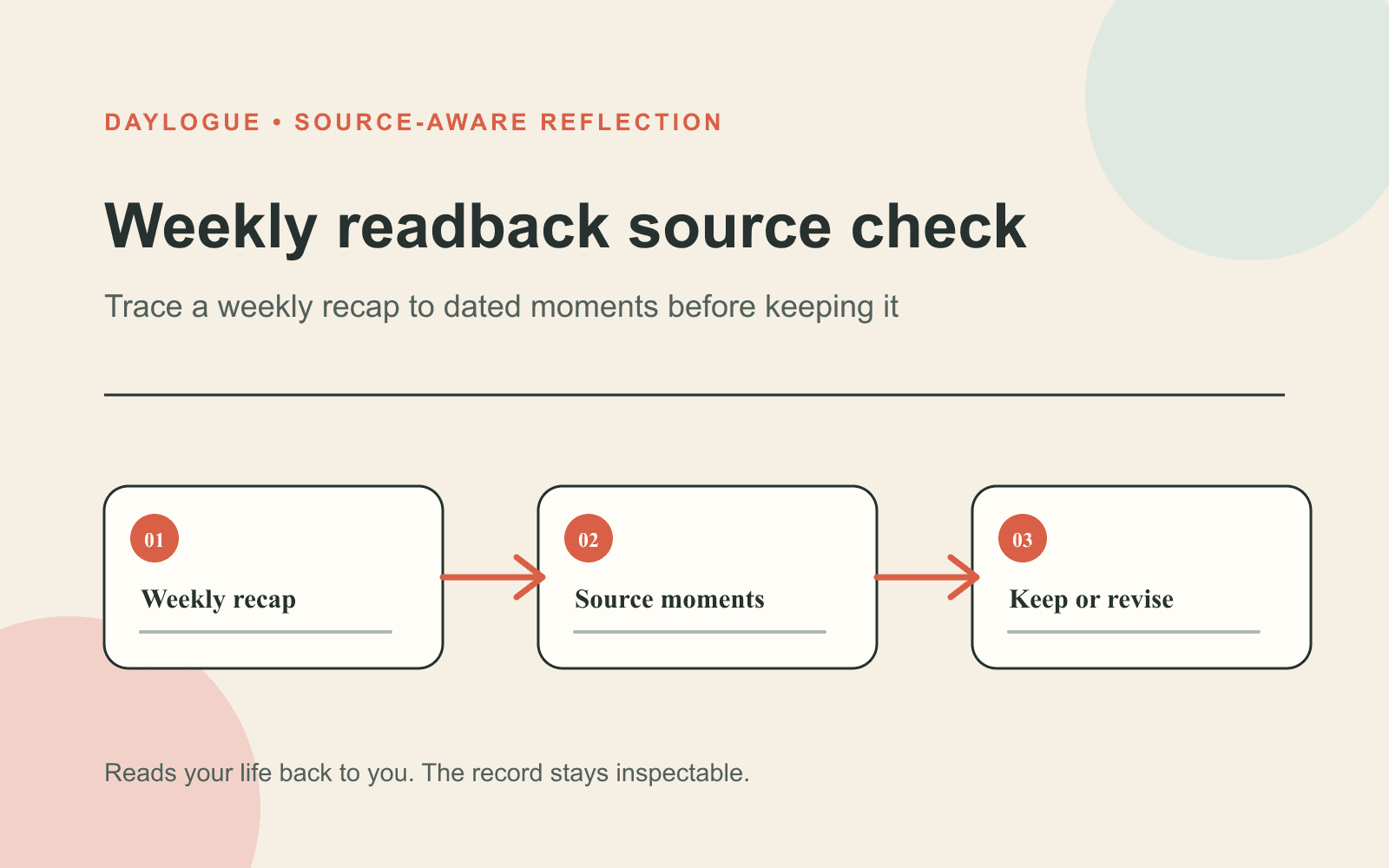
A weekly review becomes inspectable when each theme opens into dated source entries. If the summary says deadlines came up repeatedly, you should be able to see where and how often. Source access helps you catch a grouping that is too broad, a transcript error, or a line that sounded more certain in summary form than it did when you wrote it.
Corrections matter as much as citations. Look for controls to edit the source entry, dismiss an observation, or record that the wording does not fit. A review should not become permanent simply because it was generated. Your later clarification is part of the record and should shape what you see next.
- Open the exact entries behind each repeated theme.
- Check dates before reading frequency language.
- Correct transcript or tagging errors at the source.
- Dismiss a read that does not fit without losing the entry.
Keep the week's signals separate
A week can contain low energy, a good conversation, high stress, and satisfying work. One combined score makes those moments compete for a final grade. Beginner-friendly review features keep each signal in its own view and place it beside the entries that supply context. The result may be less tidy, but it is easier to understand and question.
Daylogue's privacy policy says structured mood, energy, stress, sleep, tags, timestamps, and device identifiers power dashboards, trends, and product features. Those fields can add context without becoming a verdict about the person. Missing data should stay missing, and a change in one field should not be presented as an explanation for another.
Look for the moment that complicates the summary
If a theme appears several times, the review should also help you find a similar moment that did not fit. Perhaps three late calls felt rushed and one did not. The exception may point to differences in preparation, length, role, or what happened beforehand. It may also show that the first theme was too broad.
Daylogue states that a recurring overlap does not show that one thing caused another. A weekly review can say that two details appeared together in the record. It should not convert that overlap into advice or certainty. The beginner's job is not to solve the week. It is to leave with a more specific question than the one they started with.
What Daylogue's assigned sources establish
Daylogue says generated summaries and insights are stored in readable form because they power features such as daily narratives, weekly insights, and pattern detection. Daylogue's privacy policy also says structured mood, energy, stress, sleep, tags, timestamps, and device identifiers power dashboards, trends, and product features. Together, those statements establish a weekly-insight layer and the structured context around it.
The assigned sources do not establish that Daylogue's weekly view shows coverage, dated source links, visible counterexamples, correction or dismissal controls, or one closing question. The criteria in this page are therefore buyer checks, not claims about a shipped Daylogue workflow. A current product walkthrough can confirm which of those controls are visible before someone relies on the review.
Check how reviews and entries are stored
A generated weekly review may contain sensitive details even when it does not quote an entry. Read whether entries, selected fields, summaries, and narratives are stored in readable form. Check provider processing, notifications, deletion, export, advertising, and model-training terms. A polished recap is still personal data, and its storage deserves the same attention as the original page.
Daylogue says most entries remain readable on its servers and that the service is not end-to-end encrypted. The current privacy policy can help someone decide whether that weekly review approach fits the kind of writing they plan to keep.
End the review with one question, not a plan
The final feature to look for is restraint. A useful weekly review can end with one question such as, "What was different about the calmer late call?" It does not need to prescribe a routine, rate your progress, or issue a list of improvements. One question gives the next entries a focus without turning journaling into homework.
Use the first few reviews to learn the review itself. Notice which summaries feel accurate, which source links help, and which prompts produce unnecessary detail. Adjust the fields you record and the themes you keep. A beginner does not need a perfect archive. You need a review you can understand, inspect, and leave alone when it has nothing useful to add.
Checklist
Beginner weekly journal review checklist
Use this checklist to evaluate whether a weekly review is complete enough to inspect and modest enough to trust.
- Coverage appears before any interpretation.
- Missing days remain missing instead of lowering a score.
- Every theme links to dated source entries.
- Mood, energy, stress, and sleep remain separate.
- At least one comparable exception is easy to find.
- Corrections and dismissals are available.
- The review ends with one open question.
Common questions
What should a beginner weekly journal review include?
Include coverage, repeated situations, separate selected fields, source entries, exceptions, and one open question. Keep missing days visible and avoid a combined personal score.
Should a weekly review summarize every journal entry?
No. It can name the record's coverage and surface a few recurring details. You should still be able to open the exact entries behind each observation.
Can a weekly journal review tell me what caused a hard week?
No. It can show what appeared together in the entries, but recurring overlap does not establish a cause. Use the read to form a narrower question.
How should missing journal days appear in a review?
They should remain unrecorded. A product should not guess what happened, lower a score, or describe the gap as failure or lost progress.
What privacy details matter for generated weekly summaries?
Check readable storage, provider processing, retention, deletion, export, notification previews, advertising, and model-training terms for both entries and generated summaries.
Sources
Sources were checked on the dates shown. Product details and policies can change.
- Daylogue evidence and methods · Daylogue · checked August 14, 2026
- Daylogue privacy policy · Daylogue · checked August 14, 2026
Keep exploring
Daylogue Knowledge Center
Browse practical guides for reflection, journaling, patterns, and privacy.
Read moreHow Daylogue shows patterns
See how candidate patterns stay connected to evidence and correction.
Read moreWhy Daylogue exists
Read the principles behind a system for self-understanding.
Read moreDaylogue is not therapy and is not a replacement for professional care.