Written by Daylogue Editorial Team. Published August 8, 2026. Reviewed and updated August 8, 2026.
Accepted journal threads are recurring topics or connections that you have reviewed and chosen to keep in your journal’s ongoing readback. Acceptance does not make a thread permanent or objectively true. It means the source moments are recognizable, the wording fits your experience, and the connection is useful enough to revisit.
An accepted thread is chosen, not assigned
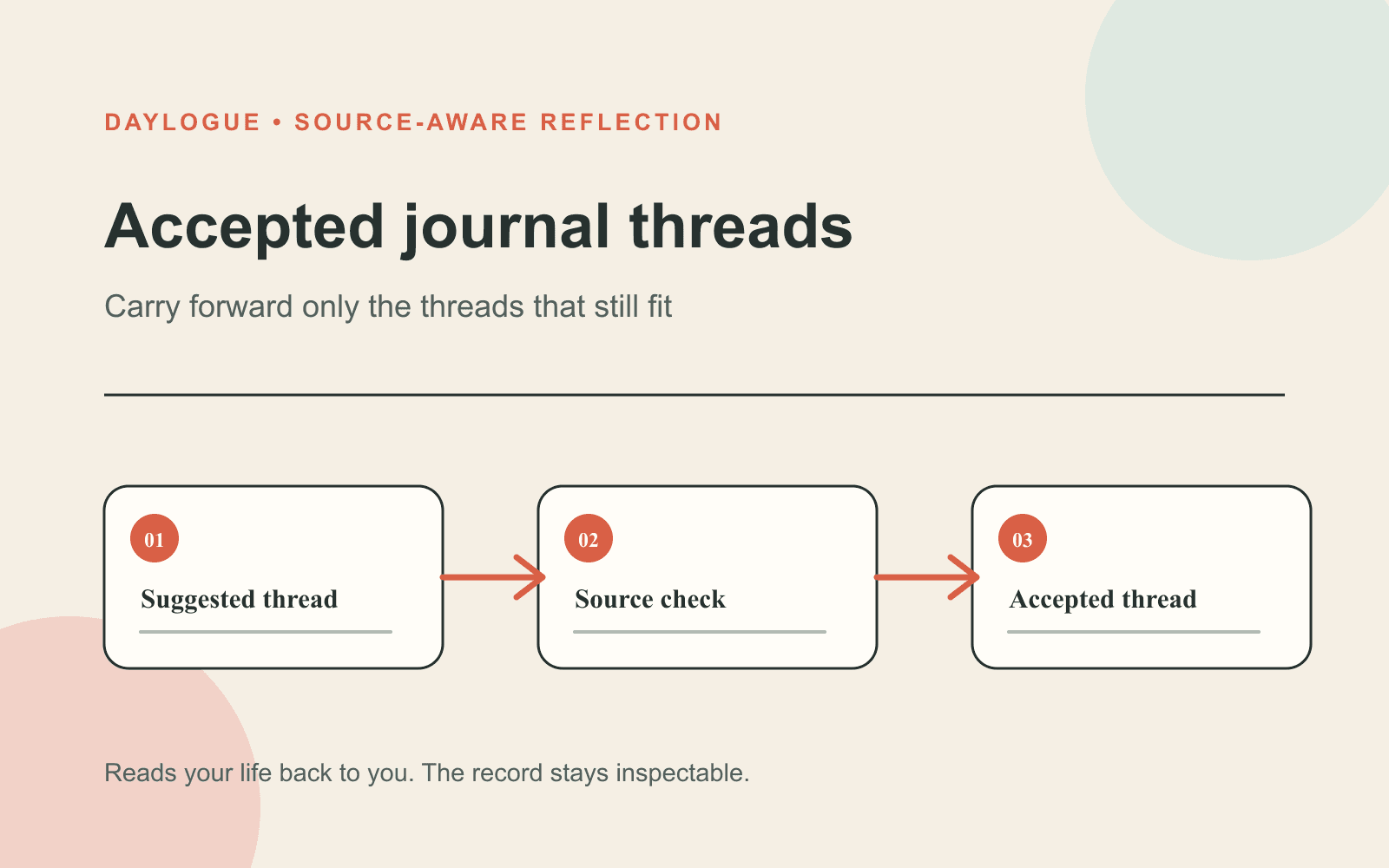
A journal thread begins when separate entries appear to share a topic, situation, phrase, or rhythm. It becomes accepted only after you inspect the moments and decide that the connection belongs in your current understanding. The software can propose. The person who lived the days decides what stays.
Acceptance is lighter than agreement with a verdict. You might accept “work planning keeps appearing in Sunday entries” while rejecting “you cannot relax on weekends.” The first statement describes the record. The second turns a small thread into a claim about the person. Good acceptance controls keep that difference clear.
Four signs a thread is ready to accept
Look for traceable source entries, limited wording, visible exceptions, and personal usefulness. A thread earns a place when you can reread where it came from and still recognize the connection. It should remain specific to a time window instead of sounding like a permanent rule about your life.
Daylogue reads across check-in history to surface emotional patterns. That process can propose a thread, but proposal and acceptance are different actions. Your correction, rejection, or reinterpretation supplies context the record may not contain. That response is part of understanding, not an error to overcome.
- Source moments are available and relevant to the proposed connection.
- The wording describes recurrence without assigning a fixed identity.
- Exceptions and missing entries remain visible beside the main thread.
- The connection helps you ask a clearer question or remember a real sequence.
Keep more than two states
A forced accept-or-reject choice makes uncertainty look like indecision. Use at least three states: accepted, maybe, and dismissed. “Maybe” is useful when the proposed thread fits two entries but the month was poorly logged. You can preserve the observation without giving it more weight than the record supports.
Accepted can also mean accepted with edits. Replace broad language with your own sentence, narrow the date range, or add the exception that changes the tone. The revised thread may become more useful precisely because it sounds less impressive and more like something you would actually say.
| State | When it fits | What happens next |
|---|---|---|
| Accepted | Evidence and wording fit your experience | Keep it available for later readbacks |
| Accepted with edits | The connection helps but the wording overreaches | Save your narrower interpretation |
| Maybe | The idea is plausible and the record is thin | Revisit after more relevant moments |
| Dismissed | Support is weak or the thread feels wrong | Preserve your reason and move on |
Acceptance does not establish cause
A repeated connection can be personally useful without proving why it happened. The same slot in your week may appear beside a recurring topic, yet the journal may not contain every schedule change, conversation, or practical constraint. Accept the limited observation and leave the explanation open.
A recurring overlap does not show that one thing caused another. An accepted thread should preserve that limit in its wording. “These appeared together in four entries” is defensible. “This caused that” asks the journal to settle a question its record may not be able to answer.
How to review a proposed thread
Open every cited moment and read one entry before and after when available. Mark what supports the proposal, what changes it, and what the journal never captured. Then rewrite the thread in one sentence without using identity labels. If the sentence still feels useful, choose the state that matches your confidence.
Date the decision so later entries can change it. An accepted thread from January may become a dismissed thread by March after a project ends. That revision does not erase the earlier record. It shows that your interpretation kept pace with your life.
01
Read the cited moments
Review the entries behind the thread instead of responding only to the summary.
02
Add missing context
Name exceptions, unlogged days, and events that may change the connection.
03
Rewrite in your voice
Use a narrow sentence that describes the record without defining the person.
04
Choose a state and date it
Accept, edit, hold as maybe, or dismiss, then leave room for a later decision.
A responsible system makes correction ordinary
AI-assisted journals should not hide uncertainty behind warm language. They should expose source moments, separate observations from advice, and make rejection as easy as acceptance. The NIST AI Risk Management Framework is intended for voluntary use. Its emphasis on managing risk fits the practical need for ongoing review rather than blind reliance.
The NIST Privacy Framework is a voluntary tool developed to help organizations identify and manage privacy risk. Accepted threads can become a sensitive summary of a long record, so review storage, processing, sharing, training, and deletion terms before building them. Continuity is valuable, and that value deserves concrete privacy choices.
Decision Table
Accepted, edited, maybe, or dismissed
A four-state decision tool for reviewing a proposed journal thread without forcing uncertainty into a simple yes or no.
- Accept when the source moments and limited wording fit your experience.
- Accept with edits when the connection helps but your own sentence is more accurate.
- Choose maybe when the record is thin, uneven, or missing important context.
- Dismiss when support is weak, the wording overreaches, or the connection feels wrong.
- Date every choice so later entries can change the interpretation without erasing history.
Common questions
Who accepts a journal thread?
The person whose journal contains the source moments should decide. An app may propose a connection, but acceptance comes after review and interpretation. That distinction keeps software in the role of surfacing candidate patterns rather than issuing conclusions about a person.
Can I change an accepted journal thread later?
Yes. Date the original acceptance and revise it when new entries, missing context, or a changed situation alter your view. A journal should show how your interpretation developed. Revision is evidence of attention, not proof that the earlier reflection failed.
What if I partly agree with a proposed thread?
Accept it with edits or keep it as maybe. Narrow the date range, replace broad language, and add the exception that matters. A partial fit should not be forced into complete agreement, especially when the underlying record is small or uneven.
Should dismissed threads disappear from the journal?
Keeping a brief record of the dismissal can be useful because it preserves your correction. The original proposal does not need to dominate future summaries. A dated note such as “dismissed because travel weeks were missing” helps prevent the same overreach from returning unnoticed.
Sources
Sources were checked on the dates shown. Product details and policies can change.
- Daylogue pattern features · Daylogue · checked August 8, 2026
- Daylogue evidence and methods · Daylogue · checked August 8, 2026
- NIST AI Risk Management Framework · National Institute of Standards and Technology · checked August 8, 2026
- NIST Privacy Framework · National Institute of Standards and Technology · checked August 8, 2026
Keep exploring
Daylogue Knowledge Center
Browse practical guides for reflection, journaling, patterns, and privacy.
Read moreHow Daylogue shows patterns
See how candidate patterns stay connected to evidence and correction.
Read moreWhy Daylogue exists
Read the principles behind a system for self-understanding.
Read moreDaylogue is not therapy and is not a replacement for professional care.