Written by Daylogue Editorial Team. Published August 8, 2026. Reviewed and updated August 8, 2026.
Journal narrative continuity is the thread that links separate entries across time. It helps you see how a concern began, changed, faded, or returned without forcing your life into one tidy explanation. Good continuity preserves dates, contradictions, and gaps. It offers a readable record, not a fixed story about who you are.
What journal narrative continuity means
Continuity is the connection between one entry and the next relevant moment. A note about a hard meeting may return as relief on Friday, then disappear for two weeks. Reading those moments together gives you a small arc. The arc remains grounded because each part can still be opened and read on its own.
Continuity does not mean consistency. Your entries can disagree. You can feel certain on Monday and unsure on Thursday. A useful journal keeps both moments visible instead of choosing the cleaner version. That is how a record becomes more honest over time rather than merely more polished.
The four parts of a continuous journal thread
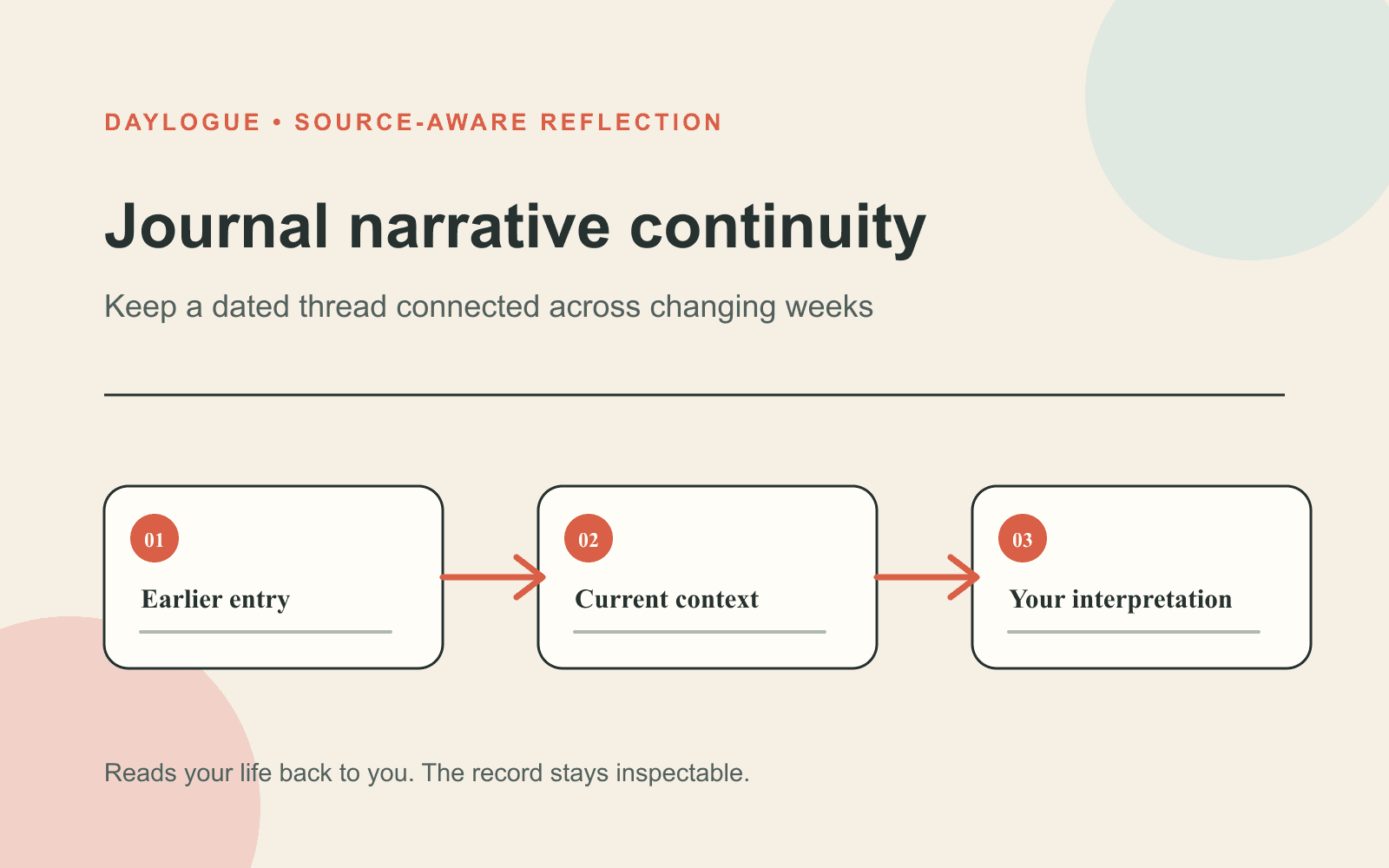
A continuous thread has an anchor, a return, a change, and a current interpretation. The anchor is the first relevant moment you can find. The return shows that the topic appeared again. The change records what shifted. The interpretation states what you think it means now, while leaving room for a later revision.
Every check-in adds another data point. That does not make every entry equally important or turn accumulation into truth. Continuity becomes useful when you can distinguish supporting moments from background noise and when you keep the exceptions that complicate the main line.
- Anchor: the earliest entry that starts the thread you are reviewing.
- Return: a later moment where the same topic or situation appears.
- Change: evidence that the thread shifted, eased, or became more complicated.
- Interpretation: your current wording, dated so it can change later.
Continuity is related to pattern detection, but not identical
A pattern emphasizes recurrence. Continuity emphasizes connection and development. Three entries about Sunday work may form a pattern. Reading how the concern started, changed after a schedule adjustment, and eventually stopped is narrative continuity. One gives you repetition. The other gives the repetition a timeline.
Daylogue reads across check-in history to surface emotional patterns. Those candidate patterns can become one part of a continuous narrative, while the final meaning remains with you. You can confirm the connection, reject it, or write a different interpretation that better fits what happened.
| Concept | Main question | Useful output |
|---|---|---|
| Single-entry reflection | What happened in this moment? | One dated account |
| Theme | What topic appears here? | A label or phrase |
| Pattern | What keeps recurring? | A repeated connection |
| Narrative continuity | How did this thread move over time? | A traceable throughline |
Continuity works when uncertainty remains visible
A smooth narrative can feel satisfying even when it leaves out the awkward evidence. The day that does not fit can stay visible, along with the week without entries and context that was not recorded. Those limits make the throughline more useful because they show exactly where the story could change.
A recurring overlap does not show that one thing caused another. If poor sleep entries appear beside higher stress notes, continuity can show how that thread moved through a month. It cannot settle every explanation. A schedule change, travel, workload, or logging habit may belong in the same story.
How to build continuity without rewriting your past
One option is to choose a current question and search backward for the earliest related moment. Reading forward in date order, you can copy one sentence from each relevant entry into a temporary list and add the moments that contradict the apparent thread. After that review, a short narrative can take shape in your present voice.
Dating the interpretation with wording such as “As of March, I think…” leaves room for later evidence. The sentence can change without making the previous entry a mistake. A journal is a record of what you noticed at different times, not a courtroom where one final account must defeat all earlier versions.
01
Choose one thread
Start with a current question narrow enough to trace through specific entries.
02
Read forward by date
Preserve the order of events so the ending does not rewrite the beginning.
03
Collect fit and friction
Save supporting moments along with exceptions, missing days, and changes.
04
Write a dated throughline
Summarize what you see now in language that can be revised later.
AI continuity works best with source visibility and privacy clarity
An AI journal can scan a longer record and propose a thread, but fluent prose is not the same as traceable continuity. Useful product controls make it possible to return to the moments behind the summary, see what was omitted, and change the wording. The record belongs in the foreground. The generated narrative remains a draft.
The NIST Privacy Framework is a voluntary tool developed to help organizations identify and manage privacy risk. For a personal journal, use that mindset before building years of continuity. Learn what the service stores, which processors handle readable content, whether personal entries train models, and how deletion works.
Framework
Anchor, return, change, interpretation
A four-part framework for tracing a journal thread over time while preserving gaps, exceptions, and your right to revise the meaning.
- Anchor the thread in the earliest relevant entry you can verify.
- Find a return where the topic, situation, or phrase appears again.
- Record a change, contradiction, or disappearance that complicates the thread.
- Write a dated interpretation in your own words and leave it open to revision.
Common questions
Is journal narrative continuity the same as storytelling?
It uses some storytelling skills, such as sequence and change, but its first duty is to the record. A journal throughline can preserve contradictions and gaps rather than shaping events for a satisfying ending. It is a way to read your entries together, not a demand for a dramatic arc.
Can narrative continuity exist with days without entries?
Yes. Days without entries become visible limits in the record. You can connect the entries you have while stating what was not captured. Continuity does not require a streak, and it becomes less trustworthy when a summary silently invents what happened between entries.
How is journal continuity different from journal memory?
Memory is the ability to retain and retrieve earlier material. Continuity is the connection you make across that material over time. A system can remember a fact without building a useful throughline, and it can build a short throughline from entries you gathered manually.
Can an AI journal create narrative continuity for me?
It can propose a narrative from the material it is allowed to read. Review options include inspecting the source moments, adding unrecorded context, and deciding what the thread means. The most useful output is editable and modest, not a finished identity statement.
Sources
Sources were checked on the dates shown. Product details and policies can change.
- Daylogue pattern features · Daylogue · checked August 8, 2026
- Daylogue evidence and methods · Daylogue · checked August 8, 2026
- NIST AI Risk Management Framework · National Institute of Standards and Technology · checked August 8, 2026
- NIST Privacy Framework · National Institute of Standards and Technology · checked August 8, 2026
Keep exploring
Daylogue Knowledge Center
Browse practical guides for reflection, journaling, patterns, and privacy.
Read moreHow Daylogue shows patterns
See how candidate patterns stay connected to evidence and correction.
Read moreWhy Daylogue exists
Read the principles behind a system for self-understanding.
Read moreDaylogue is not therapy and is not a replacement for professional care.