Written by Daylogue Editorial Team. Published August 8, 2026. Reviewed and updated August 8, 2026.
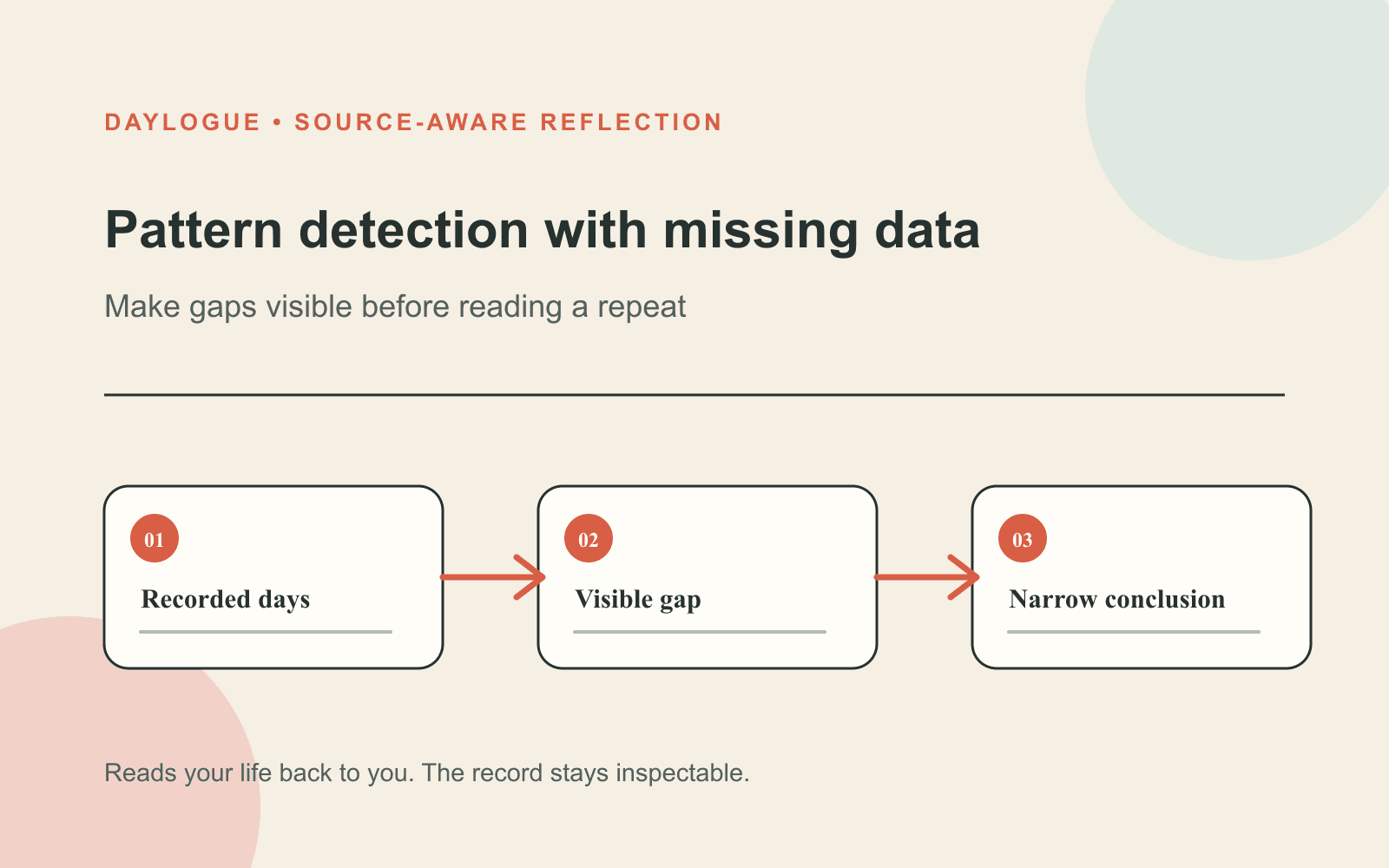
Pattern detection with missing data can still surface candidate connections, but the result must stay limited to what was recorded. Missing days, skipped fields, changed prompts, and shifts in logging habits can all reshape an apparent trend. A responsible readback marks those gaps and avoids framing absence as an improvement, a setback, or a neutral day.
Missing data means the record is incomplete
A missing value can come from a skipped check-in, an unanswered field, a changed prompt, an entry saved without context, or a week when you chose not to journal. Those situations are not interchangeable. Good pattern detection identifies the gap it can see and avoids inventing the reason behind it.
A blank day is not interpreted as improvement, difficulty, or a neutral mood. No entry does not mean the day was calm, difficult, average, or forgotten. It means the system lacks a recorded moment and should keep its conclusion narrower than it would with a fuller journal record.
Gaps can change the shape of an apparent pattern
Suppose you log stress mainly on deadline days. The record may show many high-stress entries beside late work, but it contains few ordinary days for comparison. The overlap may be real within the logged moments and still fail to represent the whole month. Missing context changes the confidence, not necessarily the observation itself.
Every check-in adds another data point. More varied check-ins can make a candidate pattern easier to inspect, yet quantity alone is not enough. A long record with the same selective habit can remain uneven. The readback should state what kinds of moments appear and which ones are scarce.
- Skipped days reduce the number of moments available for comparison.
- Partially completed check-ins leave some fields present and others absent.
- Prompt changes can alter which details appear without reflecting a personal change.
- Logging only unusual days can overrepresent intense moments.
- A changed scale or routine can make earlier and later entries hard to compare.
Ask what kind of journal information is missing
A completely missing day is different from one blank field inside a detailed check-in. An entry without context is different from choosing not to answer a question. The interface may not know the cause, but it can show the scope: which dates, which fields, and how much of the reviewed window was available.
That scope helps you choose a response. You may keep a narrow observation about recorded Thursdays while rejecting a statement about the entire month. You may add a dated context note, change nothing, or decide that manual review matters more. Missing data is information about the record, not a task you owe the app.
| Gap | What is known | What is not known |
|---|---|---|
| No journal entry | Nothing was recorded that day | How the day felt or why it was skipped |
| Blank check-in field | Other fields may still be usable | The missing value and reason |
| Changed prompt | The journal asked for different information | Whether the apparent shift reflects life or the question |
| Changed logging routine | The record’s sampling changed | Whether the apparent trend reflects life or logging |
Incomplete records need modest wording
Daylogue reads across check-in history to surface emotional patterns. When that history has gaps, any candidate pattern should remain visibly tied to the available entries. “Among the days you logged” is more accurate than “this always happens.” The qualifier tells you where the observation begins and ends.
A recurring overlap does not show that one thing caused another. Missing data adds another reason to resist causal language. If unlogged days differ from logged days, the apparent relationship may change. The pattern can guide reflection without becoming a claim that the record cannot support.
How to review a pattern with gaps
Check the date range, count the available moments, and identify which fields are complete. Then ask whether the missing periods are likely to differ from the logged ones. You do not need to guess what happened. Simply state the possibility and rewrite the observation so it applies only to the material in view.
Look for exceptions among the available entries too. A pattern that survives visible contradictions may still be interesting. One that depends on excluding inconvenient days should be held as uncertain. Your goal is a faithful reading of the record, not the highest possible confidence score.
01
Map the available window
List the dates and fields that actually contain usable information.
02
Mark every visible gap
Separate missing days, blank fields, and changed prompts where possible.
03
Check for selective logging
Ask whether you tend to record unusual moments more often than ordinary ones.
04
Narrow the sentence
Rewrite the observation so it applies only to the entries that exist.
05
Choose uncertainty honestly
Keep, hold, or dismiss the pattern without turning data completion into an obligation.
Good systems disclose uncertainty without demanding more data
The NIST AI Risk Management Framework is intended for voluntary use. Its risk-management framing supports a practical standard for personal tools: evaluate output in context, communicate limits, and keep human judgment active. A product should not hide gaps or pressure you to log more simply to improve its model.
The NIST Privacy Framework is a voluntary tool developed to help organizations identify and manage privacy risk. Supplying more personal data may reduce some gaps while increasing the sensitivity of the record. Review storage, processing, training, sharing, and deletion terms before deciding that completeness is worth that tradeoff.
Checklist
Missing-data pattern review
A practical checklist for narrowing a candidate pattern to the journal entries, prompts, and fields that were actually available.
- Confirm the dates and fields included in the pattern window.
- Separate missing days from partially completed check-ins.
- Mark changed prompts and missing fields without assigning a personal meaning.
- Ask whether unusual days are more likely to be logged.
- Rewrite the observation to begin with “among the days recorded” when needed.
- Keep uncertainty visible and never frame completion as a moral obligation.
Common questions
Can pattern detection work if I miss journal days?
Yes, but the observation should apply only to the days and fields that exist. Missing days reduce context and may introduce bias if you tend to log unusual moments. A useful readback marks the gaps instead of framing them as normal or neutral days.
Should I backfill missing journal entries?
Only if you want to and can clearly label the entry as retrospective. Backfilled memories are different from notes written in the moment. You do not owe a product complete data, and a no-streak journal should remain useful without turning gaps into guilt.
What does a changed journal prompt mean for a pattern?
It means the journal asked for different information during that period. It does not show that your underlying experience changed. The readback should state that the prompt changed and avoid converting a design change into a broad statement about you.
How should an AI journal display missing data?
It should show the affected dates or fields, limit the wording to available material, and make uncertainty easy to understand. It should not silently fill gaps, infer why you skipped, or pressure you to complete a streak. Your choice not to log remains valid.
Sources
Sources were checked on the dates shown. Product details and policies can change.
- Daylogue pattern features · Daylogue · checked August 8, 2026
- Daylogue evidence and methods · Daylogue · checked August 8, 2026
- NIST AI Risk Management Framework · National Institute of Standards and Technology · checked August 8, 2026
- NIST Privacy Framework · National Institute of Standards and Technology · checked August 8, 2026
Keep exploring
Daylogue Knowledge Center
Browse practical guides for reflection, journaling, patterns, and privacy.
Read moreHow Daylogue shows patterns
See how candidate patterns stay connected to evidence and correction.
Read moreWhy Daylogue exists
Read the principles behind a system for self-understanding.
Read moreDaylogue is not therapy and is not a replacement for professional care.