Written by Daylogue Editorial Team. Published August 12, 2026. Reviewed and updated August 12, 2026.
AI journal prompts for parents and caregivers are questions created or adapted by software to help someone begin reflecting without facing an empty page. A fixed prompt asks everyone the same thing. An adaptive prompt can respond to a detail you choose to share and ask a narrower follow-up. The prompt should help you describe a moment, not tell you what kind of parent or caregiver you are. Before using one, check what the service stores, which processors receive the entry, whether the result can be corrected, and how deletion works.
AI journal prompts are adaptive starting questions
A traditional prompt is written in advance. “What felt hard today?” appears the same way every time. An AI prompt can begin with that question, read the answer you provide, and ask about the detail that seems relevant. If you mention a rushed school pickup, it may ask what made the timing difficult. If you mention a quiet win at bedtime, it may ask what you want to remember. The useful difference is responsiveness, not authority.
The software knows only the information available in the interaction and any record the product is designed to use. It does not witness the day, know the other people involved, or understand family context from the inside. A good prompt leaves room for “that is not what I meant.” It asks for context rather than turning one tired sentence into a conclusion about your capacity, relationship, or identity.
They help when the blank page costs too much energy
Care days are full of small moments that rarely survive until evening. A prompt can lower the starting effort by asking for one scene instead of a summary of the whole day. “What moment is still with you?” is easier to answer than “How are things going?” The response can be one sentence. Naming the spilled breakfast, the medical phone call, or the joke in the car is enough to preserve something real.
Prompts can also separate overlapping roles. You can write about what happened, what you needed, what the other person directly said, and what remains uncertain. That structure makes it easier to notice when exhaustion is shaping the story. It does not require a lesson or a grateful ending. Irritation, tenderness, boredom, relief, and numbness can all be recorded without turning any one feeling into a problem to solve.
- Name one moment instead of recapping the entire day.
- Separate the event from the meaning you added afterward.
- Save a detail you want to remember next week.
- Notice what you need before answering someone else.
Fixed and adaptive prompts have different strengths
Fixed prompts are predictable. You know what will be asked, and answers are easier to compare over time. They also work offline on paper. Adaptive prompts can follow an unexpected detail and reduce the feeling of filling out a form. The tradeoff is influence. A follow-up may steer attention toward conflict, gratitude, productivity, or another frame that was not central to your experience.
Choose fixed prompts when consistency matters or you want a low-tech record. Choose adaptive prompts when the blank page stops you or the day does not fit a standard question. You can combine them by keeping one stable opening and allowing one optional follow-up. The opening gives the practice continuity. The follow-up gives the day room to be different.
| Prompt type | Strength | Limitation |
|---|---|---|
| Fixed question | Predictable and easy to repeat | May miss what mattered today |
| Adaptive question | Can follow the detail you share | May steer the reflection |
| Blank page | Complete freedom | Requires more starting energy |
| Short checklist | Fast and comparable | Can flatten context |
A useful prompt stays close to the event
Look for questions that ask what happened, what stood out, and what context changes the meaning. Be cautious with prompts that announce a hidden cause, assign a trait, or tell you what another person intended. “Why are you avoiding connection?” assumes too much. “When did you feel distant today, and what else was happening?” leaves the explanation open.
Daylogue is a system for self-understanding. Pattern journaling is how it reads you. That framing keeps the record focused on what you choose to share across time. It does not make the prompt a diagnosis, prediction, or parenting score. Your answer can correct the question, reject its premise, or end after one line.
Family stories need a privacy check
A caregiver journal can include a child’s name, school, health information, schedule, or another adult’s private story. Keep only what your reflection needs. A role, age range, or general description may preserve the meaning without collecting an identifying detail. Avoid entering information you are responsible for protecting through work, school, health, legal, or family agreements.
For a digital service, ask whether entries are readable on company servers, which vendors process them, whether content trains models, what exports contain, and what deletion covers. Daylogue says its servers read entries to write narratives and surface patterns. Your content is not used to train AI models. Read /privacy for the full current explanation before choosing how specific to be.
Use one prompt and stop when it has done its job
Start with one ordinary question: “What moment took more out of me than I expected?” Answer with the scene, not a general verdict. Add the context that could change how you read it later. Then write one sentence you want to remember. You do not need to answer every follow-up or produce a polished entry. Thirty honest seconds can be more usable than a long account written from obligation.
Return when you want, not because a streak demands it. If the prompts begin to sound repetitive, switch the opening question. If they feel intrusive, reduce the detail or use paper. If a generated summary sounds too certain, correct it or leave it aside. Daylogue is not therapy and is not a replacement for professional care. Reflection can support attention, but it does not replace human help when you need it.
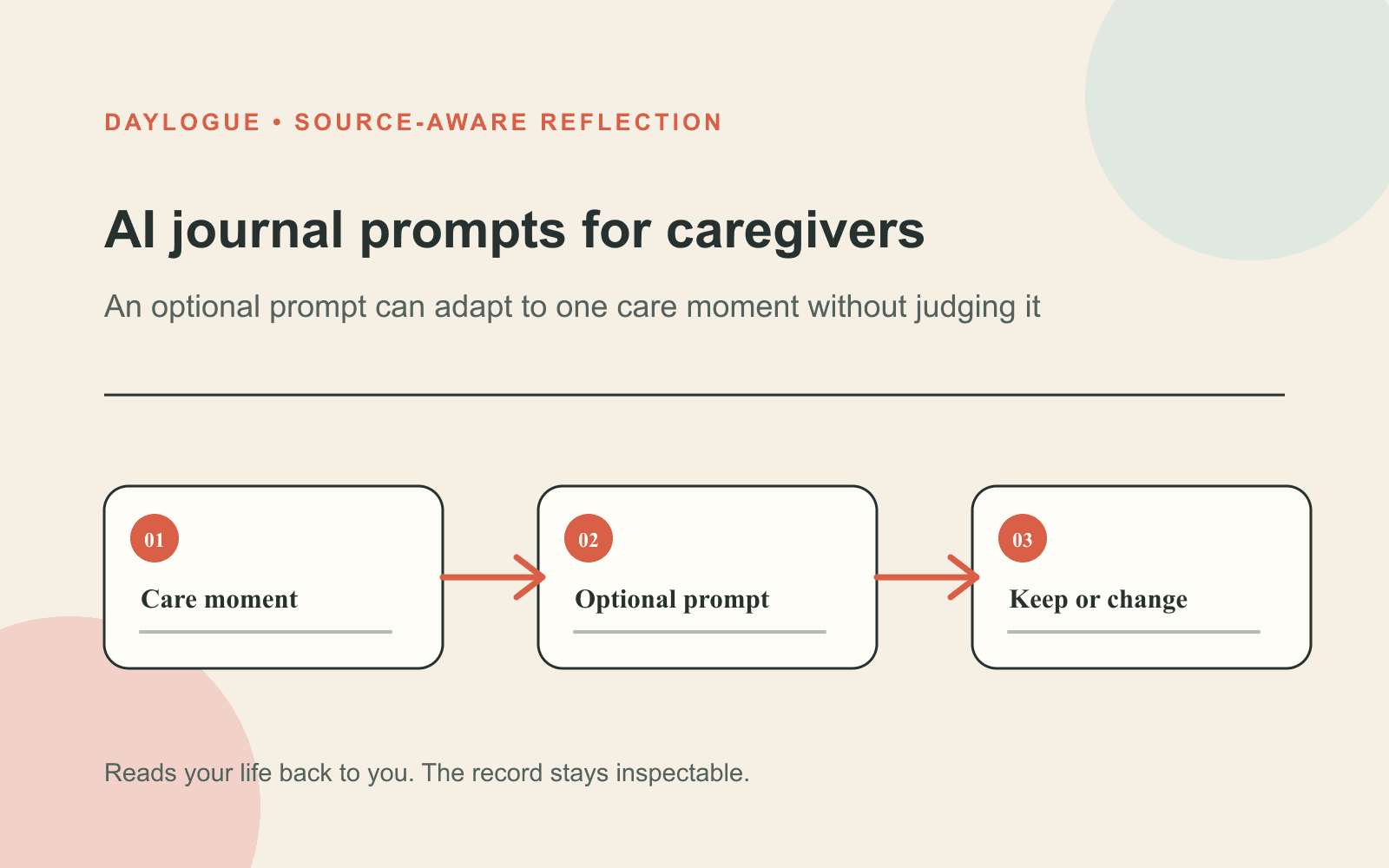
01
Choose one scene
Pick a concrete caregiving moment that still has your attention rather than reviewing the whole day.
02
Add the missing context
Name the timing, interruption, expectation, or constraint that changes how the moment should be read.
03
Keep your authority
Correct a leading question, reject a summary that feels wrong, or stop before adding details you do not want stored.
Prompt Pack
Small-moment prompts for parents and caregivers
Choose one question when you want to save a moment without turning the day into a performance review.
- What moment took more energy than I expected today?
- What small thing went better than I noticed at first?
- What context would keep me from misreading this moment later?
- What did I need but have trouble naming?
- What sentence do I want to remember next week?
Common questions
How are AI journal prompts different from regular prompts?
Regular prompts stay fixed. AI prompts can adapt to what you write and ask a follow-up. That responsiveness can help, but it can also steer attention, so your ability to disagree matters.
Do I need to write about my children by name?
No. Use roles, initials, or general context when a name is not necessary. Keep school, health, legal, and other protected details out of a tool that is not approved for them.
Can an AI prompt judge my parenting?
It should not. A prompt can ask about what you reported, but it cannot know the full day or issue a sound verdict about you, your child, or your relationship.
How long should a caregiver journal entry be?
One useful sentence can be enough. Record the moment, the context that changes its meaning, and one detail you want to remember. Continue only when more writing helps.
Sources
Sources were checked on the dates shown. Product details and policies can change.
- Daylogue evidence and methods · Daylogue · checked August 12, 2026
- Daylogue privacy policy · Daylogue · checked August 12, 2026
- Positive expressive writing systematic review · PLOS One · checked August 12, 2026
- Narrative identity and psychological well-being research · Frontiers in Psychology via PubMed Central · checked August 12, 2026
Keep exploring
Daylogue Knowledge Center
Browse practical guides for reflection, journaling, patterns, and privacy.
Read moreHow Daylogue shows patterns
See how candidate patterns stay connected to evidence and correction.
Read moreWhy Daylogue exists
Read the principles behind a system for self-understanding.
Read moreDaylogue is not therapy and is not a replacement for professional care.