Written by Daylogue Editorial Team. Published August 21, 2026. Reviewed and updated August 21, 2026.
Evening journal prompts for busy professionals are short questions that help the workday reach a stopping point. One closing cue may be enough. The entry can separate what is complete, what is still being carried, and what belongs to the next work period. It preserves context without grading productivity or asking a tired mind to explain the whole day.
Closing is a transition, not a grade
An evening entry can mark the line between work and the rest of the day. That line may be physical, such as shutting a laptop, or practical, such as deciding which unanswered message can wait. The prompt gives unfinished thoughts somewhere to land without requiring every loose end to be resolved.
A useful close sounds factual. “The proposal is drafted, the budget number is still open, and the next step belongs with Jordan tomorrow” preserves status and ownership. It says more than “productive day” or “bad day” because it names what can be retrieved later. The note can end as soon as that information is saved.
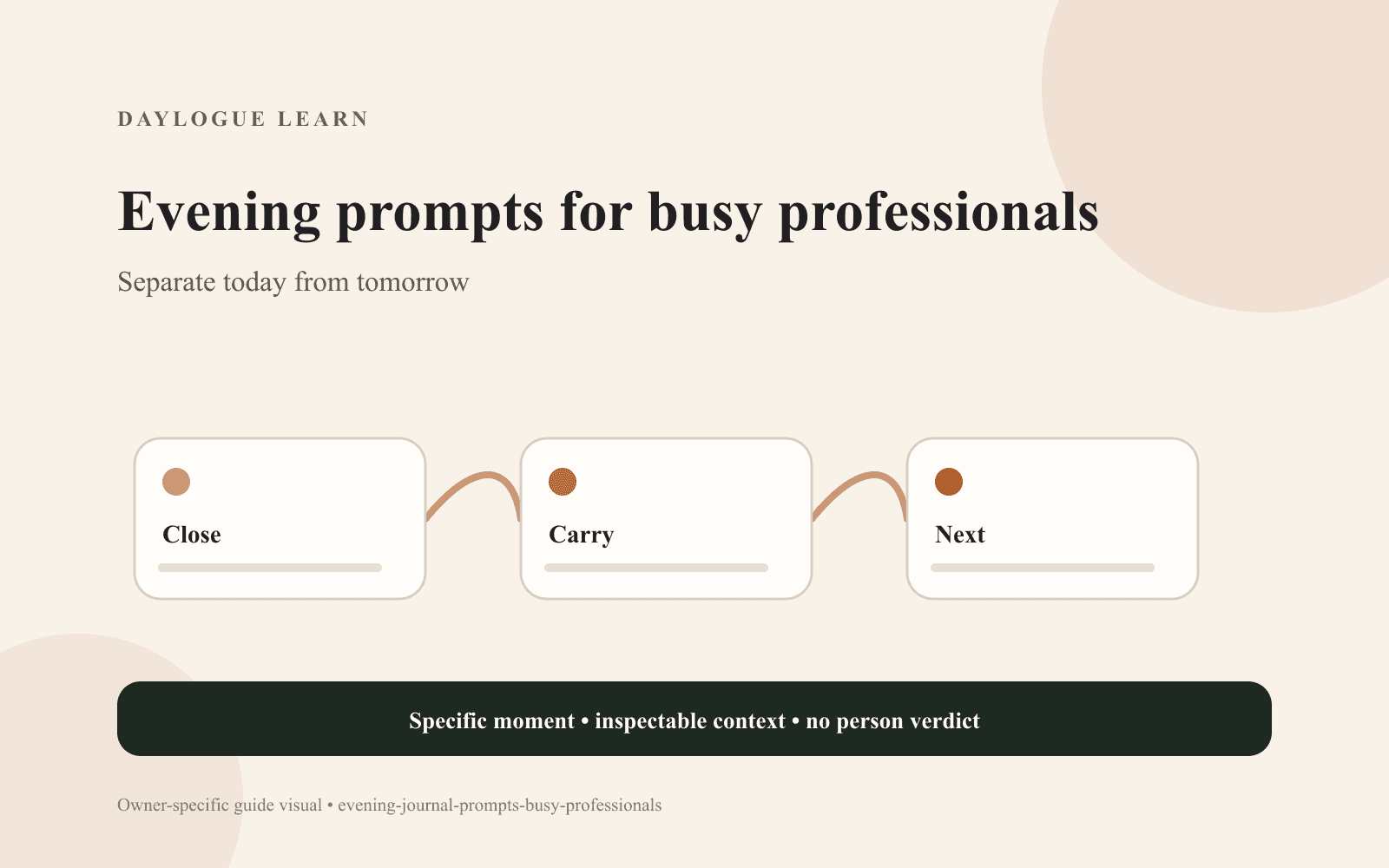
Sort the day into close, carry, and next
Close names something that reached a sufficient stopping point. Carry names the thought, feeling, or uncertainty still present after work. Next names the smallest action or question that can reopen the work later. These categories reduce the pressure to keep rehearsing every unfinished item in memory.
Not every entry needs all three categories. Some days have a clean close and no next step. Other days need one line about what is being carried. The format remains flexible because the goal is an accurate transition, not a nightly completion ritual.
Compare endings without rewriting the day
A recurring overlap does not show that one thing caused another. Several entries that mention late calls and difficulty closing the day can support a question about timing or boundaries. They cannot establish that the calls caused the experience. Original notes, dates, and exceptions keep the interpretation within the evidence.
An evening review benefits from matching like with like. Compare travel days with travel days, release weeks with release weeks, or evenings after the same recurring meeting. Notice what changed in ownership, duration, preparation, or available support. The full-day context matters more than a repeated closing phrase.
Choose what work follows you into the journal
Your journal entries and check-in notes are stored on our servers in readable form, protected in transit by TLS and by per-user access controls in the database. Daylogue is not end-to-end encrypted because its servers read entries to create narratives and pattern candidates. An evening note can include work and relationship details, so that boundary deserves a clear place in the decision.
General language can preserve the thread without copying confidential content. “A customer concern changed the timeline” may be enough. A role can replace a name. A private identifier can stay out of the entry entirely. The writer chooses the level of detail after considering storage, processing, access, training terms, deletion, and export.
Three endings that need different prompts
After a decision-heavy day, “Which detail will matter when I return?” can save the next opening point. After a tense conversation, “What words actually stand out?” keeps observation separate from the story that grew around it. After a satisfying day, “What is complete enough?” can acknowledge progress without turning gratitude into a requirement.
On an overloaded day, the most useful line may be “The remaining work belongs to tomorrow.” On a quiet day, it may be a small change that would otherwise disappear. These are different uses of an evening journal. They create distinct records instead of a repeated formula about closing every day in the same way.
Prompt Pack
Close, carry, and next evening prompts
Eight optional questions for marking a stopping point without grading the day.
- What is complete enough to leave here?
- What am I still carrying from work?
- Which detail will matter when I return?
- What changed after the plan was made?
- Which conversation is still replaying, and what words stand out?
- What belongs to tomorrow rather than tonight?
- What went better than the loudest part of the day suggests?
- What can stay unresolved for now?
Common questions
How long can an evening entry be?
A few lines can be enough to name what is closed, what is still being carried, or what comes next.
Does every evening need a journal entry?
No. The practice can be used when a closing note feels useful, and a return can start with the present day.
How can I review evening entries?
Compare similar kinds of days while keeping dates, workload, ownership, and exceptions visible.
Can evening notes prove why work was hard to leave behind?
No. They preserve timing and context. Repeated overlap can guide a question but cannot establish cause.
How much work detail belongs in an evening note?
The amount is a personal choice informed by confidentiality and the journal service’s storage, processing, access, deletion, and export practices.
Sources
Sources were checked on the dates shown. Product details and policies can change.
- Daylogue evidence and methods · Daylogue · checked August 21, 2026
- Daylogue privacy policy · Daylogue · checked August 21, 2026
Keep exploring
Daylogue Knowledge Center
Browse practical guides for reflection, journaling, patterns, and privacy.
Read moreHow Daylogue shows patterns
See how candidate patterns stay connected to evidence and correction.
Read moreWhy Daylogue exists
Read the principles behind a system for self-understanding.
Read moreDaylogue is not therapy and is not a replacement for professional care.