Written by Daylogue Editorial Team. Published August 26, 2026. Reviewed and updated August 26, 2026.
Evening journal prompts for parents and caregivers are brief questions used to capture one moment, one need, and one detail to carry forward before the day closes. They do not require a full diary entry, a gratitude list, or a positive ending. A useful set might ask what took the most attention, what support was missing, what can wait, and what small moment you want to remember. Write for two to five minutes, protect the privacy of children and care recipients, and skip any night when rest or immediate care matters more.
The prompt gives a crowded day one small container
Caregiving days often contain several stories at once: a hard handoff, an appointment, an ordinary joke, a meal nobody finished, or ten quiet minutes that mattered. An evening prompt does not ask you to summarize all of them. It gives one scene enough room to remain recognizable. The prompt might be ‘What took most of my attention?’ or ‘Which moment do I want tomorrow-me to remember?’ A short answer counts. So does ‘Nothing I want to write tonight.’ The page is available, not another obligation that measures how well you cared for someone.
Use four questions without requiring four answers
Ask what happened, what you needed, what can wait, and what you want to carry forward. ‘What happened?’ anchors the record in a scene. ‘What did I need?’ can reveal a practical gap without blaming you for not filling it alone. ‘What can wait?’ gives unfinished tasks a boundary. ‘What do I want to carry?’ makes room for a funny phrase, a small success, a hard truth, or no special meaning at all. Choose one question when energy is low. The practice should fit the evening instead of asking the evening to fit the practice.
Let care and frustration appear on the same page
An affectionate moment can sit beside anger, boredom, grief, relief, resentment, or numbness. Mixed feelings do not cancel one another and do not prove anything final about your character or relationship. Avoid prompts that require ‘the best part’ or demand gratitude after every difficult day. If you want to note something you appreciated, make it optional and specific. ‘The nurse explained the schedule clearly’ preserves a real detail. It does not require you to call the entire day good or convert hard conditions into a lesson.
Protect the person whose day overlaps with yours
Caregiver notes can contain school, financial, legal, location, and family information about another person. Record only the detail needed for your own reflection. Use a role or neutral description instead of a name when identity is unnecessary. Keep account numbers, school records, intimate care details, and restricted documents in the appropriate system rather than a general journal. If the entry syncs to a service, inspect processing, access, sharing, retention, and deletion terms. Daylogue reads synced entries and is not end-to-end encrypted, so that boundary should shape what you include.
A missed evening stays missed
Leave gaps visible instead of backfilling them to protect a streak or make the record look complete. Memory reconstructed later is different from a note written near the moment. Leave the blank visible and begin with the next current scene. If the prompt keeps you awake, makes the day feel longer, or competes with care that needs your attention, close it. The assigned systematic review reports heterogeneous writing topics, protocols, comparison groups, and outcomes, and does not establish that a specific evening prompt improves sleep or caregiving outcomes. Fit and honest context are better tests than consistency.
Where Daylogue fits in the evening
Daylogue is a system for self-understanding. Pattern journaling is how it reads you. A short evening check-in can preserve what you choose to write or say and let patterns become questions you can inspect over time. It does not grade caregiving, infer love from consistency, or decide what a difficult night says about you. Daylogue does not infer emotion from faces, voice tone, or physiology. It works from the words and context people choose to share. Use the quickest version when that is all the evening has room for. Daylogue is not therapy and is not a replacement for professional care.
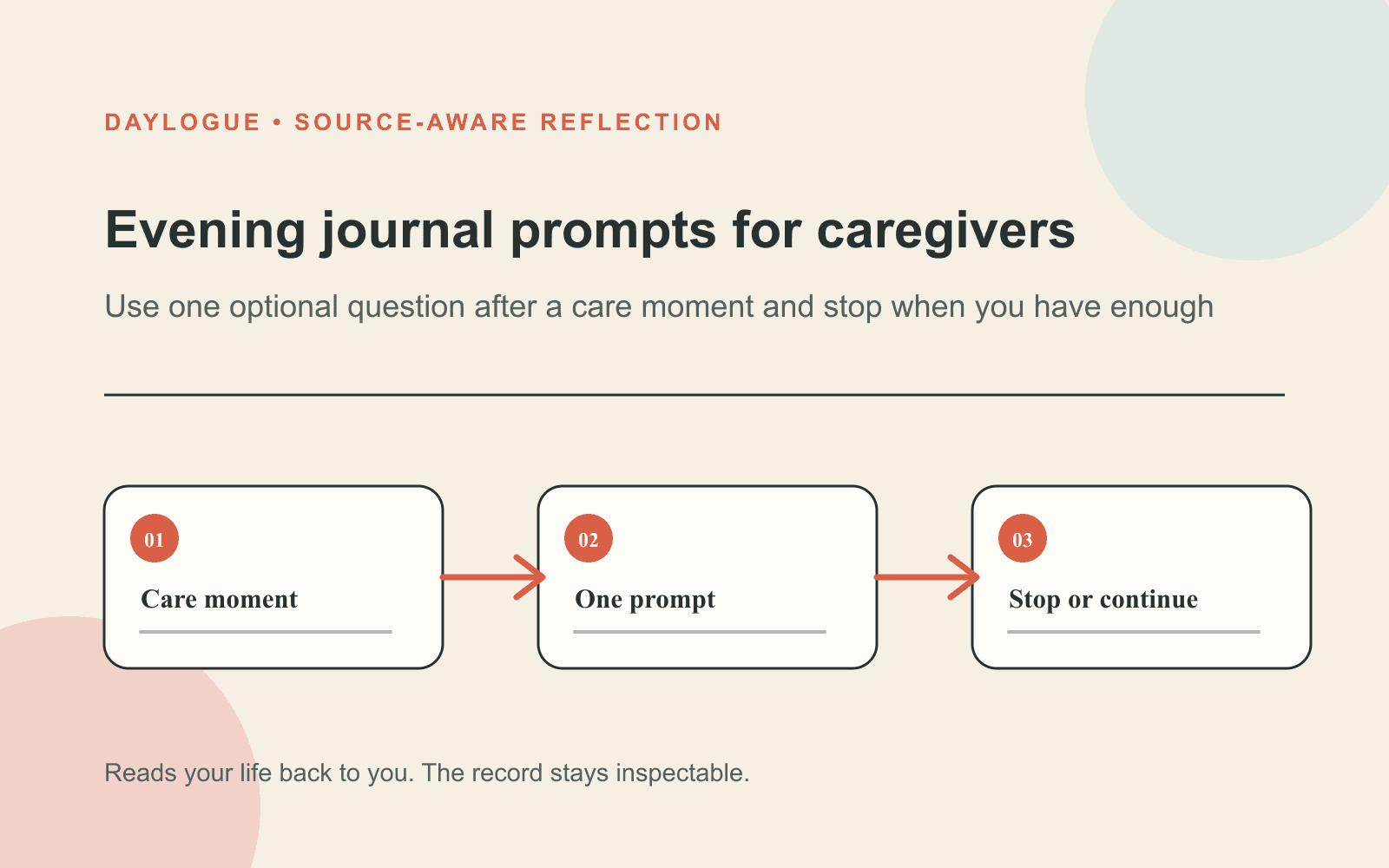
01
Choose one moment
Pick the scene still asking for attention instead of summarizing the entire day.
02
Name one need
Write what support, rest, information, or boundary was missing without turning it into self-blame.
03
Close without a lesson
Stop when the detail is preserved, even if nothing is resolved or made positive.
Prompt Pack
Five gentle evening prompts for caregivers
A small prompt set that preserves one scene, one need, and one return point without requiring gratitude, closure, or a streak.
- What took most of my attention today?
- Which scene do I want to remember accurately?
- What did I need that was not available?
- What can wait without becoming a failure?
- What small detail belongs in tomorrow's context?
Common questions
How long should a caregiver evening entry take?
Two to five minutes can be enough. One scene, one need, and one detail for tomorrow are a complete entry when energy is limited.
Do I need to write something positive every night?
No. An ordinary, mixed, difficult, or blank night is valid. Optional gratitude should never erase frustration or turn hardship into a required lesson.
Should I include my child's or care recipient's name?
Use only the identifying detail needed for your reflection. Keep health records, school information, account data, intimate care details, and restricted documents elsewhere.
What if I miss several evenings?
Leave the gap visible and start with the next current day. There is no streak to repair, and a reconstructed entry is different from a near-time record.
What if an evening prompt adds another demand?
Shorten the entry, move it earlier, or skip it. The practice should fit the evening, and choosing rest or immediate care creates no journaling debt.
Sources
Sources were checked on the dates shown. Product details and policies can change.
- Daylogue evidence and methods · Daylogue · checked August 26, 2026
- Daylogue privacy policy · Daylogue · checked August 26, 2026
- Positive expressive writing systematic review · PLOS One · checked August 26, 2026
Keep exploring
Daylogue Knowledge Center
Browse practical guides for reflection, journaling, patterns, and privacy.
Read moreHow Daylogue shows patterns
See how candidate patterns stay connected to evidence and correction.
Read moreWhy Daylogue exists
Read the principles behind a system for self-understanding.
Read moreDaylogue is not therapy and is not a replacement for professional care.