Written by Daylogue Editorial Team. Published September 2, 2026. Reviewed and updated September 2, 2026.
Exporting AI journal entries means creating a usable copy of journal writing and related files outside the account where they were created. For busy professionals, it can make room for keeping access to original writing when changing tools, making a backup, or reviewing what a service can return. The record stays bounded: it shows what was written and what context was available, while missing days and later revisions remain visible.
What exporting ai journal entries means
Exporting AI journal entries is creating a usable copy of journal writing and related files outside the account where they were created. The useful job for busy professionals is keeping access to original writing when changing tools, making a backup, or reviewing what a service can return. Its evidence remains concrete: file formats, included date ranges, attachments, transcript fields, and anything the export leaves out.
A useful workday example fits between meetings, a commute, or the end of a deadline-heavy day. An export is a copy of available data. It is not the same as a summary, an interpretation, or proof that every internal record was included. The page can stop after one honest line or remain unfinished.
A workday example
An export may contain dated text files and omit an attachment type. The useful record is the actual archive and its contents, not an assumption that every field moved. This keeps file formats, included date ranges, attachments, transcript fields, and anything the export leaves out close to the example rather than hiding the source behind a broad summary.
A second professional journal exporting note might come after a calendar change, handoff, or commute. It could disagree with the first note because workdays differ. That disagreement adds relevant circumstances to searchable files, dates, and attachments and supports keeping a usable outside copy without creating a score for the week.
| Part of the record | What it can clarify | What stays open |
|---|---|---|
| A dated source detail | What was actually written or recorded | What was not captured that day |
| Relevant surrounding context | Which conditions were present | Whether those conditions caused the scene |
| A counterexample or later note | Where the first account changed | Which account will fit a future date |
What professional journal exporting can and cannot show
Professional Journal Exporting can preserve a dated source and make searchable files, dates, and attachments easier to revisit. It can show that certain details appeared together or that wording revised across entries. Professional Journal Exporting cannot prove that one detail caused another, and it cannot establish a next-day effect from a same-day record.
A file can be complete but awkward to use. That limit matters for professional journal exporting because a confident sentence can sound stronger than the evidence behind it. A counterexample, absent date, or a later correction may narrow the wording. None of those changes turns the earlier entry into a mistake.
- Professional journal exporting may include a date, scene, and chosen chosen detail.
- Professional journal exporting may leave an uncertain word or unavailable field visibly unresolved.
- Professional journal exporting can hold a counterexample beside a recurring observation.
- Professional journal exporting is not enough to turn a recap into proof of cause or intent.
One low-pressure workweek approach
One low-pressure starting point for professional journal exporting is a single scene connected to searchable files, dates, and attachments. The written scene might include what happened, what stood out, and what remains unknown. An working account can appear on its own line if that separation feels practical. The note may end there.
Professional Journal Exporting doesn’t require a schedule or attendance target. a later entry can return to searchable files, dates, and attachments, add a different scene, or leave the first note alone. Saving, revising, exporting, or stopping are all valid endings when the purpose is keeping a usable outside copy.
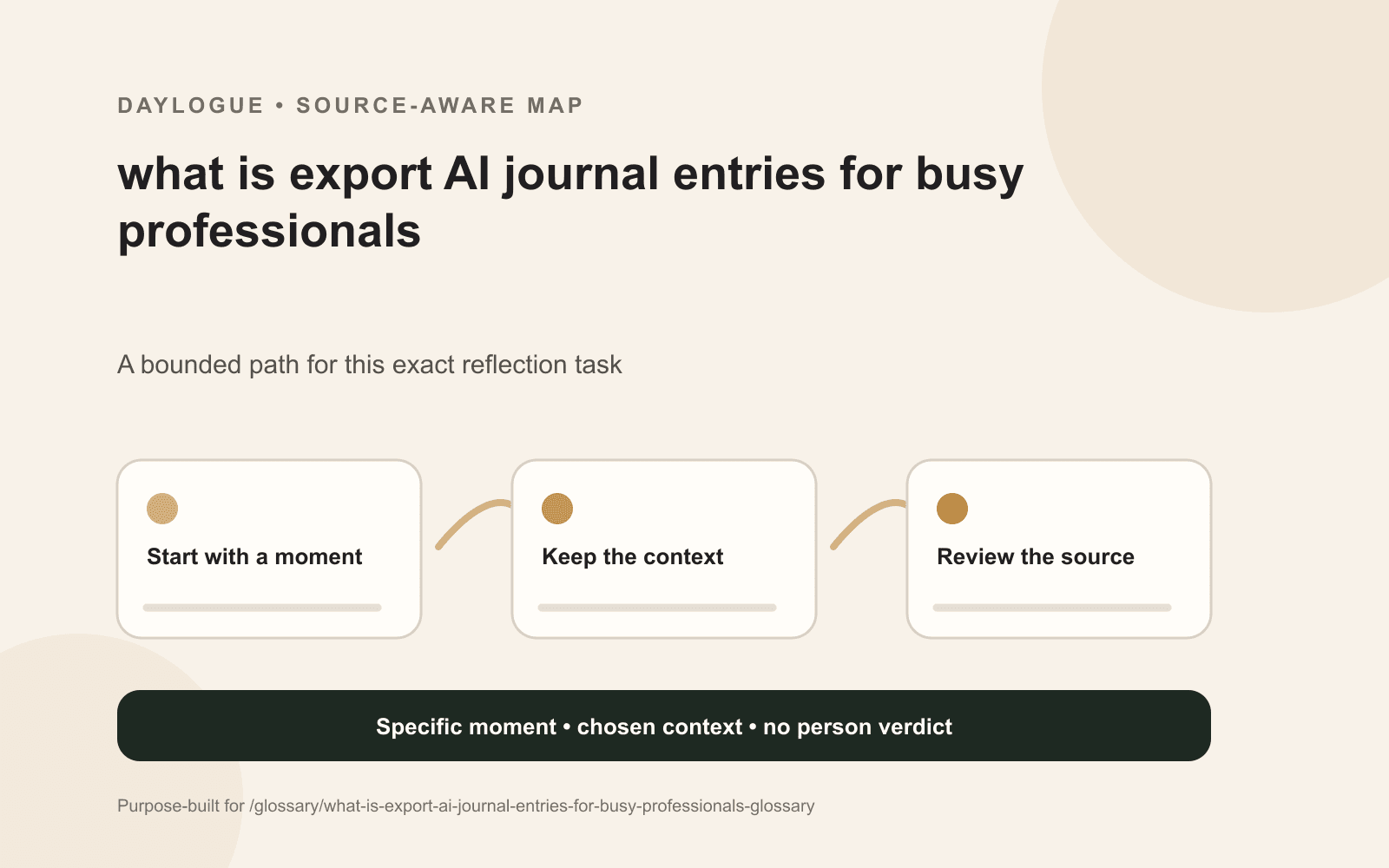
01
A scene, if worthwhile
One available start is a exact moment related to searchable files, dates, and attachments, with the time window kept as narrow as the person writing prefers.
02
A dated detail
The dated page may hold one phrase, date, condition, or change that helps professional journal exporting remain tied to what was actually recorded.
03
An working account, if wanted
A current reading can sit separately from the source, which leaves room for uncertainty and a future-note correction.
04
An ending without pressure
The saved note may be saved, revised, exported, compared on a return, or simply left as it is. No follow-up task is required.
Returning to professional journal exporting in a future note
The next review of professional journal exporting can start with the original source rather than a recap. A person may notice that searchable files, dates, and attachments stayed similar, revised, or was never recorded consistently enough to compare. Each of those outcomes is information. None requires a better-or-worse label.
Dates keep professional journal exporting from sounding permanent. A theme found in one window may disappear in another, while a counterexample may reveal a narrower condition. This is how professional journal exporting may make room for keeping a usable outside copy: the dated material stays ready for revision without erasing its earlier language.
Privacy and control around professional journal exporting
Privacy around professional journal exporting depends on defined account, device, processing, export, and sharing boundaries. The word private cannot describe all of those paths on its own. Current product disclosures can help a writer decide what feels appropriate to record and where.
Work-related professional journal exporting may also contain confidential names, plans, or customer details. A person can choose a smaller amount of nearby facts, a personal device, or no digital record at all. Workplace rules and account ownership still shape what belongs in a private reflection.
How professional journal exporting changes across situations
A crowded Monday gives professional journal exporting one kind of test: can searchable files, dates, and attachments be recorded without converting the entire day into a conclusion? In that scene, professional journal exporting may hold one recorded detail and one uncertainty. The point of professional journal exporting is keeping a usable outside copy, so everything else may remain outside the saved note. A afterward note may add setting without repairing the Monday version.
A quiet weekend gives professional journal exporting a different shape. With fewer schedule cues, searchable files, dates, and attachments may sound different or may not appear at all. That absence cannot be read as make the earlier professional journal exporting entry wrong. It simply gives professional journal exporting another source scene for keeping a usable outside copy. The two entries can be left side by side without a winner.
A shifted plan can make professional journal exporting more narrow. Instead of summarizing the day, the person writing may notice how searchable files, dates, and attachments shifted when the setting shifted. professional journal exporting can preserve the before-and-after wording while leaving cause open. That is enough for keeping a usable outside copy. The reflection is not meant to need to decide what the change says about the person.
An unfinished note still belongs inside professional journal exporting. Half a sentence, an uncertain date, or a not captured name may remain visible because searchable files, dates, and attachments does not by itself require polish. For professional journal exporting, the gap is part of the source. It supports keeping a usable outside copy by showing what was and was not available. A smooth replacement would tell a less honest story.
A counterexample keeps professional journal exporting grounded. When a similar scene produces different searchable files, dates, and attachments, professional journal exporting gains a clear limit rather than losing value. The contrast may narrow the original observation. It may also reveal a unrecorded condition. Either way, professional journal exporting continues keeping a usable outside copy with no need to make recurrence into certainty.
A return after several weeks may start wherever professional journal exporting is now. the person writing does not by itself owe the archive a recap of the absent time. searchable files, dates, and attachments may be enough for the new entry. In this way, professional journal exporting supports keeping a usable outside copy while making gaps ordinary. Continuity comes from honest dates, not perfect attendance.
Questions professional journal exporting can leave open
One usable question around professional journal exporting is whether searchable files, dates, and attachments came from the source or from a future-note working account. The answer may be left mixed. professional journal exporting works for keeping a usable outside copy when those layers stay visible. A current reading may sit beside the original detail without replacing it. That small separation keeps a future correction possible.
A missing day means only that no entry was available for review. Exporting AI journal entries cannot turn silence into a change, improvement, or hidden event. The gap can stay blank until the person chooses to add another dated source.
The timeframe around professional journal exporting also matters. searchable files, dates, and attachments found across three dates says something narrower than the same detail found across six months. professional journal exporting can name that window directly. This supports keeping a usable outside copy by preventing an old observation from sounding permanent. Newer entries may extend, narrow, or contradict it.
Privacy changes the practical meaning of professional journal exporting. searchable files, dates, and attachments may feel appropriate on a personal device but not on a shared screen or work-managed account. professional journal exporting has no universal storage answer. Particular access and processing disclosures can inform the choice. keeping a usable outside copy never requires recording more than feels appropriate.
A recap of professional journal exporting is most practical when it points back to searchable files, dates, and attachments. If the recap cannot lead to a source date, it may be too broad. professional journal exporting supports keeping a usable outside copy through traceable scenes, not confident labels. A summary can continue to be short, qualified, and still able to hold a counterexample. The source keeps the final say.
The ending of professional journal exporting can be quiet. searchable files, dates, and attachments may be saved, revised, exported, compared on another reading, or left alone. None of those endings creates an obligation. professional journal exporting has already served keeping a usable outside copy when the source moment is easier to recover. A new task is optional, and a new entry is optional too.
Evidence and working account limits
A 2019 study of 395 young adults found that the relationship between narrative coherence and well-being was more complex than a simple universal benefit. That limit matters here because a clean story can feel satisfying without being the only accurate reading of a week. Fragments, revisions, and contradictions can remain in the record.
You can request an export or account deletion. The category describes a product purpose and a mechanism. It does not turn this glossary definition into a promise about a person or an instruction about what should happen next.
A practical export check for a work journal
A professional export may need to survive a job change, a device replacement, or the end of a subscription. The most reassuring test is ordinary: open several dated files without the original app. Search for a project name, inspect the line breaks, and confirm that the timestamps still make sense. A usable copy should work outside the account that created it.
Attachments deserve their own export check. A text file may arrive correctly while a photo, audio note, or document link is absent. For a professional archive, that difference can change the meaning of an entry. The export can list which media traveled with the writing and which items require a separate download.
Work journals often contain names, client details, or confidential plans. An export creates another copy of that material, with its own storage and access choices. A person might keep a narrower archive, remove unnecessary identifiers, or choose an encrypted device folder they already understand. The export itself does not decide where the copy belongs.
File format affects what happens next. Plain text is easy to search, PDF preserves appearance, and structured formats may support another journal service. None is automatically best. The right format depends on whether the future need is reading, searching, printing, or importing, and more than one format may be appropriate.
A spot check can be small. Three distant dates, one long entry, one short entry, and one attachment may reveal obvious gaps. If something is missing, the original account can remain available while the copy is made again. The check is about preserving access, not producing a flawless archival project.
Export and deletion stay separate. Keeping an outside copy does not show that the source account or its derived records were removed. A professional can decide on those actions independently and consult the current policy for each scope. That separation keeps a backup choice from being mistaken for a deletion promise.
When professional journal exporting can fit
Professional Journal Exporting may be usable when the immediate need is keeping a usable outside copy. It may be less usable when the situation calls for urgent action, an official record, or a conversation that cannot wait. The journal may preserve reflection without pretending to replace those other paths.
A gap creates no debt in professional journal exporting. The next entry can open with the current scene and searchable files, dates, and attachments. If nothing more needs to be said, the dated page can close there. The value comes from preserving grounded setting, not from producing a perfect story.
Decision Table
Professional Journal Exporting reflection card
A choice-preserving card for professional journal exporting, with space for searchable files, dates, and attachments, uncertainty, a counterexample, and a revisited correction.
- Current purpose: keeping a usable outside copy.
- Chosen detail: one phrase, date, event, or condition connected to searchable files, dates, and attachments.
- Background: only the surrounding details that help the note make sense.
- Current reading: optional, separate from the source, and flexible enough for correction.
- Limit: what this entry cannot establish.
- Counterexample: a similar moment that turned out differently.
- Privacy choice: account, device, processing, export, and sharing boundaries.
- Ending: save, revise, export, compare on a return, or leave the note alone.
Common questions
What does professional journal exporting mean?
Exporting AI journal entries means creating a usable copy of journal writing and related files outside the account where they were created. It describes a way to keep information available for review, not a score, fixed verdict, or guaranteed result.
What is a small example of professional journal exporting?
A person downloads dated entries before changing apps, opens the files on another device, checks three older dates, and stores one backup in a chosen location. A single scene like that can be enough. That reflection may remain short, uncertain, or unfinished without losing its value.
How often does professional journal exporting need to happen?
Professional Journal Exporting has no required frequency. A person may write when searchable files, dates, and attachments becomes worth recording, return after a gap, or leave a single entry on its own.
How can professional journal exporting stay still able to hold correction?
The source date and original wording may be left visible beside a later note. A counterexample, no longer matching setting, or absent detail may then narrow the working account.
What are the limits of professional journal exporting?
Professional Journal Exporting reflects what was chosen and recorded. It cannot prove cause, reveal another person’s motive, or describe days and details that never entered the archive.
Sources
Sources were checked on the dates shown. Product details and policies can change.
- Daylogue privacy policy · Daylogue · checked September 2, 2026
- Narrative identity and psychological well-being research · National Library of Medicine · checked September 2, 2026
Keep exploring
Daylogue Knowledge Center
Browse practical guides for reflection, journaling, patterns, and privacy.
Read moreHow Daylogue shows patterns
See how candidate patterns stay connected to evidence and correction.
Read moreWhy Daylogue exists
Read the principles behind a system for self-understanding.
Read moreDaylogue is not therapy and is not a replacement for professional care.