Written by Daylogue Editorial Team. Published August 21, 2026. Reviewed and updated August 21, 2026.
Gratitude journal prompts for busy professionals are questions that help a specific act of support, moment of ease, or useful detail stay visible. One gratitude cue may be enough. The practice can sit beside frustration, fatigue, or disappointment. It does not require a positive lesson, and it does not ask a difficult day to become something else.
Keep gratitude specific rather than sweeping
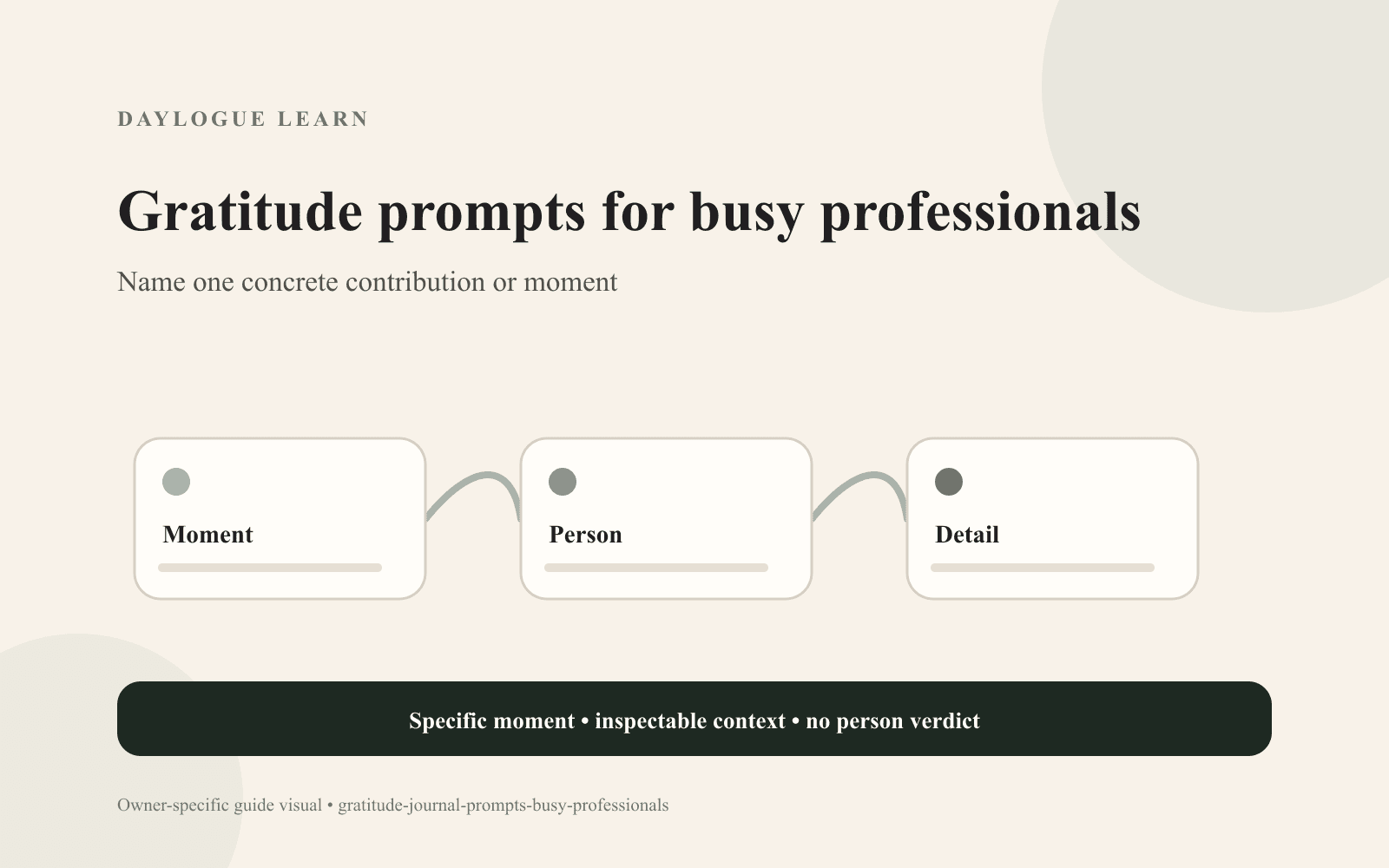
“A colleague sent the missing context before the meeting” is easier to trust and remember than “I am grateful for my team.” The first sentence names a person, action, and moment. It leaves room for the rest of the day to have been complicated. Specificity protects gratitude from becoming a performance of positivity.
The appreciated detail can be ordinary: a quiet ten minutes, a clear handoff, a meal someone prepared, or a question that slowed a rushed decision. None of these moments needs to carry a larger lesson. The entry can simply preserve what helped, what felt lighter, or what deserved notice.
A hard day can still contain one appreciated detail
Gratitude does not cancel frustration. A coworker may have been helpful while the workload remained unrealistic. A meeting may have ended with clarity after an uncomfortable exchange. Writing both facts keeps the record honest and prevents one appreciated moment from being used to dismiss what was difficult.
Some days may not offer a gratitude entry at all. A neutral observation can fit better: “The train was on time,” or “I had five uninterrupted minutes.” Another day may stay unwritten. The practice remains available without a quota or a requirement to find a bright side.
Review gratitude entries without forcing a story
A recurring overlap does not show that one thing caused another. Several notes about helpful handoffs on calmer days can suggest a question about clarity or support. They cannot prove why those days felt different. Entries that show support during difficult days are especially useful because they complicate a simple conclusion.
A review can group entries by the kind of support recorded: information, time, care, practical help, or a boundary. The original action stays visible. This makes it easier to notice what you value without turning the list into a ranking of people or a claim about what guarantees a good day.
Protect the privacy of people in the entry
Your journal entries and check-in notes are stored on our servers in readable form, protected in transit by TLS and by per-user access controls in the database. Daylogue’s servers read entries to create narratives and pattern candidates, so Daylogue is not end-to-end encrypted. Gratitude notes often involve other people, which makes identifying detail worth considering.
A role, initial, or general description may preserve the appreciated action without recording a full name, private conversation, or confidential workplace detail. The amount of context remains the writer’s choice. Storage, AI processing, training terms, staff access, deletion, export, and any organizational visibility can inform that choice.
Four grounded gratitude examples
After a chaotic launch, the note might be: “Mina caught a broken link before the customer email went out.” After a hard family call, it might be: “My brother waited while I found the words.” On a solitary day, it could be: “The late sun reached the desk for ten minutes.” Each entry points to a real moment rather than a required mood.
A final example can hold tension: “The deadline still felt unrealistic, and Priya clarified which part could move.” The appreciation does not erase the deadline problem. It records one helpful action inside a mixed experience. That is enough. Gratitude can remain a detail rather than becoming a verdict on the day.
Prompt Pack
Grounded gratitude prompts for mixed days
Eight optional questions for noticing a person, moment, or detail without forcing positivity.
- Who made one part of today easier, and what did they do?
- What useful detail arrived at the right time?
- Which ordinary comfort did I notice today?
- What boundary or clear answer helped?
- What work did someone else carry that I might have overlooked?
- Which moment felt less rushed than expected?
- What can I appreciate without changing how I feel about the whole day?
- What would I like to remember to acknowledge directly?
Common questions
What counts as a gratitude journal entry?
A specific person, action, object, or moment that felt helpful or worth noticing can be enough.
Does gratitude require feeling positive about the whole day?
No. Appreciation and frustration can appear in the same entry without canceling each other.
What if nothing feels appropriate to record?
The page can remain blank, or a neutral detail can be noted. There is no gratitude quota.
Can repeated gratitude entries show what causes a better day?
No. They can reveal what was present in recorded moments, while cause remains open.
How can I protect another person’s privacy?
A role, initial, or general description may preserve the action without including a full name or private detail.
Sources
Sources were checked on the dates shown. Product details and policies can change.
- Daylogue evidence and methods · Daylogue · checked August 21, 2026
- Daylogue privacy policy · Daylogue · checked August 21, 2026
Keep exploring
Daylogue Knowledge Center
Browse practical guides for reflection, journaling, patterns, and privacy.
Read moreHow Daylogue shows patterns
See how candidate patterns stay connected to evidence and correction.
Read moreWhy Daylogue exists
Read the principles behind a system for self-understanding.
Read moreDaylogue is not therapy and is not a replacement for professional care.