Written by Daylogue Editorial Team. Published August 12, 2026. Reviewed and updated August 12, 2026.
A journal app that finds patterns compares details across entries to surface situations that appear together or keep returning. For someone coming back after a break, it should not read missing days as a negative signal or demand a restored streak. Start with current entries. When a possible pattern appears, inspect the examples, look for exceptions, and note what the gap prevents you from knowing. A repeated overlap can support a question, but it does not prove a cause or define the person who wrote it.
Pattern-finding apps compare moments across time
A standard journal stores entries. A pattern-finding journal also compares parts of the record, such as self-reported mood, stress, sleep, tags, themes, or recurring time slots. The output may say that two things often appear together in the available entries. The helpful version points back to the underlying moments so you can see what supports the observation and what may be missing.
Daylogue is a system for self-understanding. Pattern journaling is how it reads you. One example the product documents is your stress running higher on the nights you logged under six hours, using sleep and stress from the same self-reported check-in. That wording does not claim a next-day effect, a wearable reading, or proof that sleep caused the stress.
A break changes coverage, not your standing
When entries stop, the app has less information about that period. It should not fill the gap with assumptions. An empty span does not tell you what happened, how things were going, or why the record stopped. It means the record is absent. A careful pattern view marks that limit instead of smoothing the empty space into a continuous story.
You do not need to backfill every unrecorded date. Start with today and add context about the return if it matters: “I came back because late meetings have been on my mind.” Over the next few entries, use the same plain labels when the same situation appears. Consistent wording helps comparison without forcing every day into a fixed form.
Inspect examples, exceptions, and missing context
A candidate pattern should show the moments behind it. Read the examples and ask whether they refer to the same kind of situation. Then look for an exception. If three tense evenings followed late schedule changes but one did not, the exception may reveal a condition that matters. It may also show that the first pattern statement was too broad.
A recurring overlap does not show that one thing caused another. Timing, selection, unrecorded events, and other factors can explain the same shape. Use causal language only when evidence supports it, which a personal journal usually does not establish. “Shows up alongside” and “appeared in the same entries” keep the observation close to what the record can defend.
| Check | Question |
|---|---|
| Examples | Can I open the entries behind the observation? |
| Exceptions | Which recorded moments do not fit? |
| Coverage | Which days or situations were not recorded? |
| Timing | Are the signals from the same entry or a supported time window? |
| Language | Does the wording describe overlap without claiming cause? |
A pattern is not a personality verdict
A record can show that you wrote about unclear ownership several times. It cannot establish that you are bad at collaboration, afraid of responsibility, or destined to repeat the situation. Those statements jump from events to identity. Keep the observation small enough to correct: “Unclear ownership appeared in three handoff notes this month.” Then decide whether that question deserves more attention.
Composite scores create a similar problem when they compress unrelated experiences into one number. Prefer the source details. Mood, stress, sleep, and a written event each tell a different part of the story. When the app shows them together, you should still be able to see the original labels, dates, and caveats rather than receiving a grade for the week.
- Prefer “appeared in three entries” to “this is who I am.”
- Keep self-reported fields labeled as self-reported.
- Mark missing days as unknown rather than neutral.
- Correct a label or summary that changes your meaning.
Check what the system reads and what you can correct
Pattern features require access to a record. Daylogue says its servers read entries, structured metrics, and generated outputs to write narratives and surface patterns. It is not end-to-end encrypted. Read /privacy for the current details on server readability, access controls, processors, model training, exports, and deletion before deciding which parts of your life belong there.
Ask how an edit travels. Changing an entry may not automatically change every summary or pattern already generated from it. Look for controls to inspect evidence, correct the source, dismiss an observation, or contact support. The ability to disagree is part of a trustworthy reflection tool, not an edge case reserved for obvious errors.
Restart with a small, repeatable record
Choose one or two fields you can answer honestly and one sentence of context. For example, log stress, sleep hours, and the event that shaped the evening. Keep the same approach for a few entries, then review only when there is enough material to compare. If there is nothing to say, leaving the entry blank preserves the gap. Sparse entries are more useful than a streak built from guesses.
Daylogue is not therapy and is not a replacement for professional care. A pattern journal can help you notice recurring situations and remember the examples behind them. It cannot diagnose, predict your future, or tell you what to do. Use the observation as a question you own, and bring it to the right human conversation when that would help.
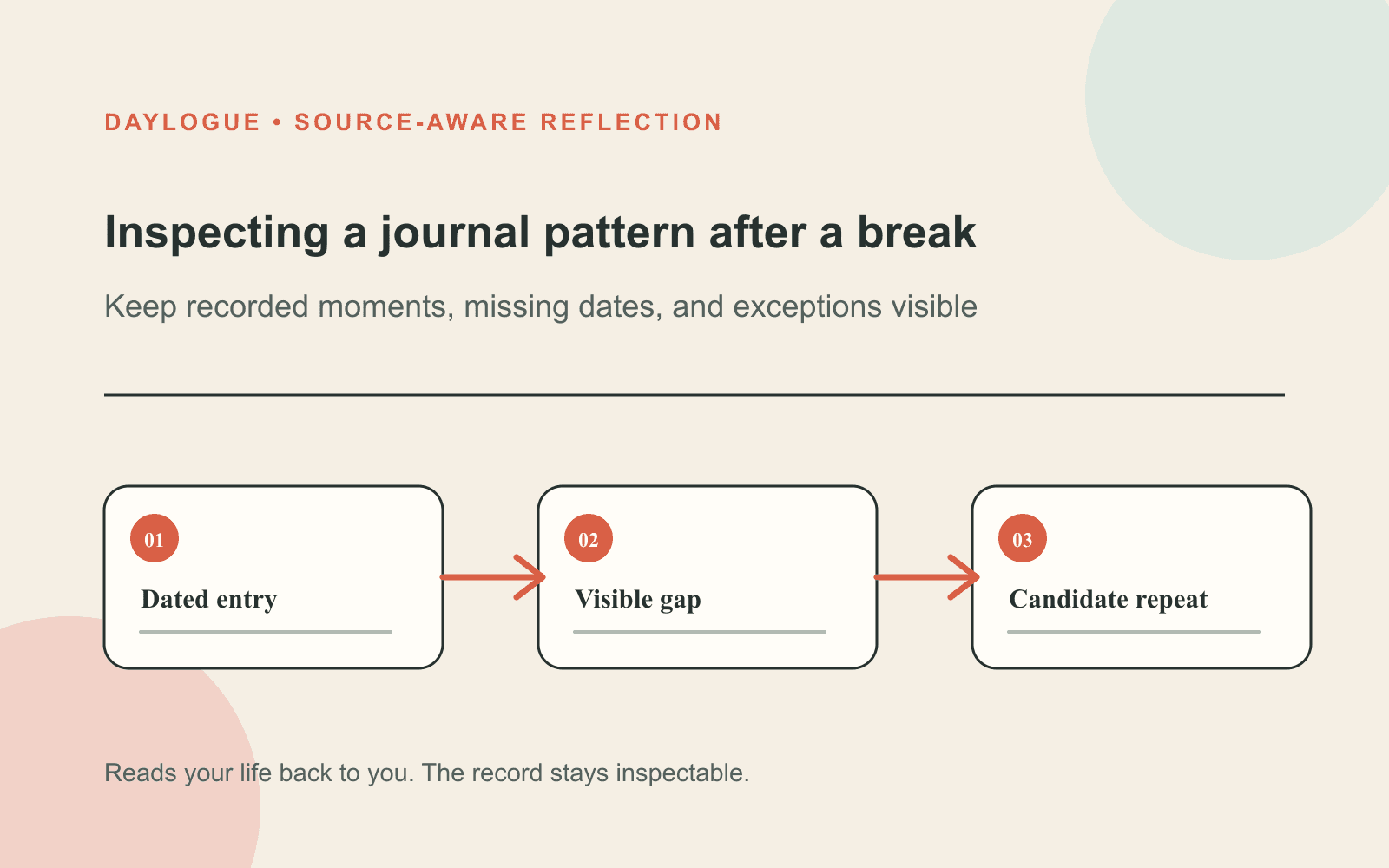
01
Begin with current entries
Leave the gap unfilled and record the moments, fields, and context that matter from this point forward.
02
Use consistent plain labels
Name repeated situations in ordinary language without assigning traits, scores, or causes.
03
Review the evidence
Open the examples, find exceptions, mark missing coverage, and revise the observation when the wording is too broad.
Checklist
Candidate pattern inspection checklist
Use this checklist to decide whether a proposed journal pattern stays close to the entries and honest about the gap.
- Open the specific entries or fields that support the observation.
- Find at least one recorded exception or state that none is available.
- Mark the dates and situations missing from the record.
- Confirm the timing described is the timing the product actually computed.
- Rewrite causal or identity language as a narrow overlap you can correct.
Common questions
Will a pattern app misread my journaling break?
A careful app should read the gap as missing information, not evidence of how someone felt, behaved, or was doing. Check how the product explains missing days.
Do I need to backfill old entries before patterns can appear?
No. Start with current entries. Backfill only when you have reliable notes and a clear reason, and label reconstructed memories as reconstructed.
Can a journal pattern prove what caused my stress?
No. Repeated overlap can suggest a question, but a personal record usually cannot isolate cause from timing, selection, missing entries, and other factors.
What should I inspect when an app shows a pattern?
Open the supporting entries, look for exceptions, check missing coverage and timing, confirm source labels, and make sure the language stays open to correction.
Sources
Sources were checked on the dates shown. Product details and policies can change.
- Daylogue evidence and methods · Daylogue · checked August 12, 2026
- Daylogue privacy policy · Daylogue · checked August 12, 2026
- Positive expressive writing systematic review · PLOS One · checked August 12, 2026
- Narrative identity and psychological well-being research · Frontiers in Psychology via PubMed Central · checked August 12, 2026
Keep exploring
Daylogue Knowledge Center
Browse practical guides for reflection, journaling, patterns, and privacy.
Read moreHow Daylogue shows patterns
See how candidate patterns stay connected to evidence and correction.
Read moreWhy Daylogue exists
Read the principles behind a system for self-understanding.
Read moreDaylogue is not therapy and is not a replacement for professional care.