Written by Daylogue Editorial Team. Published August 21, 2026. Reviewed and updated August 21, 2026.
Morning journal prompts for busy professionals are brief questions that capture the day’s starting conditions before the calendar gathers speed. One opening question may be enough. A morning note can name a priority, a boundary, or an uncertainty without becoming a promise about how the day must go. An evening comparison can show what changed without grading the difference.
Record the starting line, not a forecast
A morning note is most useful when it says what is true now. Energy may feel limited after a late night. One meeting may carry unusual stakes. A personal concern may already be competing for attention. Recording the starting conditions gives the day a reference point without pretending to know how events will unfold.
The note can be provisional. “The client conversation needs patience, and I have little space between calls” is specific enough to revisit. It does not obligate the writer to follow a perfect plan. When the day changes, the original note remains useful because it shows what was visible before the new information arrived.
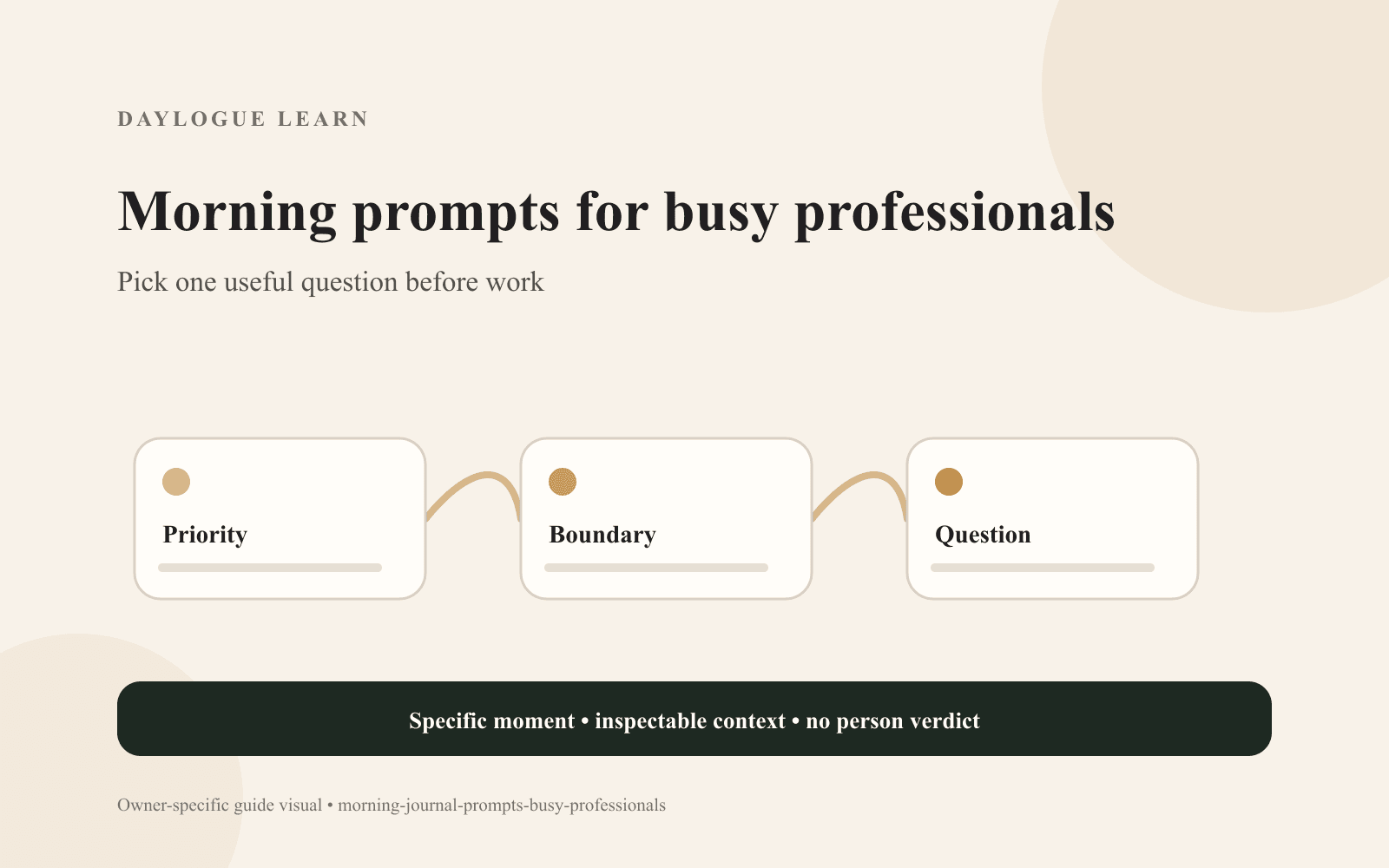
Use the three anchors: priority, boundary, question
Priority names what deserves care if the schedule shifts. Boundary names a limit around time, attention, availability, or scope. Question holds what is still uncertain. Together, those anchors can fit in three short lines and create a clearer starting record than a long list of ideal outcomes.
A priority is not always the largest task. It might be listening closely in one conversation. A boundary might be leaving five minutes between calls or declining a new request until ownership is clear. A question might be whether a deadline can move. The answers belong to this morning, and they can change when the facts change.
Compare the morning note with the evening record
At day’s end, the useful question is often “What changed?” rather than “Did I succeed?” A priority may have remained steady while the plan changed. A boundary may have been easy to hold in one setting and difficult in another. That difference gives the entry context without turning the day into a scorecard.
A recurring overlap does not show that one thing caused another. If low morning energy and crowded calendars appear together in several notes, the record can support a question about those conditions. It cannot establish cause. A calmer day with similar energy, or a busy day that felt manageable, deserves equal space in the review.
Keep morning details at the level you choose
Your journal entries and check-in notes are stored on our servers in readable form, protected in transit by TLS and by per-user access controls in the database. Daylogue’s servers read entries to create narratives and pattern candidates, so Daylogue is not end-to-end encrypted. That boundary matters when a morning note includes names, calendar details, health information, or confidential work.
A morning entry can stay useful with general descriptions. “A family concern is competing for attention” may preserve enough context without identifying another person. “The launch decision has changed inputs” may be enough without copying confidential numbers. Privacy knowledge helps the writer select detail; it does not require more disclosure.
Three morning-to-evening workflows
On a packed-call day, the morning note could name one conversation that needs patience and one gap worth protecting. In the evening, the comparison records whether the gap existed and what changed when it did not. The entry remains about timing and attention, not a verdict on discipline.
On a travel day, the morning question might be “What can be good enough?” On a decision day, it might be “Which assumption needs checking first?” These prompts produce different records because the work differs. Their value comes from preserving the starting point and later change, not from repeating the same polished routine each morning.
Prompt Pack
Morning priority, boundary, and question prompts
Eight optional openings for recording the day’s starting point without turning it into a performance contract.
- What is already taking up space this morning?
- Which commitment matters most if the day changes?
- What energy am I bringing into the first meeting?
- Where might a clearer boundary help?
- What can be good enough today?
- Which conversation needs patience rather than speed?
- What am I assuming before the day begins?
- What would I like to remember when work ends?
Common questions
How long can a morning journal entry take?
A few sentences can be enough to name a priority, boundary, or open question. Longer writing remains optional.
Does a morning note create a commitment for the whole day?
No. It records the starting point. Plans, capacity, and priorities can change as new information arrives.
How can I compare morning and evening entries?
Place the original morning note beside what actually happened. Notice what stayed steady, what changed, and which conditions were different.
Can morning entries show what caused the day to feel a certain way?
They can preserve timing and context, but repeated overlap alone does not prove cause. Counterexamples keep the review grounded.
What belongs in a private morning note?
The level of detail is a personal choice informed by the service’s storage, access, AI-processing, deletion, and export practices.
Sources
Sources were checked on the dates shown. Product details and policies can change.
- Daylogue evidence and methods · Daylogue · checked August 21, 2026
- Daylogue privacy policy · Daylogue · checked August 21, 2026
Keep exploring
Daylogue Knowledge Center
Browse practical guides for reflection, journaling, patterns, and privacy.
Read moreHow Daylogue shows patterns
See how candidate patterns stay connected to evidence and correction.
Read moreWhy Daylogue exists
Read the principles behind a system for self-understanding.
Read moreDaylogue is not therapy and is not a replacement for professional care.