Written by Daylogue Editorial Team. Published August 11, 2026. Reviewed and updated August 11, 2026.
Morning journal prompts for parents and caregivers are brief questions used at the start of the day to notice capacity, choose one priority, or prepare for a likely pressure point. They work best when they fit the morning you actually have. One sentence before breakfast or a handoff can stand on its own. The prompt should clarify what matters without demanding gratitude, calm, or a perfect plan.
Morning caregiver prompts, in plain language
A morning caregiver prompt is a small writing cue for the hours ahead. It can capture your available energy, the task that matters most, a boundary you may need, or one thing you do not want to carry alone. It is not a forecast of how the day will go. The entry records your perspective before appointments, school runs, medication schedules, work, and other demands begin to compete for attention.
One prompt for the morning in front of you
Different mornings call for different questions. A capacity prompt helps when the schedule is packed. A handoff prompt preserves the detail another person needs. A boundary prompt names what can wait. A connection prompt can hold a small moment you want to make room for. One prompt can match the morning without asking a single entry to organize the whole day.
| Morning need | Prompt | What it preserves |
|---|---|---|
| Capacity | What do I realistically have room for? | A limit before requests arrive |
| Priority | What needs my attention first? | One choice without a full-day verdict |
| Handoff | What does the next caregiver need to know? | Useful context without a complete recap |
| Boundary | What can remain unfinished today? | Permission to leave a task open |
| Connection | What small moment would I like to notice? | An intention without forced positivity |
A two-minute morning entry
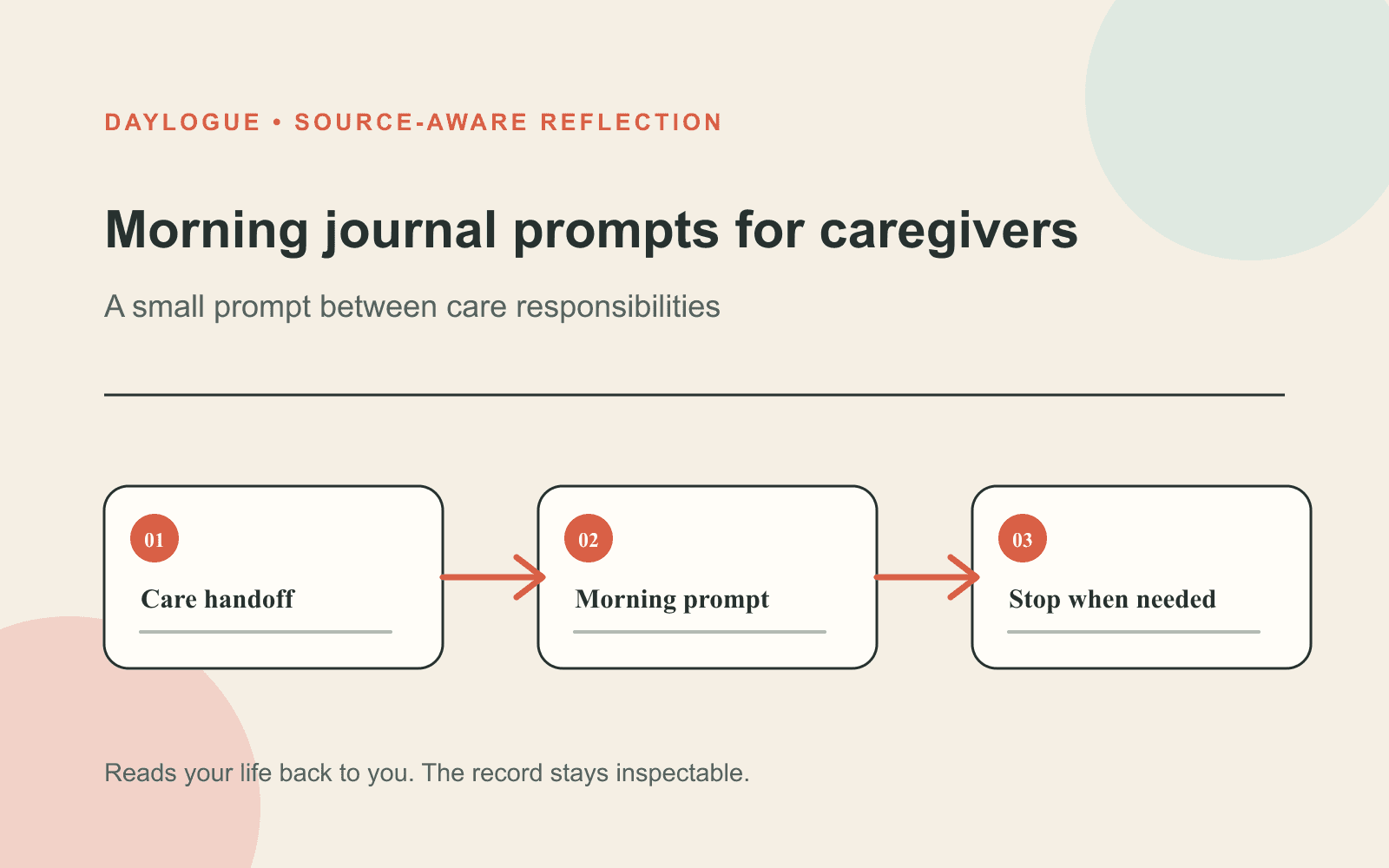
The shortest version that still feels true may be enough. The entry can hold the condition you are walking into, one point of attention, and what could change the plan. A note such as “The appointment is the priority, I am already tired, and dinner can be simple” stands on its own. If the morning interrupts you after one line, that single line can remain as it is.
01
The starting point
The schedule, available energy, uncertainty, or care task can show what is shaping this morning.
02
One focus
One task, boundary, handoff, or connection can stay visible in the entry today.
03
Room to change
One condition that could alter the plan keeps the entry flexible rather than predictive.
A hard morning is not a verdict
“I am starting with very little patience” describes a moment. “I am a bad parent” turns that moment into an identity claim. Observable context can include sleep, timing, support, interruptions, and what changed. A rough start can be worth recording without becoming evidence about your character. A calmer morning is not proof that you finally solved caregiving either.
What writing research does not establish
A 2025 systematic review examined 51 studies across seven positive writing techniques. Every study included in the 2025 systematic review was rated poor or fair in quality. The methods and outcomes varied. That review did not test this specific two-minute morning practice for parents and caregivers. It cannot show that a morning prompt will lower stress, improve care, or change how the rest of the day unfolds.
The morning record stays yours
Caregiving notes often include another person’s schedule, school information, health details, or private behavior. Roles or initials can reduce unnecessary identifiers. An online journal's storage, processing, export, and deletion terms show what happens to those details. Daylogue reads entries and structured fields server-side to write narratives and surface patterns, and it is not end-to-end encrypted. Daylogue says personal entries are not used to train AI models.
Daylogue is a system for self-understanding. A morning note might say, “The appointment is the priority, I am already tired, and dinner can be simple.” That check-in can sit beside later notes when continuity across days matters and the processing model fits your situation. Paper may be a better fit when an offline boundary matters more.
Prompt Pack
Eight morning prompts for care-heavy days
One question can fit the morning you have, with an answer that stays brief, specific, and open to whatever changes next.
- What do I realistically have room for today?
- What needs my attention first, and what can wait?
- What does the next caregiver need to know?
- Where might I need to ask for help earlier?
- What can remain unfinished without becoming a failure?
- What small moment would I like to notice?
- What am I assuming about today that I cannot know yet?
- What detail belongs to me, and what detail is not mine to record?
Common questions
What is a good morning journal prompt for a busy caregiver?
“What do I realistically have room for today?” is one option. One priority and one thing that can remain unfinished can share the answer.
How long should a caregiver morning journal entry be?
One sentence can be enough. A useful entry preserves your starting point and one focus without creating another task to complete.
What if the morning changes right after I write?
The entry can remain a record of what you knew at the time. A later note may add context without rewriting the morning into a prediction that came true.
Do morning journal prompts reduce caregiver stress?
The assigned sources do not establish that outcome. The cited review studied varied positive writing practices, not this specific caregiver morning routine.
How can I protect family privacy in a morning journal?
Names and identifying details that do not help your own record can stay out. Storage, processing, export, and deletion terms show how sensitive information is handled.
Sources
Sources were checked on the dates shown. Product details and policies can change.
- Daylogue evidence and methods · Daylogue · checked August 11, 2026
- Daylogue privacy policy · Daylogue · checked August 11, 2026
- Positive expressive writing systematic review · PLOS One · checked August 11, 2026
- Narrative identity and psychological well-being research · Frontiers in Psychology via PubMed Central · checked August 11, 2026
Keep exploring
Daylogue Knowledge Center
Browse practical guides for reflection, journaling, patterns, and privacy.
Read moreHow Daylogue shows patterns
See how candidate patterns stay connected to evidence and correction.
Read moreWhy Daylogue exists
Read the principles behind a system for self-understanding.
Read moreDaylogue is not therapy and is not a replacement for professional care.