Written by Daylogue Editorial Team. Published September 2, 2026. Reviewed and updated September 2, 2026.
No-streak journaling means a reflection practice with no attendance score, streak counter, or penalty for time away. For beginners, it can make room for returning after a missed day, a crowded week, or a long pause without treating the gap as failure. The record stays bounded: it shows what was written and what context was available, while missing days and later revisions remain visible.
What no-streak journaling means
In plain language, no-streak journaling is a reflection practice with no attendance score, streak counter, or penalty for missing a day. Its practical purpose is to make returning feel ordinary after a missed day, a busy week, or a long pause. The definition names a method and its boundaries, not a promise about what any individual entry will reveal.
The smallest useful version can be modest. It may contain the date of the new entry, the scene that brought the writer back, the detail worth keeping, and anything that remains uncertain. A writer can leave any part out when it does not fit the moment.
A beginner-scale example
A new journaler closes a notebook during exams and opens it again three weeks later with one sentence about the bus ride home. The example stays close to a particular source rather than stretching one moment into a claim about the whole person.
What matters is the boundary around the record. The writer knows what was captured, what was added later, and what never entered the note. That leaves room for a different entry to tell a different story.
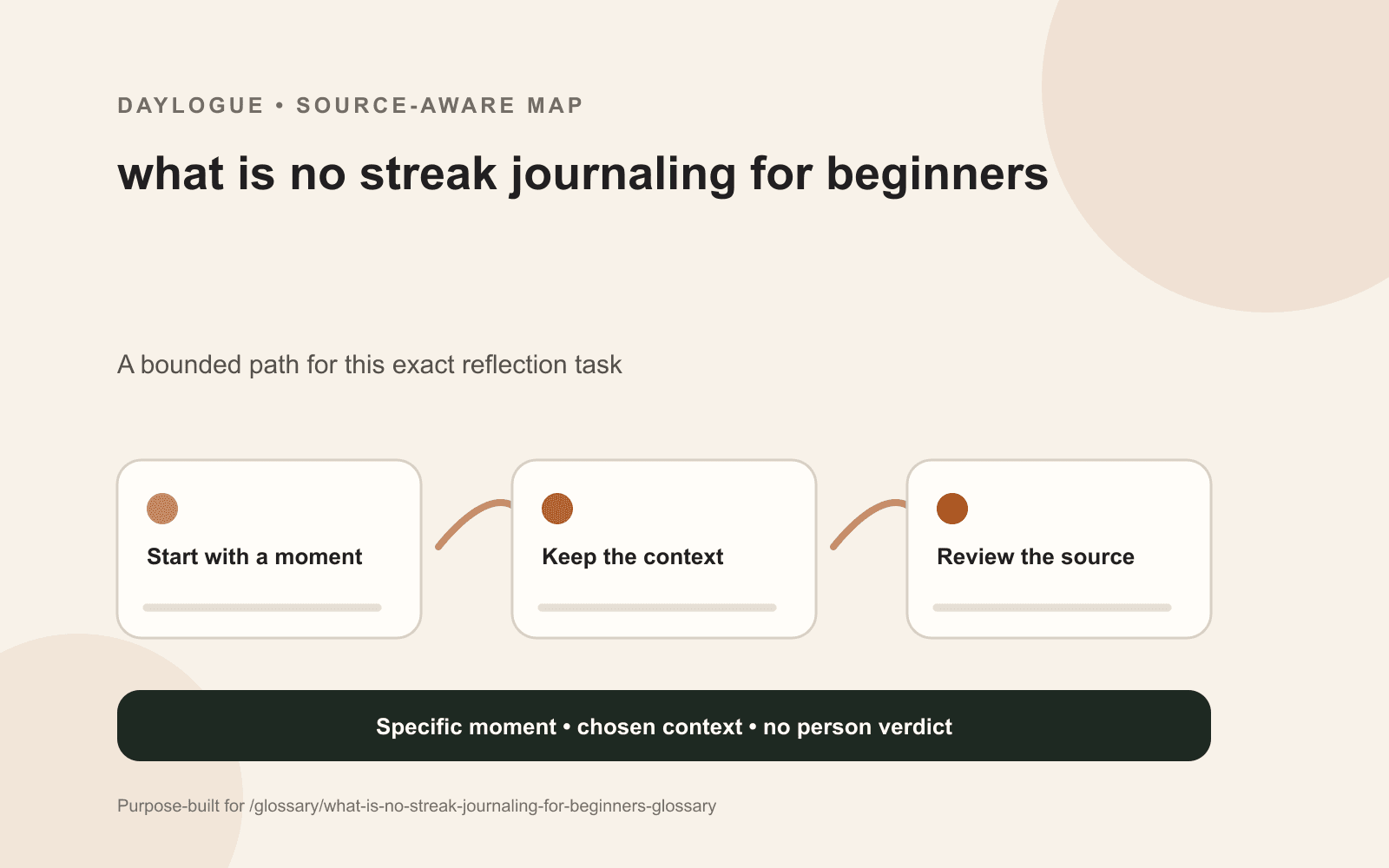
| Part | What it holds | What stays open |
|---|---|---|
| Source | The date of the new entry | Details that were not recorded |
| Context | The scene that brought the writer back | Why the moment happened |
| Review | The detail worth keeping | Anything that remains uncertain |
How it differs from nearby ideas
A habit tracker counts attendance. No-streak journaling keeps the attention on what is true when the writer returns. This distinction keeps the glossary term focused on its actual job instead of turning the page into a product comparison or a recommendation.
A comparison page asks which option fits a buyer. This definition asks what the practice is, what information belongs inside it, and where its meaning stops. A reader can understand the term without being told which tool to choose.
What the record can support
A gap contains no evidence about what happened during the unrecorded days, so it cannot be read as progress, change, or avoidance. A careful reading can describe what appears in the selected source, name the date range, and keep exceptions visible. It cannot recover details that were never written.
An explanation may sit beside the source as a current interpretation. Labeling it that way keeps the original entry intact and makes a later correction feel normal rather than embarrassing.
- A dated source can support a narrow observation about the date of the new entry.
- Relevant context may include the scene that brought the writer back when the writer chooses it.
- A counterexample can narrow the language around the detail worth keeping.
- Anything that remains uncertain can remain unresolved without making the entry incomplete.
A low-pressure way to explore it
One optional starting point is a single scene rather than a broad life summary. A few lines may be enough to preserve the source, the relevant context, and the part the writer is still unsure about.
There is no required schedule, perfect length, or polished conclusion. The note may be saved, revised, exported, revisited, or left alone. Each ending preserves the writer’s choice.
01
A chosen source
The writer may begin with the date of the new entry and only the amount of detail that feels useful.
02
Nearby context
The scene that brought the writer back can sit beside the source when it helps the scene make sense.
03
A separate interpretation
A current reading may be labeled as tentative so that anything that remains uncertain can remain open.
04
A quiet ending
Saving the note without a task or conclusion is a complete option.
Privacy, consent, and control
A return never requires a full recap, and the writer may leave names, workplace details, or other identifying information out. The meaningful question is not whether a practice sounds private. It is which device, account, processing, export, and sharing paths apply to the chosen record.
Consent belongs to each separate action. Writing, syncing, processing, exporting, and sharing do not become one blanket permission simply because they happen around the same entry.
A closer look at no-streak journaling
No-Streak Journaling begins with the date of the new entry because a beginner needs a clear place to look. the date of the new entry anchors the definition in something chosen and recorded, while the scene that brought the writer back can explain only the part of the scene that feels relevant. This keeps the entry from expanding into a life summary. It also makes a later return easier, since the original wording has not been replaced by a polished memory of what the writer thinks happened.
The place of the scene that brought the writer back in no-streak journaling is intentionally limited. It can show where a note sits in a day, a week, or a particular situation. It does not prove why the moment unfolded as it did. A beginner may find that distinction relieving. The journal does not need to solve the scene. It can simply preserve enough surrounding detail for the source to make sense when it is read again.
The detail worth keeping can add depth to no-streak journaling when the writer wants it. It remains optional because more detail is not always more useful. A note can be specific without becoming exhaustive, and it can be honest without naming everyone involved. The writer may choose the amount that fits the current setting, device, and account boundary. That choice is part of the practice rather than a sign that the entry is incomplete.
Anything that remains uncertain gives no-streak journaling room to breathe. Beginners often assume a journal entry needs a lesson or finished conclusion, but an open question can be the most accurate ending available. If a later day adds new information, the writer can add a new dated note. The original uncertainty can stay visible, showing what was known then and protecting the archive from a false sense of certainty.
A concrete scene makes no-streak journaling easier to understand: a new journaler closes a notebook during exams and opens it again three weeks later with one sentence about the bus ride home. The entry remains one example, not proof of a stable trait or universal rule. Another entry in a similar setting may sound completely different. Keeping both scenes allows the definition to stay human, as a way of recording selected experience without demanding that every day line up with the last one.
Privacy belongs inside the definition of no-streak journaling, not in a footnote added afterward, because a return never requires a full recap, and the writer may leave names, workplace details, or other identifying information out. The writer can also consider screen previews, shared devices, synced accounts, exports, and any processing that happens after saving. A private intention does not automatically create a private technical path. Clear boundaries help the person decide what level of detail feels appropriate before the words leave the page or device.
Later reading gives no-streak journaling a second life without changing its original source. In practice, later review can begin with the first entry after each gap and ask what made returning possible without judging how long the gap lasted. The new note may agree, disagree, or remain uncertain. Each response is allowed. Revision works best when it is visible and dated, because the reader can then see how the understanding changed rather than assuming the newest wording was always the truth of the earlier moment.
No-Streak Journaling has useful limits, including this one: a gap contains no evidence about what happened during the unrecorded days, so it cannot be read as progress, change, or avoidance. It may help someone recover a phrase, compare selected scenes, or notice that an interpretation has changed. It cannot speak for absent days, establish another person’s motive, or guarantee a future outcome. Naming those limits keeps the glossary term practical. The reader receives a clear tool for reflection without being handed a verdict about who they are.
What may change on a later reading
Later review can begin with the first entry after each gap and ask what made returning possible without judging how long the gap lasted. The original words can stay visible beside the later note, even when the writer now understands the scene differently.
A counterexample, a changed setting, or a missing date may narrow the first observation. That revision adds information without grading the earlier writer or forcing the archive into one smooth narrative.
Evidence and scope
Daylogue is a system for self-understanding. Pattern journaling is how it reads you. This supported statement appears here with its original scope and does not turn the glossary definition into a promise about a person.
A 2019 study of 395 young adults found that the relationship between narrative coherence and well-being was more complex than a simple universal benefit. The finding is a reminder that a coherent story can be useful without becoming the only accurate account of an experience.
Questions the term leaves open
The definition leaves practical questions for the writer: which source belongs here, which context matters, and which interpretation arrived only after the fact? Those questions can remain unanswered until another entry adds something useful.
It also leaves room for choice about format, timing, and privacy. A short note can carry the needed source. A longer account is available when the writer wants more room, not because the practice demands it.
When this definition may be useful
No-Streak Journaling can be useful when someone wants to make returning feel ordinary after a missed day, a busy week, or a long pause. It may be less useful when the situation calls for an official record, urgent action, or a conversation that cannot be replaced by private reflection.
The value of the term is clarity. It names what the practice can hold, what it cannot establish, and how the writer can stay in charge of what happens next.
Checklist
No-Streak Journaling beginner card
A choice-preserving reference for no-streak journaling, with room for source details, context, uncertainty, privacy boundaries, and a later correction.
- No-Streak Journaling source detail: the date of the new entry.
- No-Streak Journaling nearby context: the scene that brought the writer back.
- No-Streak Journaling optional extra: the detail worth keeping.
- No-Streak Journaling open point: anything that remains uncertain.
- No-Streak Journaling privacy choice: device, account, processing, export, and sharing boundaries.
- No-Streak Journaling ending: save, revise, return later, or stop here.
Common questions
What does no-streak journaling mean?
No-streak journaling means a reflection practice with no attendance score, streak counter, or penalty for time away. It describes a way to keep information available for review, not a score, fixed verdict, or guaranteed result.
What is a simple example of no-streak journaling?
One no-streak journaling example is this: a new journaler closes a notebook during exams and opens it again three weeks later with one sentence about the bus ride home. For no-streak journaling, that dated scene can stand on its own when it preserves the detail the writer hoped to remember.
What can a beginner include in no-streak journaling?
No-Streak Journaling may include the date of the new entry, the scene that brought the writer back, the detail worth keeping, anything that remains uncertain. Within no-streak journaling, every piece is optional, and an unfinished entry can still preserve a useful source.
What are the limits of no-streak journaling?
A central no-streak journaling limit is that a gap contains no evidence about what happened during the unrecorded days, so it cannot be read as progress, change, or avoidance. By itself, no-streak journaling cannot recover missing days or settle a cause.
How does privacy work around no-streak journaling?
For no-streak journaling, a return never requires a full recap, and the writer may leave names, workplace details, or other identifying information out. Around no-streak journaling, device, account, processing, export, and sharing boundaries can also inform how much detail feels appropriate.
Sources
Sources were checked on the dates shown. Product details and policies can change.
- Daylogue evidence and methods · Daylogue · checked September 2, 2026
- Narrative identity and psychological well-being research · National Library of Medicine · checked September 2, 2026
Keep exploring
Daylogue Knowledge Center
Browse practical guides for reflection, journaling, patterns, and privacy.
Read moreHow Daylogue shows patterns
See how candidate patterns stay connected to evidence and correction.
Read moreWhy Daylogue exists
Read the principles behind a system for self-understanding.
Read moreDaylogue is not therapy and is not a replacement for professional care.