Written by Daylogue Editorial Team. Published August 21, 2026. Reviewed and updated August 21, 2026.
A private AI journal is one that explains its data practices in plain language: where entries are stored, who or what can read them, how AI processing works, and what deletion or export controls exist. “Private” is not the same as end-to-end encrypted. A beginner can start by tracing one entry from typing to storage, processing, and deletion before deciding what to record.
Private is a set of promises
A lock icon cannot answer every privacy question. A journal may restrict other users from seeing an entry while still allowing its servers to process readable text. It may offer deletion while retaining limited backups for a stated period. The useful question is not simply “Is this private?” It is “What exactly happens to my words, and which controls are available to me?”
Clear privacy language names storage, access, processing, training, deletion, export, retention, and organizational visibility separately. That list helps a beginner compare services without treating one reassuring word as the whole policy. A product can make a strong promise in one area and a different tradeoff in another. Both facts belong in the decision.
Follow one entry through the system
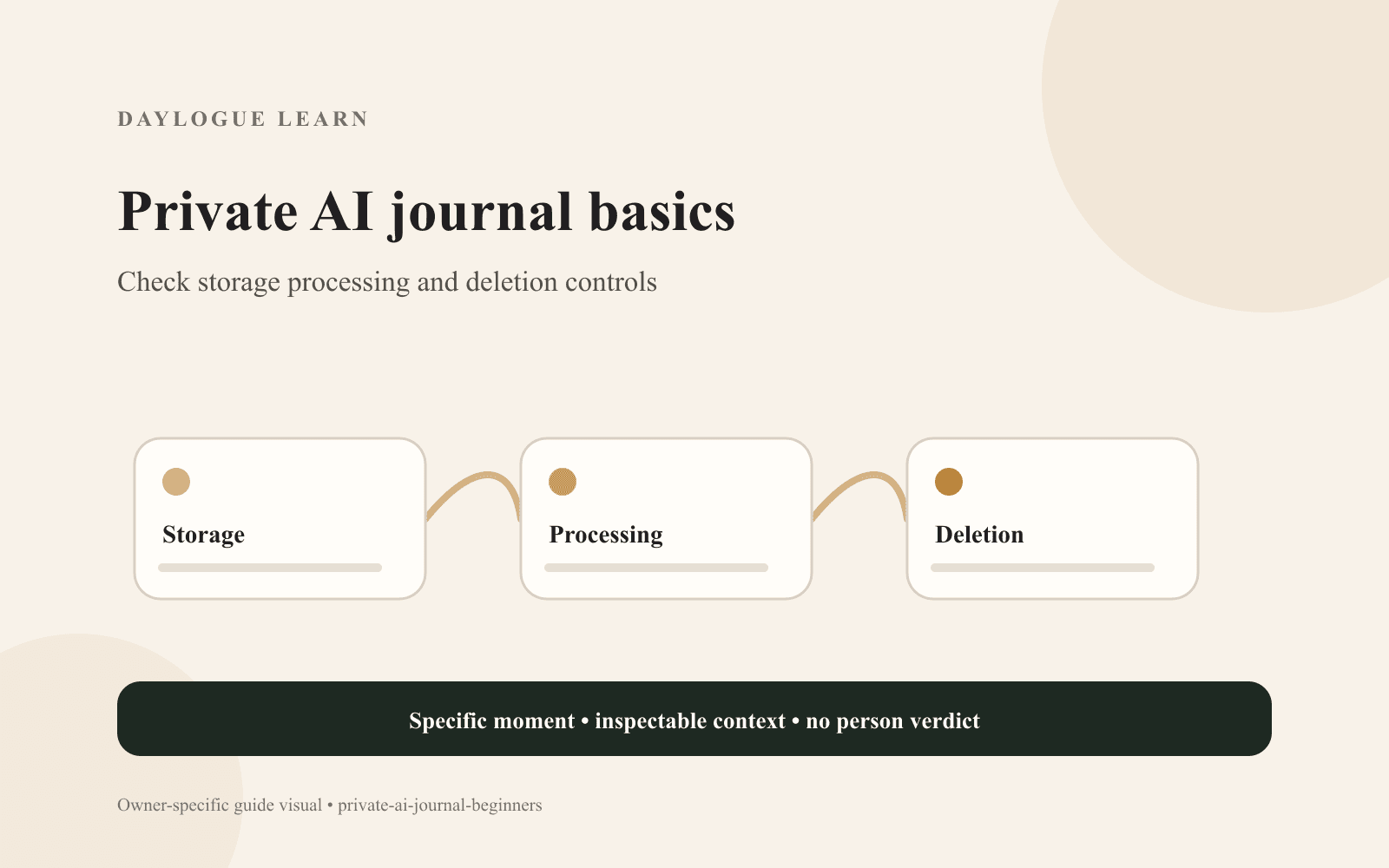
Begin with a simple data-flow map. Your text leaves the device, travels to a server, may be passed to an AI provider for processing, returns as a response, and remains stored or is deleted according to the service’s rules. Each step raises a concrete question about encryption, access, retention, and control.
Voice journaling adds another branch. The service may keep audio, discard it after transcription, or send it to another provider. A privacy page can state which path applies. When the policy is unclear, the uncertainty itself is useful information. A person can choose less identifying detail while deciding whether the service fits their expectations.
Questions to ask before the first personal entry
One privacy question may be enough to begin. The checklist can be visited in any order, and there is no requirement to complete it in one sitting. Storage and AI processing often matter first because they clarify who can technically read the entry. Deletion and export matter when considering how much control remains later.
Policy language changes over time, so a saved answer benefits from a date and a link to the source. A screenshot or short note can preserve what the service said when you made the choice. That record is more useful than trying to remember a general impression months later.
- Are entries stored in readable form on the service’s servers?
- Is the service end-to-end encrypted?
- Which AI providers receive entry text, and for what purpose?
- Are entries used for model training, and is consent required?
- Who can access production content under documented controls?
- What does deletion remove, and what retention limits remain?
- Can entries be exported in a usable format?
- Can an employer, school, or other organization see individual entries?
Daylogue’s readable-storage boundary
Your journal entries and check-in notes are stored on our servers in readable form, protected in transit by TLS and by per-user access controls in the database. Daylogue’s servers need that access to create narratives and pattern candidates. This means Daylogue is not end-to-end encrypted, even though entries are private from other people using Daylogue.
That boundary is easier to understand when the mechanism is visible. TLS protects text while it travels. Per-user database controls limit which account can retrieve it. Neither feature prevents the application’s servers from reading content during processing. The accurate description includes all three facts instead of compressing them into the single word encrypted.
Review a policy change without guessing
A recurring overlap does not show that one thing caused another. The same caution applies when a privacy policy and product behavior change near the same date. A timeline can show what changed and when, but it cannot fill in an undocumented reason. The review stays factual by quoting the policy, naming the date, and separating explicit statements from open questions.
A quarterly calendar reminder may help some people revisit the privacy page, while others may return only before adding a new kind of information. Either choice can work. The useful part is knowing what question prompted the review: a new AI feature, a change in retention, a workplace account, or a desire to export and leave.
Three beginner decisions made concrete
Someone recording ordinary daily reflections may decide that server-readable storage fits their expectations. Someone writing about confidential work may use broader descriptions and omit names. Someone who requires end-to-end encryption may choose a different tool. These are different privacy thresholds, not signs that one person understands privacy better than another.
A beginner checklist works best when it ends in a plain sentence: “I understand that this service can read my entries to provide its features, and I am comfortable recording this level of detail.” The answer can also be no or not yet. Privacy information supports a choice. It does not pressure anyone to disclose more than they want.
Checklist
Private AI journal data-flow checklist
A beginner checklist for tracing Storage, Processing, and Deletion before choosing what to record.
- Storage: Is entry text readable on the service’s servers?
- Processing: Which systems or providers receive the text?
- Training: Is separate consent required before entries are used?
- Access: Who can reach production content under documented controls?
- Voice: Is audio retained or only transcribed?
- Deletion: What is removed, and what retention limits remain?
- Export: Can entries leave in a usable format?
- Visibility: Can any organization see individual entries?
Common questions
What does private AI journal mean?
It means the service makes specific access and data-use boundaries clear. The exact promise may cover other users, staff access, AI providers, training, deletion, or organizational visibility.
Is a private AI journal automatically end-to-end encrypted?
No. End-to-end encryption prevents the service’s servers from reading entry content. Some AI journals process readable entries on their servers.
How often can I review the privacy policy?
A review can happen when a feature or policy changes, before adding a new kind of personal information, or whenever a privacy question becomes important.
What belongs in a privacy checklist?
Storage, encryption, AI providers, training consent, staff access, retention, deletion, export, voice data, and organizational visibility are useful categories.
Can repeated policy changes reveal why a company made a decision?
A timeline can document what changed, but timing alone cannot establish the reason. Published explanations and dated source material provide the stronger basis.
Sources
Sources were checked on the dates shown. Product details and policies can change.
- Daylogue evidence and methods · Daylogue · checked August 21, 2026
- Daylogue privacy policy · Daylogue · checked August 21, 2026
Keep exploring
Daylogue Knowledge Center
Browse practical guides for reflection, journaling, patterns, and privacy.
Read moreHow Daylogue shows patterns
See how candidate patterns stay connected to evidence and correction.
Read moreWhy Daylogue exists
Read the principles behind a system for self-understanding.
Read moreDaylogue is not therapy and is not a replacement for professional care.