Written by Daylogue Editorial Team. Published August 26, 2026. Reviewed and updated August 26, 2026.
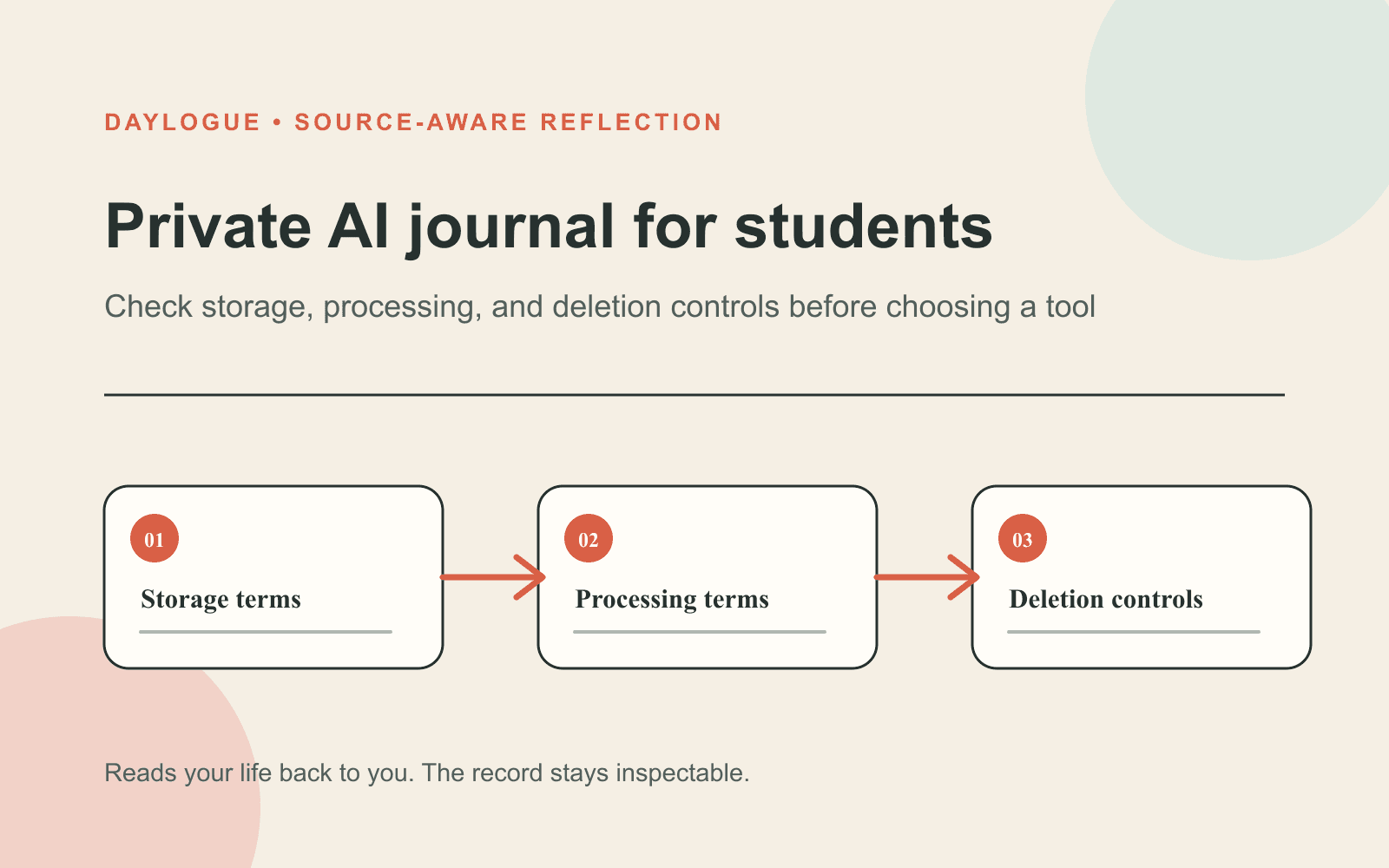
A private AI journal for students is a digital journal that uses automated processing while giving a clear account of access, storage, providers, retention, and user controls. “Private” does not automatically mean end-to-end encrypted, local-only, anonymous, or invisible to the service. The current disclosures give students the information needed to decide which details belong in a synced system before writing them.
Make the word private earn its place
A lock icon or quiet design does not explain a data path. Ask who can access an entry through the product, whether the service can read synced text, which providers process it, and what remains stored after a feature runs. Each answer describes a different boundary. A service can restrict other users while still processing readable text on its servers.
End-to-end encryption is a specific technical claim, not a synonym for careful handling. Local-only storage, encryption in transit, per-user database controls, and end-to-end encryption solve different problems. A useful journal comparison looks for plain statements about each layer instead of accepting the word “encrypted” as a complete answer.
Map what happens after you press save
Start with the entry itself. Does it remain on the device, sync to a service, or go to another provider for a requested feature? Then ask which outputs are created, such as a summary, narrative, transcript, or pattern read. The processing path should be understandable before the student shares intimate writing, not discovered after a problem occurs.
AI features may need readable input to produce the result a person requests. That does not answer how long the input or output remains stored, which contract governs a provider, or whether the material is used for training. Those are separate questions. Good disclosure keeps them separate too.
Check five controls before writing
Look for deletion, export, account access, AI choices, and clear provider disclosures. Confirm what a deletion request covers and whether legal, billing, security, or backup exceptions are described. Check what can be exported and in which format. Review account recovery because a private journal is not useful if a weak recovery path exposes it.
Also ask whether AI can be turned off for new material and what that choice actually changes. A no-AI setting may still allow synced server storage. A local journal may avoid a remote processing path but create a different backup or device-loss risk. Compare the controls against the kind of material you plan to write.
01
Read the privacy page
Find the current statement about readable entries, access, and end-to-end encryption.
02
Find the provider list
Identify which services can process text, audio, or generated outputs.
03
Check training language
Separate the journal company’s own model training from provider handling.
04
Test your controls
Locate export, deletion, AI, password, and account-recovery choices before relying on them.
Share less when less is enough
Privacy decisions begin with the material you choose to enter. Use initials or neutral roles when a name adds no value. Leave out student IDs, passwords, financial details, health records, private messages, and another person’s identifying information. A reflection can preserve your own experience without becoming a copy of every sensitive fact around it.
For school or work, follow the rules that apply to those records. A consumer journal should not hold protected classroom data, confidential research, customer information, or restricted workplace details. If removing the detail makes the entry useless, the topic may belong in an approved system or nowhere in a synced journal.
Reject hidden emotion verdicts
No student has to accept uncertainty about whether a face, vocal quality, pause, or body signal becomes a secret emotional label. Ask the service exactly what it reads. The safe boundary is chosen material, such as words and self-reported fields, with no claim that a system can discover a hidden emotion from appearance or sound.
Automated output can also be wrong. Keep the source entry visible, correct a summary that misses context, and inspect a pattern against the record. A journal should help you revisit your own words. It should not turn an uncertain model output into a verdict about personality, health, or intent.
Compare the actual tradeoffs
Paper avoids an online service but can be lost, photographed, or read by someone nearby. A local file limits remote processing but depends on device security and backups. A synced journal can support search and continuity across devices while introducing service access and provider questions. None of the formats is automatically private in every situation.
Choose based on the entry, not a permanent identity as a paper or app person. A short ordinary reflection may fit a synced system whose disclosures you understand. A highly sensitive detail may belong offline or outside a journal. Revisit the decision when the product, provider list, or privacy policy changes.
What Daylogue discloses
Daylogue reads the entries you choose to sync to create narratives and surface patterns. Entries are not end-to-end encrypted. Daylogue does not use personal entries to train its own models. Provider handling follows the current service configuration, written terms, and subprocessor disclosures.
Daylogue does not run emotion recognition on your face or on the tone of your voice. It works only from what you choose to share. Daylogue observations are designed for reflection, not diagnosis, prediction, treatment, or clinical decision-making. Daylogue is not therapy and is not a replacement for professional care.
Decision Table
Private journal questions students can verify
A practical set of questions for comparing storage, processing, access, providers, and user controls before sharing sensitive writing.
- Can the service read synced entries?
- Is the journal end-to-end encrypted?
- What is protected by TLS in transit?
- Which providers receive text or audio?
- What generated outputs remain stored?
- Does the company use entries to train its own models?
- What do provider terms say about handling?
- Can AI processing be disabled for new entries?
- What does a deletion request cover?
- Which backup or legal exceptions are disclosed?
- Can entries and outputs be exported?
- How does account recovery protect access?
- Can another user see the entry through the product?
- What names or restricted details can I leave out?
Common questions
Does private mean an AI journal cannot read my entries?
No. A service may restrict access from other users while still reading synced text to provide requested features. Check the current processing and storage disclosures.
Is encryption the same as end-to-end encryption?
No. Encryption in transit, server-side controls, and end-to-end encryption describe different protections. Look for a direct statement about which one applies.
Which school records stay out of a consumer journal?
Protected student data, confidential research, credentials, and restricted workplace information belong outside a consumer journal. The rules for the record still apply.
Can I use an AI journal without sharing names?
Yes. Neutral roles, initials, or a description of your own experience often preserve enough context without storing another person’s identifying details.
Is Daylogue end-to-end encrypted?
No. Daylogue reads synced entries to create requested narratives and surface patterns. Entries are not end-to-end encrypted.
Sources
Sources were checked on the dates shown. Product details and policies can change.
- Daylogue evidence and methods · Daylogue · checked August 26, 2026
- Daylogue privacy policy · Daylogue · checked August 26, 2026
Keep exploring
Daylogue Knowledge Center
Browse practical guides for reflection, journaling, patterns, and privacy.
Read moreHow Daylogue shows patterns
See how candidate patterns stay connected to evidence and correction.
Read moreWhy Daylogue exists
Read the principles behind a system for self-understanding.
Read moreDaylogue is not therapy and is not a replacement for professional care.