Written by Daylogue Editorial Team. Published August 21, 2026. Reviewed and updated August 21, 2026.
Relationship journal prompts for busy professionals are questions that help an interaction stay clear enough to revisit. One conversation cue may be enough. The entry can separate observed words or actions from interpretation, name what remains uncertain, and prepare a respectful question without assigning motives or turning a difficult moment into a verdict about another person.
Start with what was said or done
A relationship note becomes easier to trust when it begins with an observable detail. “They looked at the clock twice” is an observation. “They wanted to leave” is an interpretation. The interpretation may be understandable, but the entry stays clearer when the two are labeled separately.
Remembered wording can be imperfect, so phrases such as “as I recall” or “the part that stayed with me” preserve that uncertainty. The goal is not a courtroom transcript. It is a careful record of what stood out, what you understood at the time, and what may still need clarification.
A useful two-column note keeps “what happened” apart from “what I made it mean.” The first column may hold a delayed reply, changed plan, interrupted request, or exact phrase. The second may hold disappointment, worry, or an assumption about motive. Separation does not make the interpretation wrong. It shows which part another conversation could confirm, complicate, or correct. That distinction gives the writer more room than a single story about the relationship.
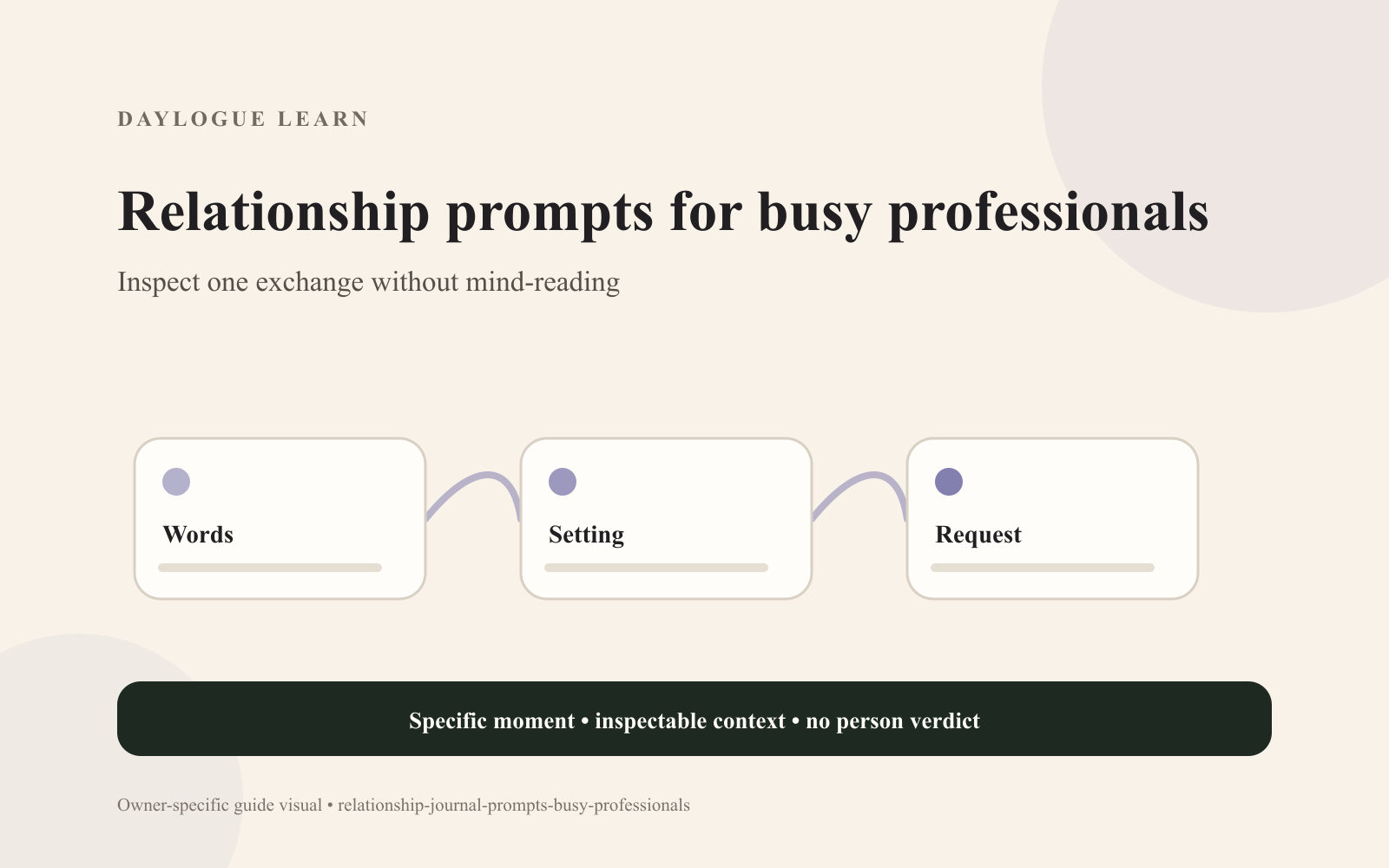
Use three anchors: words, setting, and request
Words capture the sentence, question, or silence that mattered. Setting names where the exchange happened, who was present, how much time was available, and what else was competing for attention. Request names what you wanted, offered, or might ask next. These anchors keep the entry connected to a real interaction.
A request can remain private until the writer decides whether to share it. “I wanted more warning before the plan changed” may be enough for reflection. If a conversation follows, the journal can help turn that private need into a question. It cannot decide the other person’s intent or write consent on their behalf.
Review words and settings without assigning motives
A recurring overlap does not show that one thing caused another. If several tense exchanges happen near deadlines, that timing can support a question about pressure or availability. It cannot prove why either person responded as they did. Different settings, remembered words, and counterexamples keep the review open.
A useful comparison separates recurring actions from a fixed story about character. “Our last three handoffs ended without a named owner” is inspectable. A fixed character conclusion goes beyond what the entries establish. The journal can support a future question about the handoff process while leaving another person’s inner experience with them.
Three examples with different purposes
After a rushed handoff, the note might separate “They said, ‘I thought you had it’” from “I took that as blame.” Before a follow-up, the writer could add: “I want to ask how we can name ownership earlier.” The observation, interpretation, and request are visible without deciding anyone’s motive.
After a warm exchange, a different note might preserve the exact question that made room for honesty. After a disagreement at home, the useful detail may be that the conversation happened while both people were leaving. These scenes need different prompts. Their value comes from specificity, not a repeated formula for every relationship.
The request can stay small enough to answer. “Could we finish this conversation after dinner?” names a time. “Could you tell me when the plan changes?” names an action. “I need a little notice before visitors arrive” names a boundary. Each sentence leaves room for acceptance, refusal, or another proposal. The relationship prompt has done its job when it helps the writer speak clearly without claiming to know the other person’s interior state.
Prompt Pack
Words, setting, and request reflection prompts
Eight optional questions for separating observation from interpretation and preparing a respectful clarification.
- Which words or action are still with me?
- What did I observe, and what did I infer?
- What was I trying to communicate?
- What request was present but unspoken?
- How did time, setting, or audience shape the exchange?
- What detail complicates my first interpretation?
- Which question could invite clarification?
- What part belongs to me, and what remains unknown?
Common questions
How long can a relationship journal entry be?
A few sentences can be enough to separate an observation, an interpretation, and an open question.
Can a journal tell me what another person meant?
No. It can preserve remembered words and your interpretation. The other person’s meaning remains theirs to clarify.
How often is it useful to review relationship entries?
A review can begin before a conversation or when a specific interaction pattern needs context. Source scenes and counterexamples stay visible.
Can repeated exchanges prove someone’s motive?
No. Repetition can support a question about actions or settings, while motive remains unknown.
How can I protect someone else’s privacy?
Use only the detail you choose after considering storage and audience. Roles or initials may preserve context without a full identity.
Sources
Sources were checked on the dates shown. Product details and policies can change.
- Daylogue evidence and methods · Daylogue · checked August 21, 2026
- Daylogue privacy policy · Daylogue · checked August 21, 2026
Keep exploring
Daylogue Knowledge Center
Browse practical guides for reflection, journaling, patterns, and privacy.
Read moreHow Daylogue shows patterns
See how candidate patterns stay connected to evidence and correction.
Read moreWhy Daylogue exists
Read the principles behind a system for self-understanding.
Read moreDaylogue is not therapy and is not a replacement for professional care.