Written by Daylogue Editorial Team. Published August 26, 2026. Reviewed and updated August 26, 2026.
Relationship journal prompts for parents and caregivers are focused questions about a family or care interaction. They help the writer preserve what happened, notice their own response, name a need, and prepare a respectful request. A useful prompt keeps observation separate from assumption. It does not decide what a child, partner, parent, or other family member meant, and it does not grade the writer's worth as a caregiver.
Relationship prompts for care moments, in plain language
A relationship journal prompt narrows a complicated interaction to one question you can answer from your own point of view. For a parent or caregiver, the scene might be a rushed school morning, a handoff between siblings, a repeated request, a changed plan, or a conversation with an older relative. The prompt helps keep the scene available without turning it into a complete story about either person.
The useful unit is a moment, not a personality label. “The plan changed after I had packed the bag” gives you something concrete to revisit. “Nobody respects my time” may express how the moment landed, but it reaches beyond the scene. Both sentences can appear in an honest entry when one is labeled as the event and the other as your interpretation.
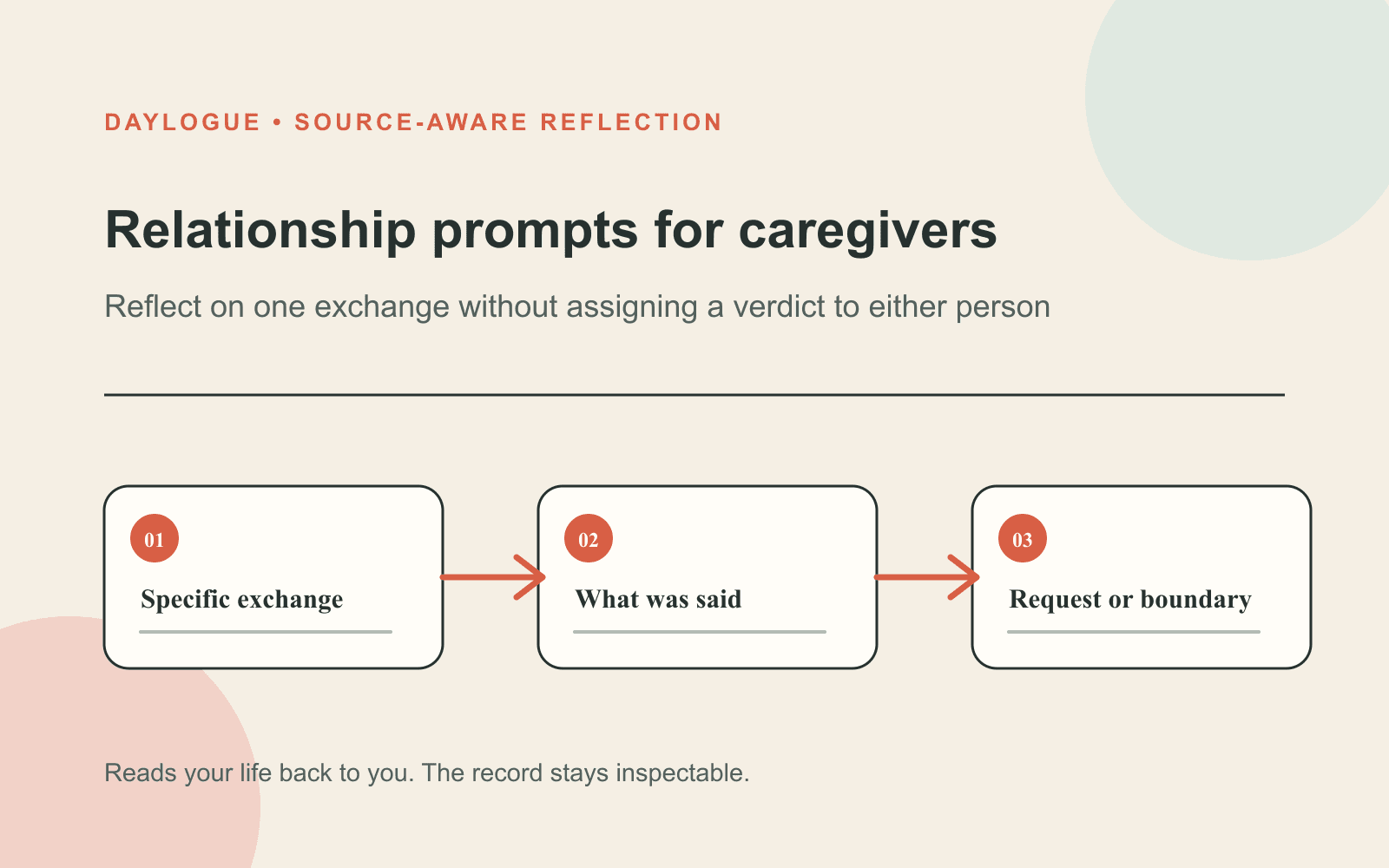
Use four parts: scene, response, need, and question
The scene records the words, action, timing, or constraint that mattered. The response names what you noticed in yourself. The need identifies what felt absent or important. The question opens a possible next conversation. This sequence gives a caregiver enough structure to reflect without requiring a polished essay after an already demanding day.
Keep ownership clear. You can write “I heard the request as criticism” without claiming that criticism was the other person's intent. You can write “I needed ten quiet minutes” without deciding what they should have known. The journal prepares language you may choose to use later. It cannot speak for the other person or guarantee how a conversation will go.
01
Keep the scene
Record the specific exchange, handoff, request, or change that you want to remember.
02
Name your response
Describe what you noticed in your own words without turning the reaction into a fixed identity.
03
Find the need
Name the time, clarity, help, rest, choice, or boundary that mattered in that scene.
04
Write an open question
Prepare a question that leaves room for the other person's memory, needs, and answer.
Match the prompt to the care moment
Different care moments need different questions. After a rushed transition, timing and available help may matter most. After a disagreement, separating remembered words from inferred meaning may bring clarity. During an ongoing care arrangement, a prompt about ownership can reveal where two people are relying on different assumptions. A good prompt makes the next distinction easier to see.
Positive scenes belong in the record too. A handoff that felt easy, a request that was understood, or a moment when help arrived can complicate the first story about what always happens. An exception is not proof that the hard scene did not matter. It gives the review another real event to work with.
- What happened before this moment became difficult?
- Which words do I remember, and which meaning did I add?
- What was I trying to protect or make possible?
- What help did I need but struggle to name?
- What belonged to timing, resources, or a changed plan?
- When did a similar handoff go more smoothly?
- What question could invite the other person's version?
- Which detail belongs to someone else and can stay out of the entry?
Keep the page from becoming a caregiver verdict
A tired response, missed cue, sharp sentence, or need for distance can be worth examining. It does not prove that you are a good or bad parent, partner, adult child, or caregiver. One record can hold the demand, the available support, the time pressure, and what you wish had gone differently. Another scene may add context later.
The same boundary applies to the other person. Repeated conflict can support a question about a handoff, schedule, or communication habit. It cannot reveal someone else's motive or produce a reliable label for their character. Relationship prompts are most useful when they improve the writer's description and prepare a clearer conversation, not when they close the case.
What narrative research can and cannot add
A 2019 study of 395 American young adults examined narrative coherence, identity functioning, and wellbeing. Narrative coherence was positively related to measures of identity functioning in that sample. The authors said the relationship between coherence and wellbeing may be more complex than originally assumed.
The study did not test relationship journal prompts for parents or caregivers, family communication, or a journaling app. It cannot show that writing a clearer account will repair a relationship or produce a particular outcome. It does support a cautious idea for reflection: context, chronology, and theme are distinct parts of a personal account, and keeping them visible may help you inspect what you remember without treating coherence as a score.
Where Daylogue fits in relationship reflection
Daylogue is a system for self-understanding. Pattern journaling is how it reads you. A check-in can preserve your side of a care moment, and later readback can remain connected to the source entry. The useful pattern is about what you recorded in your own life, not an analysis of another person's hidden feelings or a verdict about the relationship.
Daylogue may fit when you want guided capture and later readback, and when the disclosed server-side processing works for the material. Paper may fit when an offline boundary is the priority. A shared planning tool may fit logistics, but personal reactions may belong elsewhere. Choose the format after deciding what the entry needs to do and whose information it would contain.
Worksheet
One care moment, four clear parts
Use this short worksheet to preserve one interaction, keep ownership clear, and prepare a question without assigning motive.
- Scene: what specific words, action, handoff, or change am I remembering?
- Context: what timing, resources, audience, or competing demand shaped the moment?
- Response: what did I notice in myself, in my own words?
- Interpretation: what meaning did I add that the scene alone cannot confirm?
- Need: what time, clarity, help, choice, rest, or boundary mattered?
- Exception: when did a similar moment go differently?
- Question: what could I ask without presuming the answer?
- Privacy: which identifying detail belongs to someone else and can stay out?
Common questions
What is a good relationship journal prompt after a hard care moment?
Try: “What happened, what did I make it mean, and what question remains?” Keep the observable scene separate from your interpretation.
Can relationship prompts tell me what my child or relative meant?
No. They can preserve remembered words and your response, but the other person's meaning remains theirs to explain in an age-appropriate conversation.
Can a journal tell me if I am a good parent or caregiver?
No. A journal can help you examine one choice and its context. It cannot issue a reliable verdict about your worth or identity.
How can I journal about a recurring family conflict?
Keep separate scenes, note timing and constraints, and include an exception. Repetition can support a question, but it does not prove motive or blame.
What family details should stay out of a digital journal?
Leave out details your reflection does not need, especially credentials, account numbers, formal records, private messages, and identifying school or health information.
Should I share a relationship journal entry with the other person?
Only after reconsidering consent, audience, timing, and what belongs to someone else. A short request in your own words may be more useful than sharing the full entry.
Sources
Sources were checked on the dates shown. Product details and policies can change.
- Daylogue evidence and methods · Daylogue · checked August 26, 2026
- Daylogue privacy policy · Daylogue · checked August 26, 2026
- Narrative identity and psychological well-being research · Frontiers in Psychology · checked August 26, 2026
Keep exploring
Daylogue Knowledge Center
Browse practical guides for reflection, journaling, patterns, and privacy.
Read moreHow Daylogue shows patterns
See how candidate patterns stay connected to evidence and correction.
Read moreWhy Daylogue exists
Read the principles behind a system for self-understanding.
Read moreDaylogue is not therapy and is not a replacement for professional care.