Written by Daylogue Editorial Team. Published August 11, 2026. Reviewed and updated August 11, 2026.
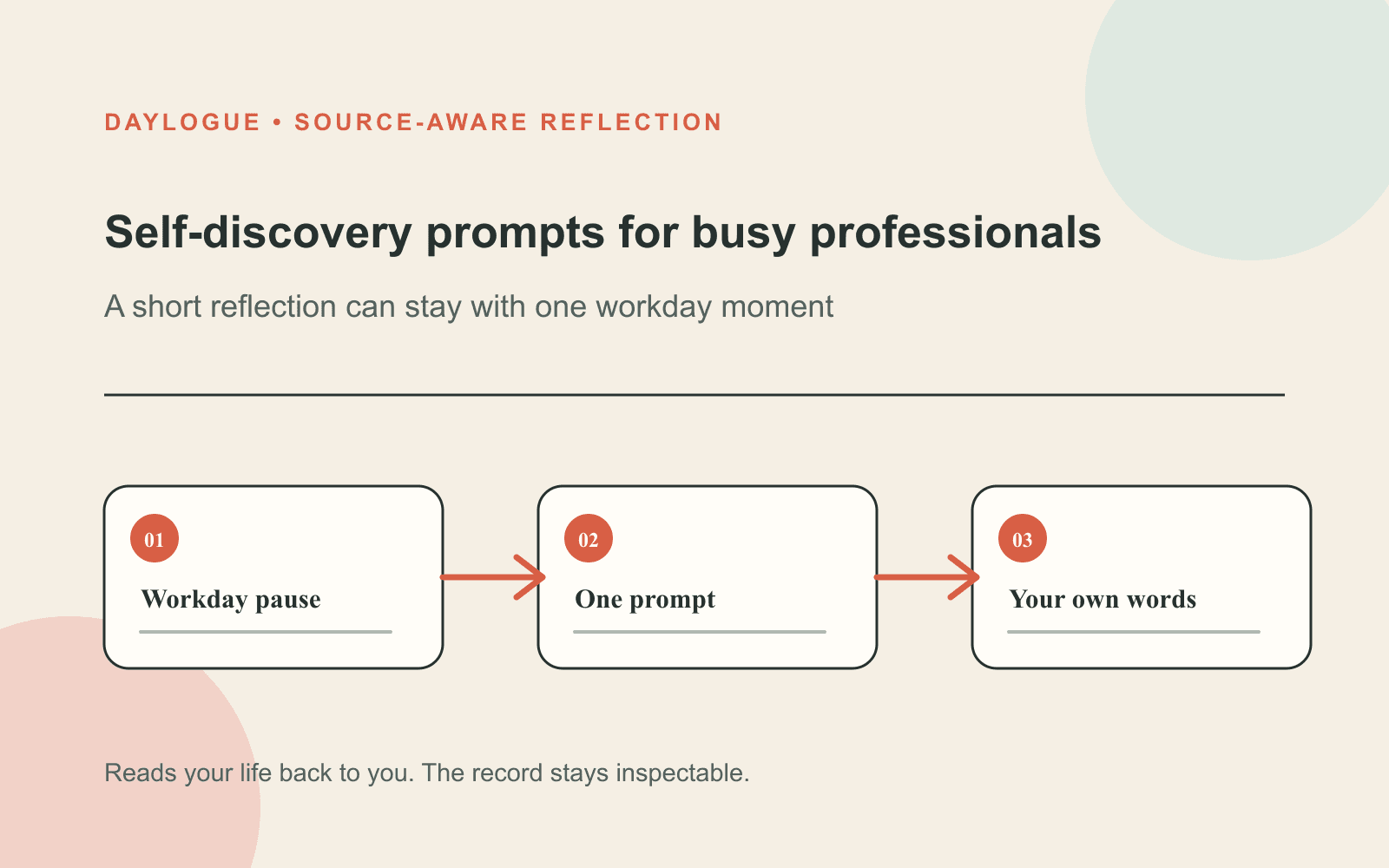
Self-discovery journal prompts for busy professionals are focused questions about choices, values, boundaries, and recurring work situations. They are most useful when they examine one event instead of asking for a complete identity statement. A good prompt preserves what happened, what mattered, what was uncertain, and when you responded differently. The result is a record to inspect, not a verdict about your personality or professional potential.
Self-discovery prompts for work, in plain language
A self-discovery prompt helps you examine how you responded to a particular situation and what mattered in that response. In a work context, the subject might be a decision, boundary, conflict, risk, or recurring meeting. The prompt should narrow attention without telling you what the answer means. “What was I protecting in that choice?” opens more space than “Why am I bad at speaking up?”
Prompts for different work questions
A decision prompt can examine a choice. A values prompt can hold two competing priorities. A boundary prompt can revisit a request or interruption. A recurring-situation prompt can follow a weekly slot that keeps carrying similar tension. One question with one example is easier to revisit than mixing all four into a complete theory of your working style.
| Job | Prompt | Useful detail |
|---|---|---|
| Decision | What could I see when I chose? | Options and missing information |
| Values | What was I trying to protect? | The value present in the moment |
| Boundary | What did I agree to before checking capacity? | The request and timing |
| Recurring situation | What keeps showing up in this slot? | Dates, context, and exceptions |
| Change | When did I respond differently? | A counterexample to the main story |
A five-minute decision record
A five-minute record can preserve the situation in two sentences, the options that seemed available, and one value or constraint that mattered. “Delay the decision” can remain an option when it was genuinely available. The entry can end with what remained unknown. When the outcome becomes clearer, a dated follow-up preserves the original perspective instead of letting hindsight make the choice look obvious.
01
The decision
The decision or exchange can stay in ordinary language without assigning you a trait.
02
Available options
The options that genuinely felt available may include delay or asking for help.
03
Decision context
A value, deadline, relationship, or constraint can show what shaped the decision.
04
What remained unknown
What was unknowable at the time can remain open for a separately dated follow-up.
A repeated response is not a professional verdict
A repeated response can be worth noticing without becoming a label such as “bad leader,” “people pleaser,” or “not resilient.” The conditions around each example and a comparable situation that went differently can widen the view. The exception may show that timing, authority, workload, or relationship context matters. It may also show that the first label was simply too broad.
Narrative research in context
A 2019 study of 395 American young adults found narrative coherence was positively related to identity functioning as measured in that study. The authors called the relationship between coherence and wellbeing more complex than originally assumed. The study does not prove that a prompt, app, or coherent career story will create wellbeing or better work decisions.
Work reflection stays personal
Private reflection may not belong in a shared system unless the audience and ownership are clear. Roles or initials can preserve context when names add no value. Daylogue reads entries and structured metrics server-side to write narratives and surface patterns, and it does not use personal entries to train AI models. It may fit when continuity matters and the privacy model works for you. Paper may fit when an offline boundary matters more.
A role change, new employer, or device replacement can be a useful moment to review the account again. A space that felt personal can become linked to a managed account without the journal entry itself changing.
Worksheet
Five-minute work decision record
This worksheet can preserve one decision as it looked at the time without turning the outcome into a verdict about you.
- Situation: what choice or exchange am I examining?
- Options: what genuinely felt available at the time?
- Value: what was I trying to protect or move toward?
- Constraint: what deadline, relationship, or limit mattered?
- Unknown: what information did I not have?
- Exception: when have I handled a similar situation differently?
- Later note: what belongs in a separately dated update?
Common questions
What is a good self-discovery prompt after a hard workday?
“What condition made the hardest moment harder?” is one option. The event and one comparable situation that felt different can sit beside each other.
Can self-discovery prompts help with career decisions?
They can preserve your options, values, constraints, and uncertainty. They cannot predict the right career move or replace practical advice from people you trust.
How do I avoid overanalyzing one work interaction?
One event, a five-minute window, and a comparable example can limit overanalysis before a recurring thread gets a name.
Should I write colleagues' names in a private journal?
Names may be unnecessary for your own record. Roles or initials often preserve context while reducing exposure if the entry leaves your possession.
Can Daylogue tell me what kind of professional I am?
Daylogue surfaces patterns from what you choose to share. It does not issue a fixed verdict about your identity, ability, or future.
Sources
Sources were checked on the dates shown. Product details and policies can change.
- Daylogue evidence and methods · Daylogue · checked August 11, 2026
- Daylogue privacy policy · Daylogue · checked August 11, 2026
- Positive expressive writing systematic review · PLOS One · checked August 11, 2026
- Narrative identity and psychological well-being research · Frontiers in Psychology via PubMed Central · checked August 11, 2026
Keep exploring
Daylogue Knowledge Center
Browse practical guides for reflection, journaling, patterns, and privacy.
Read moreHow Daylogue shows patterns
See how candidate patterns stay connected to evidence and correction.
Read moreWhy Daylogue exists
Read the principles behind a system for self-understanding.
Read moreDaylogue is not therapy and is not a replacement for professional care.