Written by Daylogue Editorial Team. Published August 12, 2026. Reviewed and updated August 12, 2026.
Self-discovery journal prompts for parents and caregivers are focused questions about needs, choices, boundaries, and recurring care situations. They help preserve what happened, what mattered, what felt available, and what remained outside your control. A useful prompt examines one moment without deciding what kind of parent or caregiver you are. The page becomes a record to revisit, not a score for how well you care.
Caregiver self-discovery prompts, in plain language
A self-discovery prompt narrows attention to one choice, need, value, or repeated situation. For a parent or caregiver, that might be a handoff that keeps breaking down, a request you answer automatically, a quiet part of yourself that has been crowded out, or a moment when care felt shared. The prompt should help you describe the context. It should not turn an exhausted response into a permanent trait.
A bounded question for each reflection job
Some questions help with identity outside the care role. Others clarify a boundary, a decision, support, or a recurring situation. A bounded question can match what happened. Mixing every concern into “Who am I now?” can make an already loaded day harder to inspect. One focused record is easier to compare with another real moment later.
| Reflection job | Prompt | Keep in view |
|---|---|---|
| Identity | What part of me had no room today? | A need without rejecting the care role |
| Boundary | What did I agree to before checking capacity? | The request, timing, and available support |
| Choice | What options actually felt possible? | Constraints that shaped the decision |
| Support | When did care feel shared rather than carried alone? | Specific actions and exceptions |
| Recurring situation | What keeps happening around this handoff? | Dates, context, and missing information |
A three-minute care snapshot
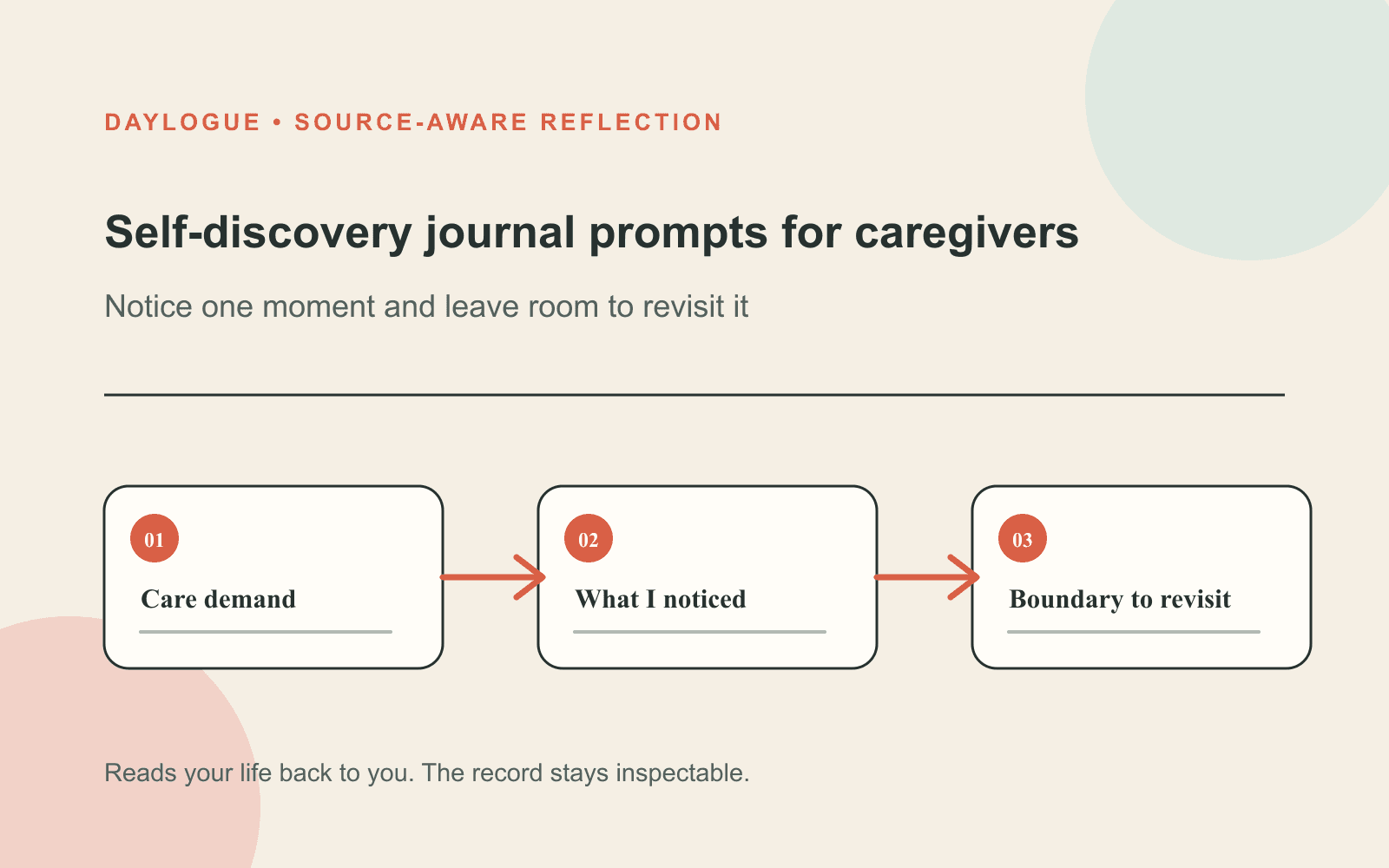
One event can stay in ordinary language, with what was in your control separated from what was not. The need or value that mattered can sit beside one uncertainty or counterexample. A later entry can add new context without rewriting the first one. This keeps hindsight from turning a complicated care decision into something that now looks obvious.
01
The moment
The handoff, request, interruption, choice, or exchange can remain free of fixed traits.
02
What was in your control
What was yours to decide can sit apart from timing, resources, another person, or chance.
03
What mattered
A need, value, relationship, or limit may show what shaped your response in that moment.
04
An opening
One uncertainty or comparable moment may not fit the first interpretation, and can remain visible.
A recurring response is not a caregiver score
Repeated frustration, withdrawal, overcommitting, or asking for help may be worth noticing. None of those observations proves that you are a good or bad caregiver. Timing, sleep, resources, relationships, and what was asked of you add context. A similar situation that went differently can reveal conditions the first story missed, or show that the label was too broad from the start.
Narrative research in context
A 2019 study of 395 American young adults found narrative coherence was positively related to identity functioning as measured in that study. The authors described the relationship between narrative coherence and wellbeing as more complex than originally assumed. The study did not examine caregiver prompts, parenting decisions, or an app. It does not prove that writing a coherent care story will improve wellbeing or reveal your true identity.
Care stories rarely belong to one person alone
A caregiver journal may contain a child’s school details, an older adult’s health information, family conflict, or another person’s private words. Only the identifiers your own record needs may be necessary. Roles or initials may preserve enough context. Readable storage, processors, model-training terms, export, and deletion show the boundary of an online journal.
Daylogue is a system for self-understanding. A recurring question about a difficult handoff can stay linked to the entries behind it. Daylogue reads entries and structured fields server-side to write narratives and surface patterns, and it does not use personal entries to train AI models. It may fit when later readback matters and the processing model works for your family context. Paper may fit when an offline boundary matters more.
Worksheet
Three-minute care snapshot
This worksheet holds one care moment with context, limits, and room to revise the first story you tell about it.
- Moment: what specific handoff, request, choice, or exchange am I examining?
- Control: what was mine to decide in that moment?
- Outside me: what belonged to timing, resources, another person, or chance?
- Need: what did I need but struggle to name?
- Value: what was I trying to protect or move toward?
- Exception: when did a similar situation go differently?
- Privacy: which details belong to someone else and can be removed?
- Later note: what uncertainty belongs in a separately dated update?
Common questions
What is a good self-discovery prompt for a tired caregiver?
“What part of this moment belonged to me, and what did not?” is one option. One event can stay separate from any conclusion about yourself.
Can self-discovery prompts tell me if I am a good parent?
No. A prompt can help you examine choices and context, but it cannot issue a reliable verdict about your identity or value as a parent.
How do I journal about resentment without judging myself?
The specific request, limit, support gap, or repeated situation can provide context. The feeling can remain information from that moment rather than proof of a permanent trait.
How do I keep caregiving reflection from becoming overanalysis?
One event, a short time window, and one counterexample can limit overanalysis. Another comparable moment may add context before a recurring thread gets a name.
How can I protect another person’s privacy in my journal?
Names and identifying details that are not needed can stay out. Storage, processing, export, and deletion terms show how sensitive family information is handled.
Sources
Sources were checked on the dates shown. Product details and policies can change.
- Daylogue evidence and methods · Daylogue · checked August 12, 2026
- Daylogue privacy policy · Daylogue · checked August 12, 2026
- Positive expressive writing systematic review · PLOS One · checked August 12, 2026
- Narrative identity and psychological well-being research · Frontiers in Psychology via PubMed Central · checked August 12, 2026
Keep exploring
Daylogue Knowledge Center
Browse practical guides for reflection, journaling, patterns, and privacy.
Read moreHow Daylogue shows patterns
See how candidate patterns stay connected to evidence and correction.
Read moreWhy Daylogue exists
Read the principles behind a system for self-understanding.
Read moreDaylogue is not therapy and is not a replacement for professional care.