Written by Daylogue Editorial Team. Published September 2, 2026. Reviewed and updated September 2, 2026.
Voice journal transcription means the conversion of spoken journal audio into written words that can be read, searched, and corrected. For beginners, it can make room for making a spoken reflection reviewable while keeping uncertain words and edits visible. The record stays bounded: it shows what was written and what context was available, while missing days and later revisions remain visible.
What voice journal transcription means
Voice journal transcription means the conversion of spoken journal audio into written words that can be read, searched, and corrected. For beginners, that can support making a spoken reflection reviewable while keeping uncertain words and edits visible. The term stays tied to the source audio when retained, the transcript, corrections, timestamps, and any words marked as uncertain, so a small sample never has to become a conclusion about the person.
A transcript represents recorded speech. It does not establish tone, intent, or emotion beyond the words a person chose to share. A useful first example can be small: one dated scene, one detail, and one question left open. A short or unfinished note can preserve the scene without requiring a polished ending.
A transcript with one uncertain phrase
A beginner records a note while walking near traffic. The transcript changes “I can make room for that” to “I cannot make room for that.” Because one word reverses the meaning, the writer listens again and marks the sentence uncertain until it can be corrected.
Other errors may matter less. Missing filler words or different punctuation may not change the thought. Transcript review can therefore focus on names, negations, numbers, and phrases central to the entry rather than demanding a polished copy of every sound.
| Audio detail | Possible transcript issue | Why it matters |
|---|---|---|
| A name | Wrong spelling or another word | The source person or place changes |
| A negation | “Not” is omitted | The sentence meaning reverses |
| A number or date | Digits are confused | Chronology becomes unreliable |
| A pause or restart | Punctuation hides uncertainty | Tentative speech looks settled |
Audio source and written representation
The recording contains the spoken signal. The transcript contains recognized words and formatting choices. Search usually happens against the text, which makes the transcript convenient, but convenience does not remove the distinction between source audio and generated text.
A visible correction can preserve that distinction. The corrected phrase may appear beside a note that the first transcript was wrong, or the final text may retain an uncertainty marker. Either approach is clearer than allowing an error to become an unmarked journal fact.
Punctuation can change the reading
Speech often arrives without clear sentence boundaries. A transcription system adds commas, periods, and paragraph breaks based on its own processing. The same words can feel more certain or more abrupt when punctuation changes. A beginner may revise the formatting without changing the original idea.
Pauses, laughter, sighs, and emphasis may be absent or inconsistently represented. Their absence does not authorize an inference about emotion. The transcript works from captured words and available context, not from a hidden reading of the speaker.
A focused transcript review
A full replay is not always necessary. A person may choose only the passages where the wording looks surprising, a name is unfamiliar, or a sentence affects the entry’s meaning. This keeps review proportionate to the reason the transcript exists.
The writer can also leave a phrase as “[unclear]” when the audio does not support a confident correction. Visible uncertainty is useful information. It protects the journal from a clean sentence that the source never established.
01
Meaning-changing words
Negations, numbers, names, and dates may deserve attention when one error would alter the entry.
02
Uncertain audio
A phrase can remain marked as unclear rather than being filled with a guess.
03
Writer corrections
Spelling and punctuation can be revised while the original recording remains the source.
04
Enough review
The person may stop after checking the passages that matter for their purpose.
Why searchable text is useful
A transcript can make spoken entries discoverable by phrase, person, place, tag, or date. That can help a beginner recover the original moment without listening to an entire archive. Search results still need the surrounding entry, because a matching phrase may have been quoted, corrected, or used in a different context.
Searchability is a convenience, not proof of accuracy. A misspelled name can hide the wanted entry, and an incorrectly recognized phrase can surface an irrelevant one. Corrections improve retrieval when the words matter later.
The processing path deserves a clear look
Voice transcription can involve microphone access, an audio file, transfer to a transcription service, generated text, synced storage, and device previews. A privacy description needs to name the applicable paths instead of relying on the reassuring word “private.”
A writer may choose a quieter setting, omit names, delete an unwanted recording under the available controls, or use text instead. Consent to record, transcribe, sync, export, and share should not be treated as one automatic permission.
Daylogue voice and processing boundaries
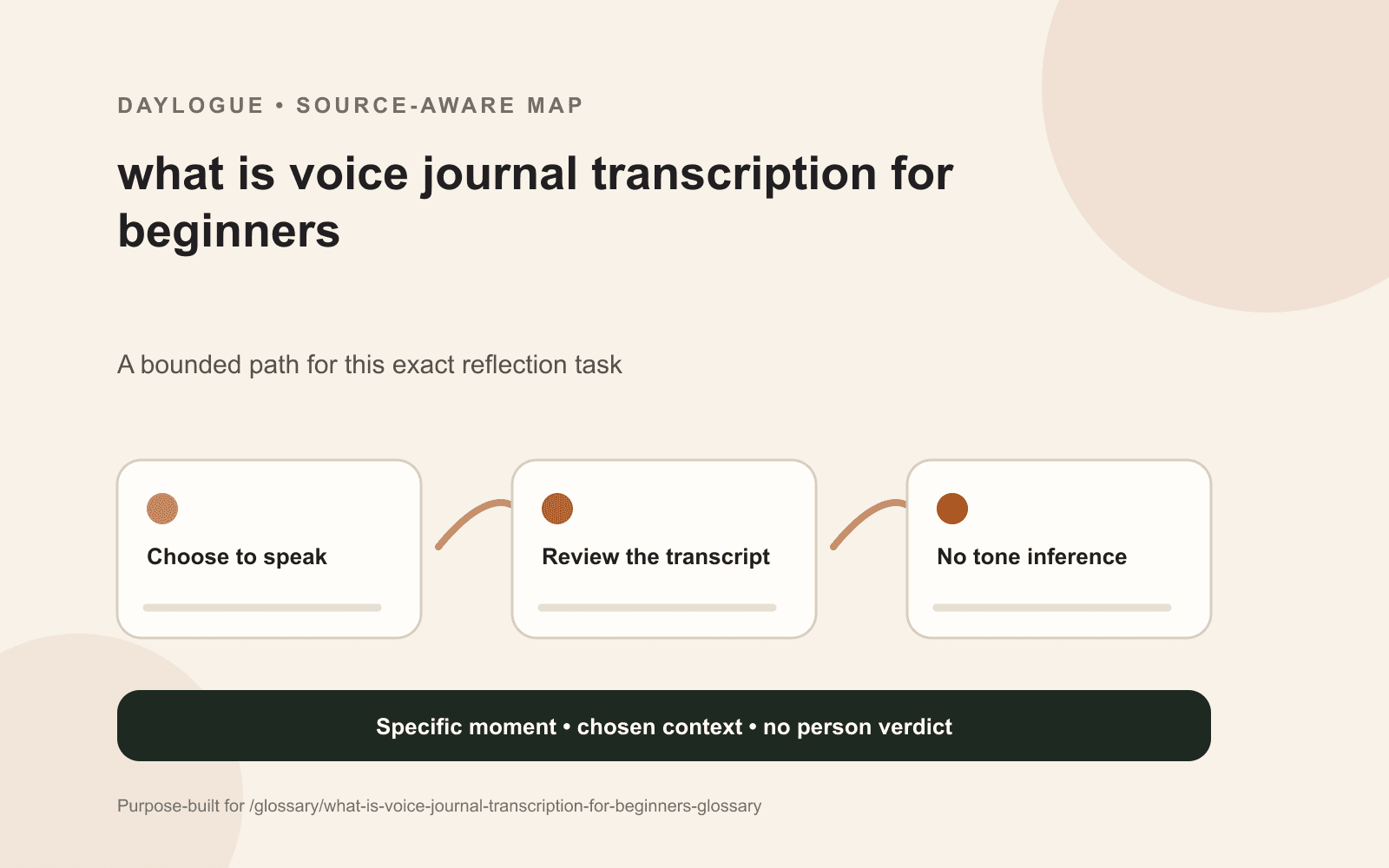
Daylogue does not infer emotion from faces, voice tone, or physiology. It works from the words and context people choose to share. Voice tone is therefore not treated as a separate emotion signal.
Daylogue reads the entries you choose to sync to create narratives and surface patterns. Entries are not end-to-end encrypted. This keeps the current server-readable scope visible and avoids describing synced voice-derived text as end-to-end encrypted.
What a transcript cannot establish
A transcript cannot establish why someone paused, whether a background sound changed their mood, or what they intended beyond the words and context they chose to share. It also cannot prove that the text is complete when the recording was clipped or difficult to hear.
The useful scale is smaller. Voice journal transcription makes speech readable and searchable, with a source that can support correction. A beginner can use that convenience while keeping errors, processing, and privacy boundaries in view.
Checklist
Voice Journal Transcription beginner card
A choice-preserving reference for voice journal transcription, with room for source details, context, uncertainty, privacy boundaries, and a later correction.
- Voice Journal Transcription source detail: the audio source.
- Voice Journal Transcription nearby context: uncertain words.
- Voice Journal Transcription optional extra: names and punctuation.
- Voice Journal Transcription open point: corrections made after listening.
- Voice Journal Transcription privacy choice: device, account, processing, export, and sharing boundaries.
- Voice Journal Transcription ending: save, revise, return later, or stop here.
Common questions
What does voice journal transcription mean?
Voice journal transcription means the conversion of spoken journal audio into written words that can be read, searched, and corrected. It describes a way to keep information available for review, not a score, fixed verdict, or guaranteed result.
What is a simple example of voice journal transcription?
One voice journal transcription example is this: a beginner records a note outdoors and later finds that traffic noise changed one sentence, so the uncertain phrase stays marked until it can be checked. For voice journal transcription, that dated scene can stand on its own when it preserves the detail the writer hoped to remember.
What can a beginner include in voice journal transcription?
Voice Journal Transcription may include the audio source, uncertain words, names and punctuation, corrections made after listening. Within voice journal transcription, every piece is optional, and an unfinished entry can still preserve a useful source.
What are the limits of voice journal transcription?
A central voice journal transcription limit is that transcription does not analyze hidden feeling or intent. It can only represent the words the system receives, with the accuracy limits of the recording and service. By itself, voice journal transcription cannot recover missing days or settle a cause.
How does privacy work around voice journal transcription?
For voice journal transcription, voice capture may involve microphone permission, audio transfer, transcription processing, synced text, and device previews. Each path deserves a clear disclosure. Around voice journal transcription, device, account, processing, export, and sharing boundaries can also inform how much detail feels appropriate.
Sources
Sources were checked on the dates shown. Product details and policies can change.
- Daylogue voice check-ins · Daylogue · checked September 2, 2026
- Daylogue privacy policy · Daylogue · checked September 2, 2026
Keep exploring
Daylogue Knowledge Center
Browse practical guides for reflection, journaling, patterns, and privacy.
Read moreHow Daylogue shows patterns
See how candidate patterns stay connected to evidence and correction.
Read moreWhy Daylogue exists
Read the principles behind a system for self-understanding.
Read moreDaylogue is not therapy and is not a replacement for professional care.