Written by Daylogue Editorial Team. Published September 2, 2026. Reviewed and updated September 2, 2026.
Voice journal versus text journal means a choice between speaking a reflection and recording it through typing or handwriting. For beginners, it can make room for matching the capture method to the setting, the detail worth keeping, and the amount of editing the writer wants. The record stays bounded: it shows what was written and what context was available, while missing days and later revisions remain visible.
What voice journal versus text journal means
Voice journal versus text journal describes a choice between speaking a reflection and recording it through typing or handwriting. Its practical boundary is visible in the words or audio actually recorded, the corrections made afterward, and the privacy limits of the setting. For beginners, the method may help with matching the capture method to the setting, the detail worth keeping, and the amount of editing the writer wants.
A useful first example can be small: one dated scene, one detail, and one question left open. The boundary remains simple: voice and text are capture methods. Neither method makes the reflection more accurate simply because it is faster or more polished. A partial entry is still a usable source.
The same day, two useful formats
After a walk, a new journaler speaks for two minutes because their thoughts are moving quickly. Later that evening, they type one sentence from the recording because the exact phrase still matters. The voice note captures flow, while the text captures the line they want to find again.
On another day, a shared room makes speaking uncomfortable. A quiet text entry fits better even if it is shorter. The surrounding setting changes the practical choice, and the writer does not owe the journal the format they used last time.
| Situation | Voice may offer | Text may offer |
|---|---|---|
| Thoughts moving quickly | Fast, less edited capture | A shorter distilled phrase |
| Shared or public space | Limited privacy for speaking | Quiet capture with screen considerations |
| Later search | Search after transcription | Direct phrase search |
| Exact wording | Original audio for checking | Writer-controlled spelling and punctuation |
How editing pressure changes the entry
Speaking can reduce the urge to polish each sentence, which may help a beginner get started. It can also produce repetition, false starts, or details the person would rather remove. Text makes editing immediate, but that convenience may invite overthinking before the thought reaches the page.
Neither effect is guaranteed. Some people feel exposed when speaking and freer when typing. Others lose their thought while editing. A few real entries reveal more than a permanent personality label about being a “voice person” or a “writing person.”
Where transcription enters the choice
A voice journal may produce a transcript for search and review. That transcript is a representation of the audio, not the audio itself. Background noise, names, accents, punctuation, and pauses can change what appears in text. An uncertain word can remain marked until it is checked.
Text journaling avoids speech recognition but still includes typing errors, autocorrect, and later edits. Both formats can preserve the original date and a visible correction rather than silently presenting the newest wording as the only version.
A small way to compare the formats
A beginner may try each format in a different low-stakes moment and notice what survived. The comparison can focus on one question: did the method preserve the detail they wanted? Speed, length, and polish do not need to become scores.
The result may be situational. Voice can fit a private walk, text can fit a shared room, and paper can fit a moment when no synced account feels right. Choosing again each time is a valid pattern.
01
A spoken scene
One short voice note may show how spontaneous wording feels when privacy and time allow.
02
A written scene
One short text note may show how quiet capture and direct editing change the result.
03
The wanted detail
The comparison can center on what the writer hoped to remember rather than which entry was longer.
04
A flexible choice
The next entry can use the same format, the other format, paper, or no entry at all.
Speaking changes the immediate privacy boundary
A person nearby can overhear speech even when they cannot see a screen. A text entry can expose content through previews, shoulder surfing, shared devices, or account access. Each method has a different practical boundary, and neither becomes private through its label alone.
Voice may also involve microphone permission, audio storage, transcription processing, and synced text. The writer can read the relevant disclosures and choose less detail, another setting, or a different format when those paths do not fit.
What Daylogue does with chosen words
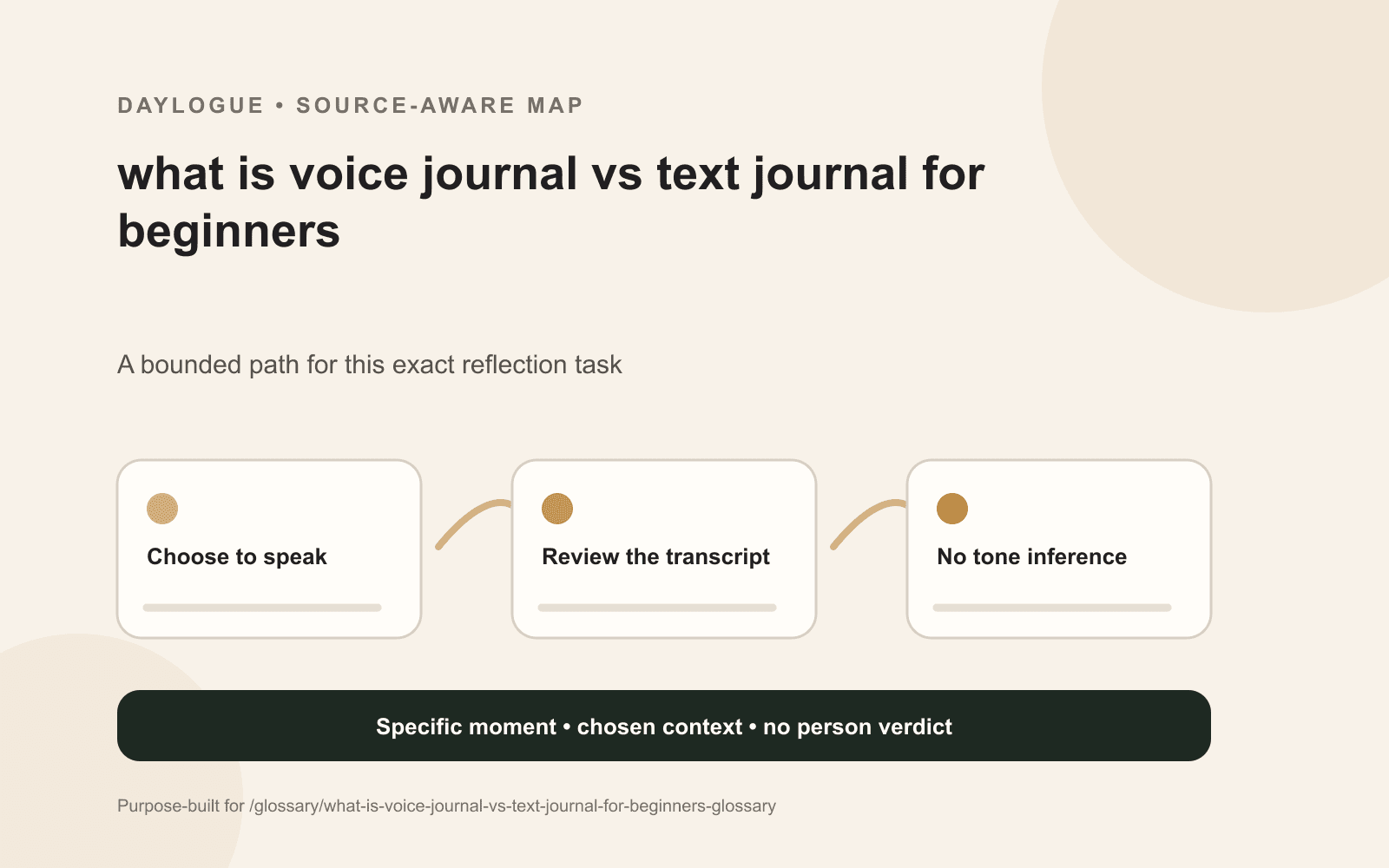
Daylogue does not infer emotion from faces, voice tone, or physiology. It works from the words and context people choose to share. This means a voice entry is not interpreted through facial expression, vocal tone, or a physiological signal.
Daylogue reads the entries you choose to sync to create narratives and surface patterns. Entries are not end-to-end encrypted. The statement applies to synced entries and keeps the server-processing limit visible. It does not describe an offline paper journal or promise that synced content is unreadable to the service.
The format does not decide the meaning
A fast voice note may sound intense because the person was walking uphill, rushing, or speaking near traffic. A polished text note may hide uncertainty because it was edited several times. The capture format alone cannot settle what the experience meant.
Later review works best when it returns to the chosen words and relevant context. The writer can correct a transcript, revise a typed sentence, or leave both versions intact. The format serves the source instead of becoming a verdict about the writer.
When each method may fit
Voice may fit when hands are occupied, thoughts are arriving quickly, and speaking is genuinely private. Text may fit when quiet matters, exact wording matters, or direct search matters. Handwriting may fit when the person wants a record outside a synced service.
The beginner answer stays simple: use the method that preserves the wanted detail with boundaries that feel appropriate in that moment. A different answer tomorrow does not invalidate today’s entry.
Checklist
Voice Journal vs Text Journal beginner card
A choice-preserving reference for voice journaling versus text journaling, with room for source details, context, uncertainty, privacy boundaries, and a later correction.
- Voice Journal vs Text Journal source detail: the setting.
- Voice Journal vs Text Journal nearby context: privacy around speaking.
- Voice Journal vs Text Journal optional extra: editing pressure.
- Voice Journal vs Text Journal open point: search and later review.
- Voice Journal vs Text Journal privacy choice: device, account, processing, export, and sharing boundaries.
- Voice Journal vs Text Journal ending: save, revise, return later, or stop here.
Common questions
What does voice journaling versus text journaling mean?
Voice journal versus text journal means a choice between speaking a reflection and recording it through typing or handwriting. It describes a way to keep information available for review, not a score, fixed verdict, or guaranteed result.
What is a simple example of voice journaling versus text journaling?
One voice journaling versus text journaling example is this: a new journaler speaks a rough two-minute note after a walk, then types a shorter version when a precise phrase matters. For voice journaling versus text journaling, that dated scene can stand on its own when it preserves the detail the writer hoped to remember.
What can a beginner include in voice journaling versus text journaling?
Voice Journal vs Text Journal may include the setting, privacy around speaking, editing pressure, search and later review. Within voice journaling versus text journaling, every piece is optional, and an unfinished entry can still preserve a useful source.
What are the limits of voice journaling versus text journaling?
A central voice journaling versus text journaling limit is that the format cannot reveal an emotion that was not expressed, and a transcript may not preserve pauses, emphasis, or every spoken word. By itself, voice journaling versus text journaling cannot recover missing days or settle a cause.
How does privacy work around voice journaling versus text journaling?
For voice journaling versus text journaling, the practical boundary depends on who can hear the recording, who controls the device, how the file is processed, and where synced text is stored. Around voice journaling versus text journaling, device, account, processing, export, and sharing boundaries can also inform how much detail feels appropriate.
Sources
Sources were checked on the dates shown. Product details and policies can change.
- Daylogue voice check-ins · Daylogue · checked September 2, 2026
- Daylogue privacy policy · Daylogue · checked September 2, 2026
Keep exploring
Daylogue Knowledge Center
Browse practical guides for reflection, journaling, patterns, and privacy.
Read moreHow Daylogue shows patterns
See how candidate patterns stay connected to evidence and correction.
Read moreWhy Daylogue exists
Read the principles behind a system for self-understanding.
Read moreDaylogue is not therapy and is not a replacement for professional care.