Written by Daylogue Editorial Team. Published August 21, 2026. Reviewed and updated August 21, 2026.
Work stress journal prompts for beginners are short questions that help one work moment stay specific. One question may be enough: what happened, what demand was present, and what boundary or support mattered? A useful note can end there. Later entries may add context, but repetition alone cannot prove why a feeling or response appeared.
One moment, not the whole job
A first work-stress note can stay close to a single scene. The last five minutes of a meeting, an unclear handoff, or the moment a deadline changed is easier to describe than an entire role. A date, a few remembered words, and what shifted from the usual routine give the entry enough shape to revisit without asking for a polished explanation.
Beginners often get more from a narrow question than a long prompt list. One sentence about the demand in front of you can be useful. Another sentence can name what you needed, expected, or wanted to clarify. The note remains a record of that moment, not a judgment about your work, your coworkers, or your ability to cope.
Save the moment, demand, and boundary
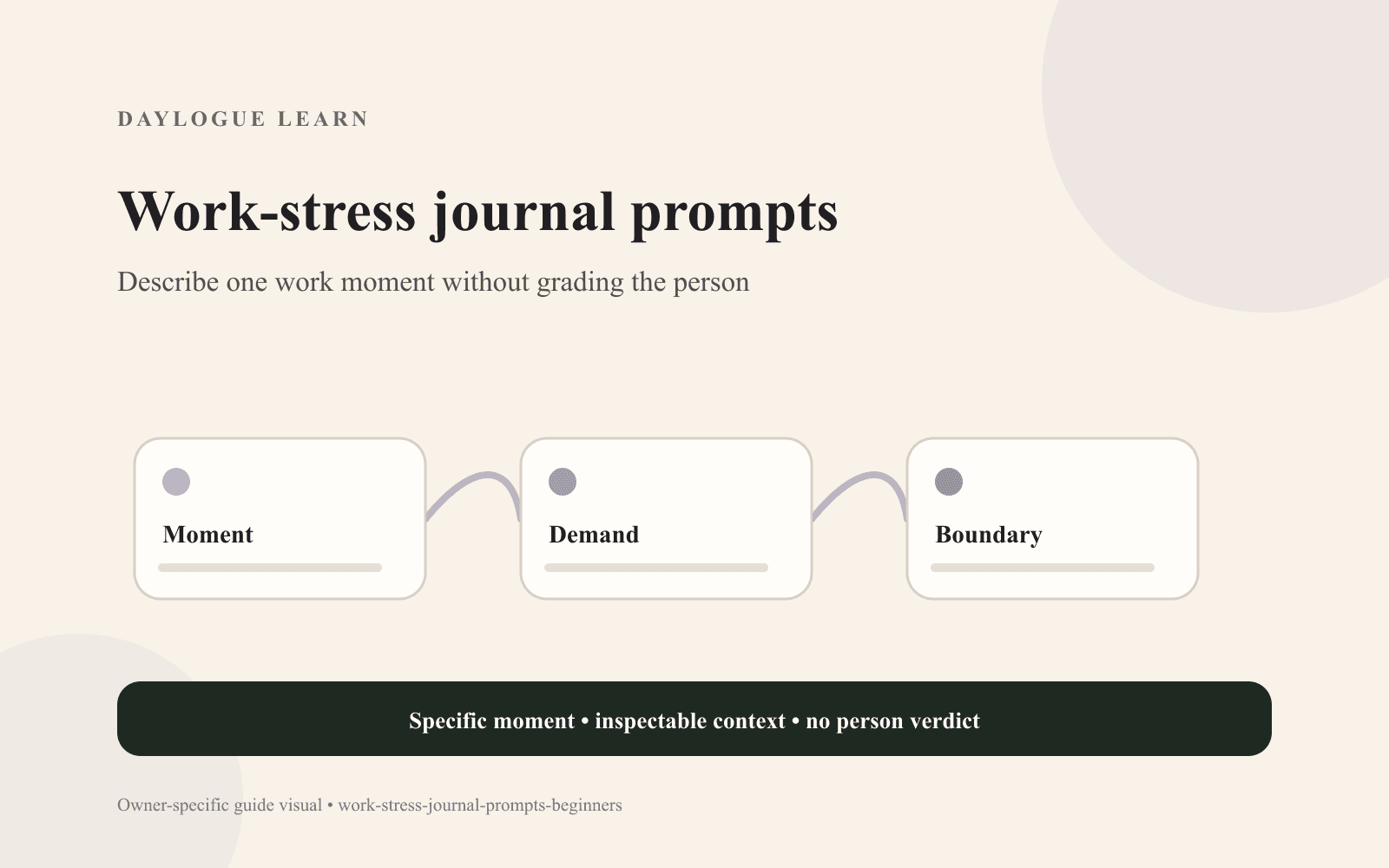
The assigned visual names three anchors: Moment, Demand, and Boundary. Moment locates the event. Demand names what required attention, such as time pressure, conflicting requests, or an unexpected change. Boundary records what limit, request, or stopping point was present or absent. These anchors make a short entry easier to understand when the immediate pressure has passed.
A boundary can be practical and small. It might be the need for a clearer owner, ten quiet minutes before another call, or permission to leave one question open overnight. Recording the boundary does not mean it was available or expressed. It simply preserves what would have changed the scene from your point of view.
Compare similar scenes with care
A recurring overlap does not show that one thing caused another. Three difficult meetings on crowded afternoons can support a question about timing, workload, or format. They cannot establish which condition produced the response. Dates, source entries, and a quiet counterexample keep the observation proportionate to what was actually recorded.
A fair comparison holds the scene steady where possible. A scheduled one-to-one and an emergency group call differ in audience, preparation, stakes, and control. Those differences belong beside the feeling recorded in each note. Language such as “showed up alongside” or “appeared in these entries” leaves room for another explanation and another day.
Choose work details with privacy in view
Your journal entries and check-in notes are stored on our servers in readable form, protected in transit by TLS and by per-user access controls in the database. Daylogue is not end-to-end encrypted because its servers read entries to create narratives and pattern candidates. That distinction matters before a note includes names, confidential projects, customer information, or sensitive workplace details.
A useful work entry rarely needs every identifying fact. Initials, a role, or a general description may preserve the context while limiting exposure. The amount of detail remains the writer’s choice. Storage, deletion, export, training terms, staff access, and any organizational visibility are worth understanding before personal or company information enters a journal.
Three ways a short note can work
After an unclear handoff, the note might say: “The owner changed near the end of the call, and I left unsure who would contact the client.” That sentence records the moment and demand. A second line could name the boundary: “I wanted a written owner before the meeting ended.” No motive needs to be assigned to anyone.
After a crowded afternoon, another note might record that two meetings ran together and lunch moved later. After a quiet win, a note might preserve that a colleague clarified a request early and the work felt easier to sequence. These entries point in different directions. Together they create a more useful record than five versions of the same conclusion.
Prompt Pack
Beginner work-stress prompt pack
Eight optional questions organized around the visual anchors Moment, Demand, and Boundary.
- What happened right before work started feeling heavier?
- Which demand took more attention than expected?
- What changed from the plan I began with?
- Where was ownership clear, and where was it uncertain?
- What boundary would have made this moment easier to navigate?
- Which part can remain unresolved tonight?
- What went better than my first summary suggests?
- What detail will help me recognize this situation later?
Common questions
How long can a beginner work-stress entry be?
Two or three sentences can be enough when they name one moment, one demand, and one useful detail. More writing remains optional.
Is every prompt meant to be answered?
No. The prompts are choices. One question can open the note, and the rest can wait for another day or remain unused.
When is it useful to review entries?
A review can begin when a specific question appears, such as whether unclear ownership keeps showing up in similar handoffs. Original dates and context stay visible.
Can repeated notes prove what causes work stress?
No. Repeated timing can support a careful question, while cause remains open. Counterexamples and changed conditions belong in the comparison.
How much workplace detail belongs in a journal?
Only the amount you choose after considering privacy, confidentiality, and retrieval. General roles or initials may provide enough context without recording every identifier.
Sources
Sources were checked on the dates shown. Product details and policies can change.
- Daylogue evidence and methods · Daylogue · checked August 21, 2026
- Daylogue privacy policy · Daylogue · checked August 21, 2026
Keep exploring
Daylogue Knowledge Center
Browse practical guides for reflection, journaling, patterns, and privacy.
Read moreHow Daylogue shows patterns
See how candidate patterns stay connected to evidence and correction.
Read moreWhy Daylogue exists
Read the principles behind a system for self-understanding.
Read moreDaylogue is not therapy and is not a replacement for professional care.