Written by Daylogue Editorial Team. Published August 21, 2026. Reviewed and updated August 21, 2026.
Work stress journal prompts for busy professionals are focused questions that record an event, its impact, and a possible next step in a few minutes. One work cue may be enough. The note can preserve workload, ownership, capacity, and changed conditions without turning the entry into another task or treating a repeated situation as proof of cause.
Write an operational note, not a life summary
A busy-day entry can stay close to one pressure point. “Two urgent requests arrived after the project owner left for the day” identifies the event and workload. It is more useful for later review than “Everything was chaos,” because the source of uncertainty remains visible without requiring a complete account of the week.
Operational language can include volume, timing, ownership, dependency, and available capacity. It does not need to sound detached. A note can also say the interruption felt frustrating or the uncertainty was hard to carry. The distinction is that the feeling remains connected to what the person chose to share, not inferred from tone, behavior, or physiology.
Use the three anchors: event, impact, and next step
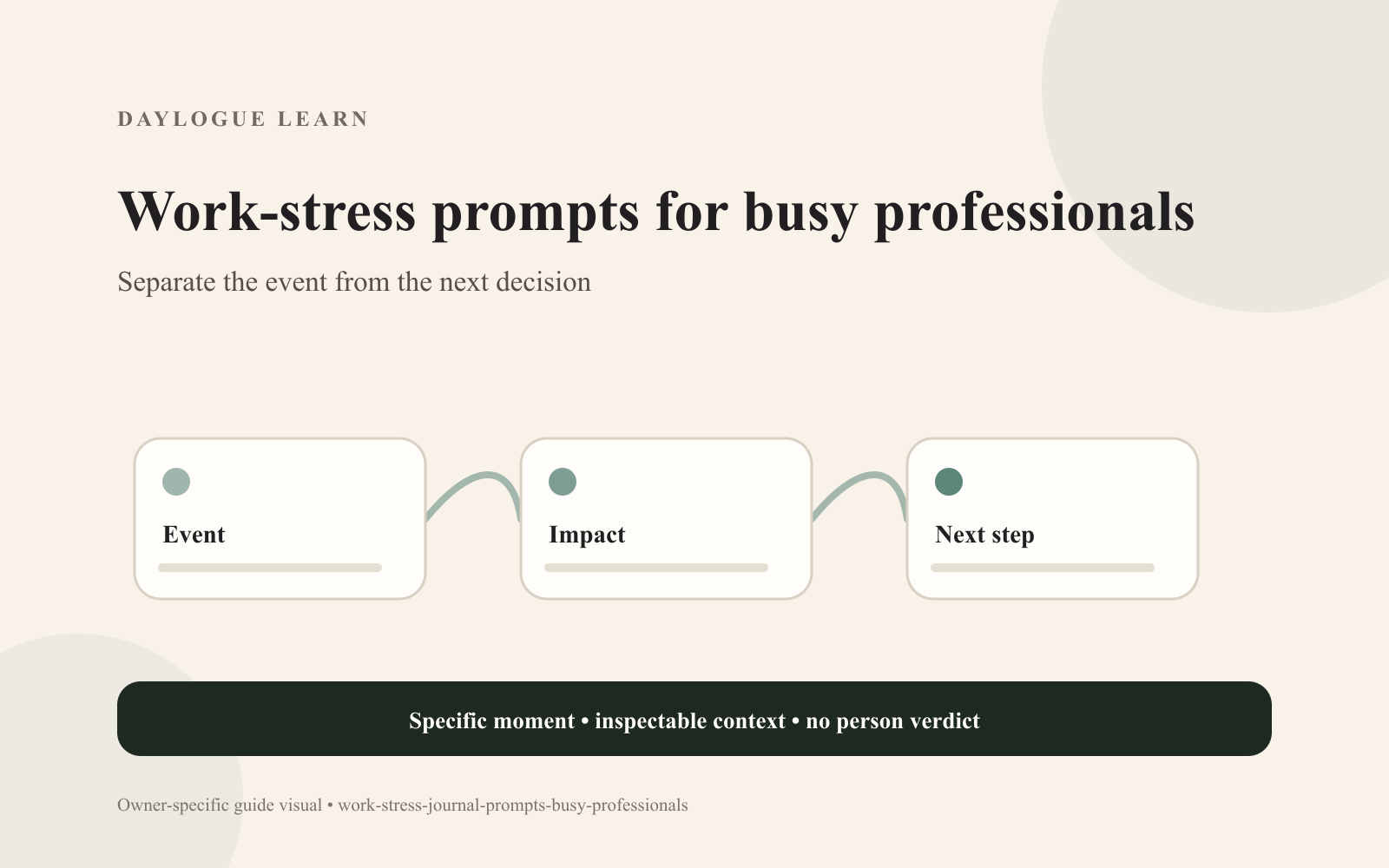
Event names what changed. Impact records what the change affected, such as sequence, focus, available time, or an existing commitment. Next step identifies the smallest reopening point, which might be a question about ownership rather than another task. These anchors fit a short entry and make it easier to resume work later.
A next step can be “Ask which deadline moves” or “Confirm who owns the customer reply.” It can also be “Leave this until morning.” The point is clarity about what remains open. The journal does not need to solve the workload or prescribe the right response.
The four lenses can separate problems that feel similar in the moment. A high workload with clear ownership creates a different record from a smaller task with no owner. A real deadline differs from a request presented with urgent language but no consequence. Capacity may change after interruptions, caregiving, travel, or a run of meetings. Naming the operational shape gives a later comparison more than one intensity word to work with.
Compare workload conditions without claiming cause
A recurring overlap does not show that one thing caused another. If unclear ownership and late work appear together in several entries, the record can support a question about handoffs. It cannot prove that ownership caused the later finish. A week with clear ownership and the same outcome, or unclear ownership without late work, belongs in the comparison.
Useful comparisons keep workload and capacity visible. Number of meetings, timing of requests, decision rights, available help, and existing commitments may differ even when two days share the word stressful. Original dates and notes prevent the comparison from becoming a broad statement about the job or the person doing it.
A fair comparison may pair two client deadlines, two planning meetings, or two handoffs involving the same role. The record can include what remained constant and what changed. Perhaps transition time was protected on one day, or the owner was clear before work began. That difference can suggest a process question. It remains an observation rather than proof that one condition caused the entire response.
Keep confidential operational detail at the level you choose
Your journal entries and check-in notes are stored on our servers in readable form, protected in transit by TLS and by per-user access controls in the database. Daylogue’s servers read entries to create narratives and pattern candidates, so Daylogue is not end-to-end encrypted. That boundary matters when an operational note could identify a customer, employee, contract, incident, or unreleased project.
A general project label, role, or rounded description may be enough to preserve the impact. Company policy may place additional limits on what can enter any external journal. The writer can consider storage, AI processing, training terms, access, deletion, export, and confidentiality before selecting the detail.
Four examples that lead to different questions
A calendar overload note may ask which commitment displaced planned focus. A handoff note may ask who had decision rights. A scope-change note may record which assumption became outdated. An interruption note may preserve what was paused and what will make resuming easier. Each prompt has a specific operational job.
After a customer escalation, the useful next step might be confirming ownership. After three meetings move, it might be choosing which preparation window survives. After a quiet but demanding day, the note may simply record that focused work used more capacity than expected. These distinct examples make the page useful beyond a generic work-stress template.
The next observable point might be the time ownership becomes clear, the arrival of missing information, or the first protected block on tomorrow’s calendar. Recording that point makes the note retrievable without converting it into advice. A future review can ask whether the operational condition appeared again, what capacity was available, and which counterexample prevents the workweek from collapsing into an “always” statement.
Prompt Pack
Event, impact, and next-step work prompts
Eight optional questions for recording workload, ownership, and capacity without adding another completion target.
- What event changed the shape of the day?
- Which commitment absorbed more capacity than expected?
- Where is ownership still unclear?
- What dependency is holding the work open?
- Which deadline or scope assumption changed?
- What impact is visible right now?
- What question would clarify the next step?
- What can wait without being rehearsed tonight?
Common questions
How long can a busy-professional work-stress entry take?
A few lines can be enough to record the event, impact, and next question. More writing is optional.
Which prompt fits an overloaded day?
A question about changed commitments, capacity, ownership, or dependencies can be more useful than a broad request to summarize everything.
How can I compare workweek entries?
Place similar situations together and preserve dates, workload, ownership, capacity, and counterexamples.
Can recurring work notes establish what caused the pressure?
No. They can support a question about conditions, while cause remains open.
What operational details are safer to omit?
Customer names, employee information, contract terms, security details, and confidential projects may not be needed for a useful personal note.
Sources
Sources were checked on the dates shown. Product details and policies can change.
- Daylogue evidence and methods · Daylogue · checked August 21, 2026
- Daylogue privacy policy · Daylogue · checked August 21, 2026
Keep exploring
Daylogue Knowledge Center
Browse practical guides for reflection, journaling, patterns, and privacy.
Read moreHow Daylogue shows patterns
See how candidate patterns stay connected to evidence and correction.
Read moreWhy Daylogue exists
Read the principles behind a system for self-understanding.
Read moreDaylogue is not therapy and is not a replacement for professional care.