Written by Daylogue Editorial Team. Published August 26, 2026. Reviewed and updated August 26, 2026.
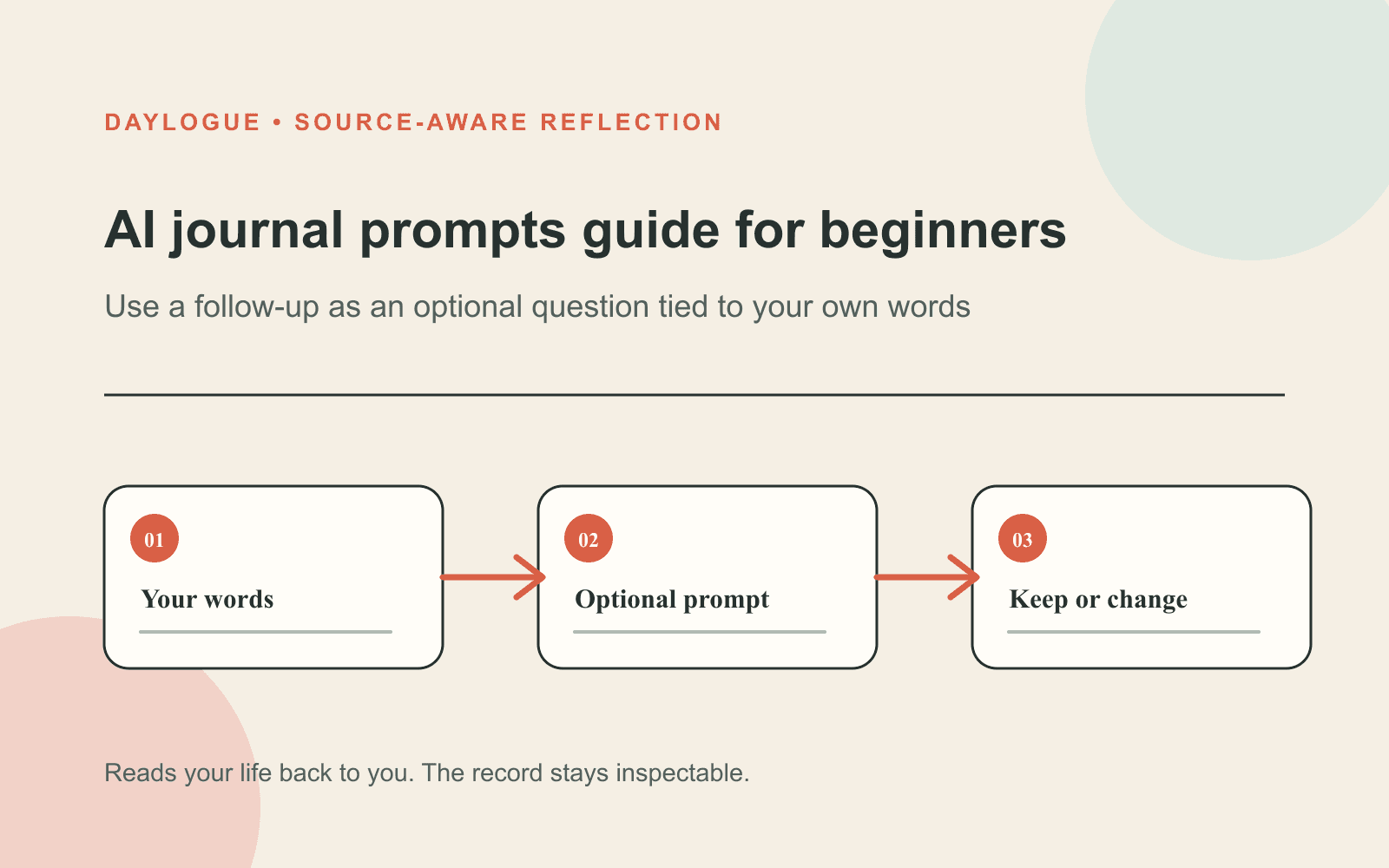
AI journal prompts can help a beginner move past an empty page by offering one focused question at a time. Start with a moment you can describe, such as a decision, conversation, delay, or small surprise. Keep the answer in your own words and change or skip any prompt that points the wrong way. The tool can help you begin and organize. It cannot know the whole context, decide what another person meant, or turn one entry into a verdict about you.
One moment, not your whole life
The hardest prompt is often ‘How are you?’ because the honest answer can include sleep, family, friendships, work, money, and whatever happened five minutes ago. A narrower frame can help. Start with one moment still following you, such as the relief when a deadline moved, a text you keep rereading, or the quiet walk home. One scene gives the entry somewhere real to begin.
What happened can come before what it might say about you. “I opened the assignment three times and switched tabs” is an event you can examine. “I am lazy” is a verdict. The event leaves room for missing instructions, fear of starting, exhaustion, distraction, or a task that was simply boring. Specificity creates room to understand the moment without excusing or judging it.
- What happened in one scene?
- What detail keeps replaying?
- What else was happening around it?
- What do I know, and what am I assuming?
What an AI prompt adds
A fixed journal prompt gives everyone the same question. An AI prompt can respond to what you write and ask about the part you emphasized. If you mention that a group project felt strange, a follow-up might ask what changed. If you mention a good conversation, it might ask what made it feel different. That responsiveness can reduce blank-page pressure and make a short entry feel less generic.
The tradeoff is influence. A follow-up can make one detail seem more important than it was, assume the wrong cause, or use language that does not sound like you. The question is a suggestion. A different question, a corrected frame, “that is not the point,” or ending the entry are all available choices. The prompt does not have authority over your memory or the meaning of the day.
| Prompt style | Useful when | Watch for |
|---|---|---|
| Fixed question | You want a predictable routine | The question may not fit today |
| Adaptive AI prompt | You want a relevant follow-up | The follow-up may steer the story |
| Blank page | You already know what to say | Starting can take more energy |
| Quick check-in fields | You have less than a minute | Numbers can lose the context |
Class prompts can examine the work without grading you
After a class, meeting, or focused work block, a prompt might ask what became clearer, what is still fuzzy, and what example would help. Before a demanding task, it might ask what feels hard to begin and what would make the first ten minutes smaller. Afterward, the record can hold what surprised you about the preparation or conditions before any result arrives. These questions show how the work happened without pretending one outcome explains your ability.
Academic reflection stays grounded when it remains close to observable choices. “I remember more when I explain the concept aloud” is a useful note. “I am a visual learner” may be too broad if it came from one session. “The library was quieter than my room tonight” names a condition worth testing again. Your journal can hold experiments and exceptions without becoming another gradebook.
- What part of this topic can I explain without notes?
- Where did I lose the thread, exactly?
- What condition helped me begin today?
- What would make the next study block easier to enter?
- What surprised me about how I prepared?
Use a three-line shape when the first sentence feels hard
A repeatable shape can remove the decision about how to begin. Line one names an event or choice. Line two describes how it landed in words that sound like you. Line three holds an open question. You do not have to answer that question now.
For example: "I kept reopening the message. My shoulders tightened each time. Was I unsure about the wording or the response?" The entry records what you noticed without pretending to know the cause. Later context may change how you read it.
01
Name the moment
Record one event, choice, conversation, or shift in attention that you can place in the day.
02
Use your words
Describe how it landed without forcing a feeling label or making the sentence sound polished.
03
Leave a question open
Write one thing you might want to notice again, then stop without demanding an answer.
Let the prompt start the entry, not interpret it
A generated prompt can help with the blank page, but it should not tell you why you acted a certain way or what your response proves about you. Rewrite any question that assumes a motive. "Why do I always avoid conflict?" can become "What happened before I decided not to respond?"
Daylogue says its observations are designed for reflection, not diagnosis, prediction, treatment, or clinical decision-making. It is not therapy and is not a replacement for professional care. The same boundary is useful for prompts. A question should help you look closer while leaving conclusions open.
- Prefer what, when, and which questions.
- Remove words such as always and never.
- Keep causes as questions, not answers.
- Skip prompts that feel too personal.
Turn a vague answer into something you can revisit
A sentence such as "daily life was stressful" may be true, but it gives future you little to work with. Add one observable detail: "I felt rushed after the lab ran late, and I carried that feeling into dinner." The added detail does not need to explain why anything happened. It simply records the sequence. Names, locations, and private specifics are optional. You can write "a group project" instead of identifying the people involved.
A useful entry often contains three pieces: the moment, your own words for how it landed, and one open question. For example: "I kept checking the time during the study session. I felt scattered. Was I tired, worried about the exam, or simply done for the day?" Leave the question open. Reflection is allowed to preserve uncertainty. You can notice what happened without turning one day into a verdict about who you are.
01
Name the moment
Record one event, choice, or change in attention that you can place in the day.
02
Use your own words
Describe how it landed without reaching for a label that does not feel like yours.
03
Leave one question open
Write what you are curious about, then let a later entry add context if it ever does.
Begin with evidence from your actual day
Broad questions such as "Who am I?" can produce broad answers. Start closer to the ground. Ask when you lost track of time this week, which commitment you wanted to keep, or what made you speak up when staying quiet would have been easier. These moments show how you moved through a real situation. They do not prove a permanent trait, but they give you something honest to examine.
Write the event before the interpretation. ‘I stayed a few minutes to finish the conversation’ is an event. ‘I care about understanding things fully’ is one possible reading. Add another possibility if it exists. Maybe you were curious, worried about an unresolved detail, or enjoying the conversation. Keeping observation and interpretation separate makes the page easier to revisit. Future entries can support, complicate, or replace your first explanation.
| Topic | Too broad | Try this instead |
|---|---|---|
| Values | What are my values? | Which choice this week felt worth the effort? |
| Strengths | What am I good at? | What did someone ask me to help with? |
| Belonging | Where do I fit? | Where did I edit myself less? |
| Direction | What should I do with my life? | Which next step feels worth testing? |
| Boundaries | What are my limits? | What did I agree to and later resent? |
Use a journal tool that leaves interpretation with you
A digital journal can help you search old entries or notice repeated words, but it should not hand down a verdict about your personality. Look for tools that show where an observation came from, allow corrections, and explain how your data is handled. Be cautious when software claims to know your motives, predict your future, or identify an emotion from your face, voice tone, or body. Your own words and choices should remain the source.
Daylogue does not run emotion recognition on your face or on the tone of your voice. It works from what you choose to share. Daylogue stores AI-generated summaries and insights in readable form. Entries are not end-to-end encrypted. Read those details before using it for private reflection. Whatever tool you choose, let it preserve your questions rather than replace them with answers. Daylogue is not therapy and is not a replacement for professional care.
Check the evidence and privacy boundary
Daylogue states that a recurring overlap does not show that one thing caused another. That limit matters when an AI prompt points toward a repeated theme. Use the suggestion as a question you can inspect against the entries, missing days, and moments that do not fit.
Daylogue says most journal entries and check-in notes are stored in readable form on its servers so it can write narratives and surface patterns. Daylogue does not use personal entries to train its own models. Provider handling follows current written terms, configuration, and subprocessor disclosures. Read the current policy yourself before including names, workplace details, or another person’s private information.
Prompt Pack
Fifteen first prompts for beginner AI journaling
Pick one question that matches a real moment, answer only what feels useful, and change the wording whenever the prompt misses your context.
- What moment is still easy to picture?
- What took more effort than I expected?
- What choice is actually in front of me?
- What detail would change my first explanation?
- What did I hear, and what am I assuming?
- What stayed unsaid in that conversation?
- What helped me begin something difficult?
- What made an ordinary task feel lighter?
- Which expectation am I carrying today?
- What information is still missing?
- What would a counterexample to this thought look like?
- What do I want to remember a week from now?
- What name or detail can I leave out for privacy?
- Which part can remain unresolved?
- What is one sentence I know is accurate?
Common questions
What should a beginner write in a first AI journal entry?
Choose one recent moment and record what happened, what stood out, and what context might change the first interpretation. One honest paragraph is enough.
Do I have to answer every AI journal prompt?
No. Skip, shorten, or rewrite any question. A prompt is useful only when it helps you express what you chose to examine in your own words.
Can an AI journal tell me what my entry really means?
It can suggest a question or organize the details you shared, but it does not know every circumstance and should not issue a verdict about you or anyone else.
How should a beginner check an AI journal’s privacy?
Read what is stored, whether entries are readable to the service, which providers process them, how deletion works, and whether content is used for advertising or model training.
What if the first prompt feels too personal?
Leave details out, replace names, choose a lighter moment, type instead of speaking, or stop. Your boundary matters more than completing the prompt.
Sources
Sources were checked on the dates shown. Product details and policies can change.
- Daylogue evidence and methods · Daylogue · checked August 26, 2026
- Daylogue privacy policy · Daylogue · checked August 26, 2026
Keep exploring
Daylogue Knowledge Center
Browse practical guides for reflection, journaling, patterns, and privacy.
Read moreHow Daylogue shows patterns
See how candidate patterns stay connected to evidence and correction.
Read moreWhy Daylogue exists
Read the principles behind a system for self-understanding.
Read moreDaylogue is not therapy and is not a replacement for professional care.