Written by Daylogue Editorial Team. Published August 29, 2026. Reviewed and updated August 29, 2026.
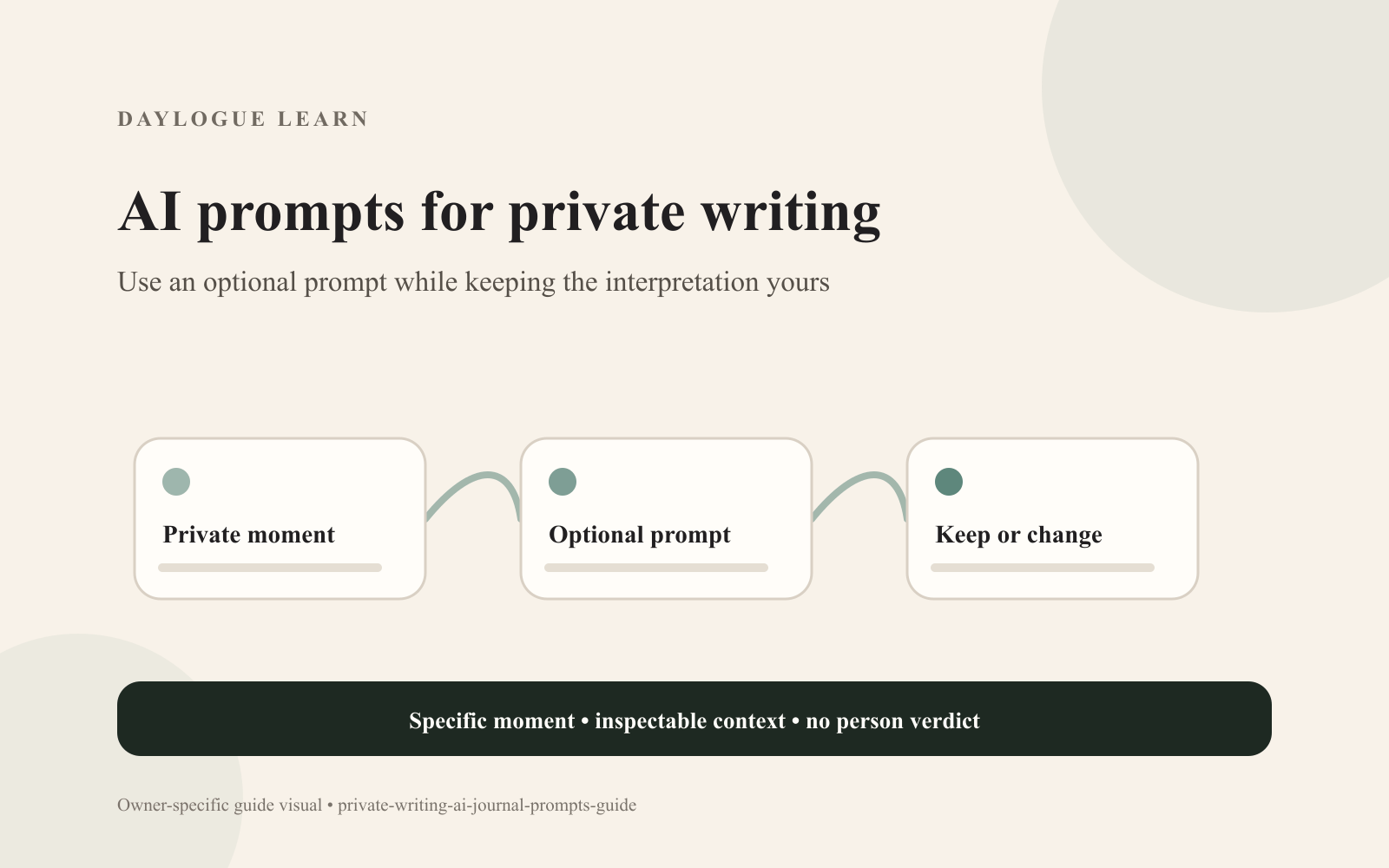
For private writing, ask an AI journal for one optional question about a moment you name. Remove any assumed motive, fixed trait, or emotional label from the prompt. Answer in your own words, inspect what becomes part of the saved record, and edit or discard generated text that changes your meaning. The prompt starts the entry. It does not own the interpretation.
What an optional AI question can add
An AI question can give a private entry a starting edge. You name the situation, ask for one neutral question, and decide whether it fits. The useful part is the invitation to notice a detail you might have skipped. The question should not supply your motive, label your character, or turn uncertainty into an answer.
Keep the interpretation yours. Edit wording that sounds unlike you, skip questions that feel invasive, and discard generated text that bends the record. Private writing can remain unfinished. The tool does not earn more detail simply because it asked.
Use a three-line shape when the first sentence feels hard
A repeatable shape can remove the decision about how to begin. Line one names an event or choice. Line two describes how it landed in words that sound like you. Line three holds an open question. You do not have to answer that question now. Keep the private response tied to the chosen private scene rather than a fixed identity.
For example: "I kept reopening the message. My shoulders tightened each time. Was I unsure about the wording or the response?" The private response records what you noticed without pretending to know the cause. Later context may change how you read it. Keep the private response tied to the chosen private scene rather than a fixed identity.
01
Name the chosen private scene
Record one event, choice, conversation, or shift in attention that you can place in the day.
02
Use your words
Describe how it landed without forcing a feeling label or making the sentence sound polished.
03
Leave a question open
Write one thing you might want to notice again, then stop without demanding an answer.
Turn a vague answer into something you can revisit
A sentence such as "daily life was stressful" may be true, but it gives future you little to work with. Add one observable detail: "I felt rushed after the lab ran late, and I carried that feeling into dinner." The added detail does not need to explain why anything happened. It simply records the sequence. Names, locations, and private specifics are optional. You can write "a group project" instead of identifying the people involved. Leave one optional AI question open when the available context is incomplete.
For this private writing task, let “Turn a vague answer into something you can revisit” have a narrow job. Use one optional AI question, answer with a dated action or phrase, and stop before the answer turns into a verdict. If the first explanation feels certain, list one missing fact and one counterexample you would need to check before keeping it.
01
Name the chosen private scene
Record one event, choice, or change in attention that you can place in the day.
02
Use your own words
Describe how it landed without reaching for a label that does not feel like yours.
03
Leave one question open
Write what you are curious about, then let a later private response add context if it ever does.
Start with one chosen private scene, not your whole day
A workday check-in gets easier when the optional AI question has clear edges. "How was work?" can feel too large. "What took most of my attention?" gives you a place to begin. Name the chosen private scene, add one detail, and stop if that is all you have.
Choose questions about what happened, what changed, or what stayed with you. These optional AI questions keep the private response close to your own record. They also leave the meaning with you. If a question does not fit, skip it without replacing it.
- What took most of my attention?
- Which choice felt harder than expected?
- What detail do I want to remember?
- When did my energy change?
- What felt easier this time?
- What can remain unanswered during the workday?
Optional AI questions for examining a decision
Project priorities, role changes, budgets, schedules, client requests, and team commitments can all compete at once. A private response about a decision does not need to produce the answer. The choice, what matters most, missing information, and what could reopen the decision can stay in the record. This gives your future self the context that disappears once the outcome is known. Keep the private response tied to the chosen private scene rather than a fixed identity.
Preference and pressure can appear as separate parts of the private response. An optional AI question might ask what you would choose without an immediate explanation, whose expectations are present, and which constraint is real during the workday. Keep the tradeoff and final choice in your hands. The optional AI question can make your own reasoning easier to see and discuss with someone you trust. Keep the private response tied to the chosen private scene rather than a fixed identity.
01
The actual choice
The options can stay in plain language without expanding into a judgment about your future.
02
Values and constraints
What matters to you can sit apart from deadlines, costs, obligations, and expectations that shape the choice.
03
Missing information
Missing information may point to a question for a manager, subject-matter expert, experienced peer, or trusted person.
04
A revisit point
A later review point can support the decision without keeping it open every hour.
Review your pages without boxing yourself in
When you reread, mark recurring verbs, situations, and choices. Maybe "explaining," "building," or "organizing" appears several times. Maybe you keep writing about quiet mornings or last-minute plans. Consider these repetitions questions. Ask what else was true on those days and where the pattern did not appear. Avoid turning a handful of private responses into "I am the kind of person who always..." Your context can change, and so can you. Leave one optional AI question open when the available context is incomplete.
Keep expectations for AI prompts modest, then inspect the result
A 2025 systematic review examined 51 positive expressive writing studies, and the authors rated the included studies poor or fair in quality. The formats, topics, comparisons, and outcomes varied. Use that evidence as a reason to keep expectations modest, not as a promise that one question, schedule, or writing style will create a particular result.
Daylogue says its observations are designed for reflection, not diagnosis, prediction, treatment, or clinical decision-making. For this AI prompts guide, the useful standard is simpler: does the private response preserve a chosen private scene, show what remains unknown, and leave the interpretation open to revision? If not, shorten or change the optional AI question.
Use AI questions without pressure
Ask for one question rather than a sequence. You might request a cue about a decision, a conversation, an ordinary detail, or something that remains unresolved. Answer in a sentence if that is enough. You can also rewrite the question before answering or leave it blank.
A useful private-writing question keeps the moment specific and the conclusion open. “What changed before I made the choice?” leaves more room than “Why do I always avoid hard things?” The first points back to your record. The second arrives with a verdict already attached.
Keep, change, or discard the generated question
Before answering, check the question for assumed motives, fixed labels, and details you did not provide. Keep it when it opens a useful direction. Change it when the language is too certain. Discard it when the question asks for more than you want to share.
After writing, inspect what became part of the saved record. Separate your words from generated questions and summaries. Correct anything that changes the meaning, and use the service only within privacy terms you understand.
Prompt Pack
AI Journal Prompts for Private Writing: twelve prompts
Choose one question for a specific AI prompts moment, answer in your own words, and leave the interpretation open to later context.
- What part of this moment do I want to name?
- Which detail can stay broad?
- What changed before I made the choice?
- What assumption is hiding inside the prompt?
- Which word sounds unlike me?
- What am I not ready to decide?
- What fact am I returning to?
- What alternative explanation deserves room?
- What would I remove before saving?
- What do I want to keep in my own wording?
- What question feels honest but not invasive?
- What can remain private and unfinished?
Common questions
What part of this moment do I want to name?
Use this as an optional AI question about a decision you want to examine without saving names or unnecessary background. Answer with one observable detail first, then add your current reading only if it helps. You can stop after the record is clear.
What changed before I made the choice?
Keep the answer inside one chosen private scene. Write what changed, what stayed fixed, and which fact is missing. That structure prevents a limited private response from becoming a verdict about a person or an entire period.
What am I not ready to decide?
Put the direct answer in your own words and remove names that add nothing to the task. If the question assumes a motive or outcome, rewrite it so the missing context remains visible.
What would I remove before saving?
Return to dated source lines before calling this a repeat. Look for an exception and an unrecorded gap. A repetition can support another question, but it cannot prove a cause by itself.
What can remain private and unfinished?
Leave this unanswered when the available record is too thin. A useful private writing practice allows an open question, a visible gap, and a clean stopping point without inventing completion.
Sources
Sources were checked on the dates shown. Product details and policies can change.
- Daylogue evidence and methods · Daylogue · checked August 29, 2026
- Positive expressive writing systematic review · PLOS One · checked August 29, 2026
Keep exploring
Daylogue Knowledge Center
Browse practical guides for reflection, journaling, patterns, and privacy.
Read moreHow Daylogue shows patterns
See how candidate patterns stay connected to evidence and correction.
Read moreWhy Daylogue exists
Read the principles behind a system for self-understanding.
Read moreDaylogue is not therapy and is not a replacement for professional care.