Written by Daylogue Editorial Team. Published August 14, 2026. Reviewed and updated August 14, 2026.
The best AI journal prompts for short check-ins point to one moment you can describe in your own words. Try: What took most of my attention? What choice felt harder than expected? What detail do I want to remember? Answer in one to three lines. A useful prompt opens the door. It does not decide what the moment means or require you to keep writing.
Start with one moment, not your whole day
A short check-in gets easier when the prompt has clear edges. "How was today?" can feel too large. "What took most of my attention?" gives you a place to begin. Name the moment, add one detail, and stop if that is all you have.
Choose questions about what happened, what changed, or what stayed with you. These prompts keep the entry close to your own record. They also leave the meaning with you. If a question does not fit, skip it without replacing it.
- What took most of my attention?
- Which choice felt harder than expected?
- What detail do I want to remember?
- When did my energy change?
- What felt easier this time?
- What can remain unanswered today?
Pick the size of the check-in before you write
Decide how much space you want to give the entry before the prompt appears. Three words can hold a quick impression. One sentence can preserve a specific event. Three lines can capture what happened, how it landed, and one question you want to leave open.
A limit can make stopping feel natural. It also prevents a small reflection from quietly becoming a long task. If more words arrive and you want to continue, keep going. The limit is permission to stop, not a rule about how much you may say.
| Available time | Prompt shape | Possible response |
|---|---|---|
| 30 seconds | What stands out? | Three words |
| 1 minute | What took my attention? | One sentence |
| 2 minutes | What changed in this moment? | Before and after |
| 3 minutes | What am I curious about? | Moment plus question |
Use a three-line shape when the first sentence feels hard
A repeatable shape can remove the decision about how to begin. Line one names an event or choice. Line two describes how it landed in words that sound like you. Line three holds an open question. You do not have to answer that question now.
For example: "I kept reopening the message. My shoulders tightened each time. Was I unsure about the wording or the response?" The entry records what you noticed without pretending to know the cause. Later context may change how you read it.
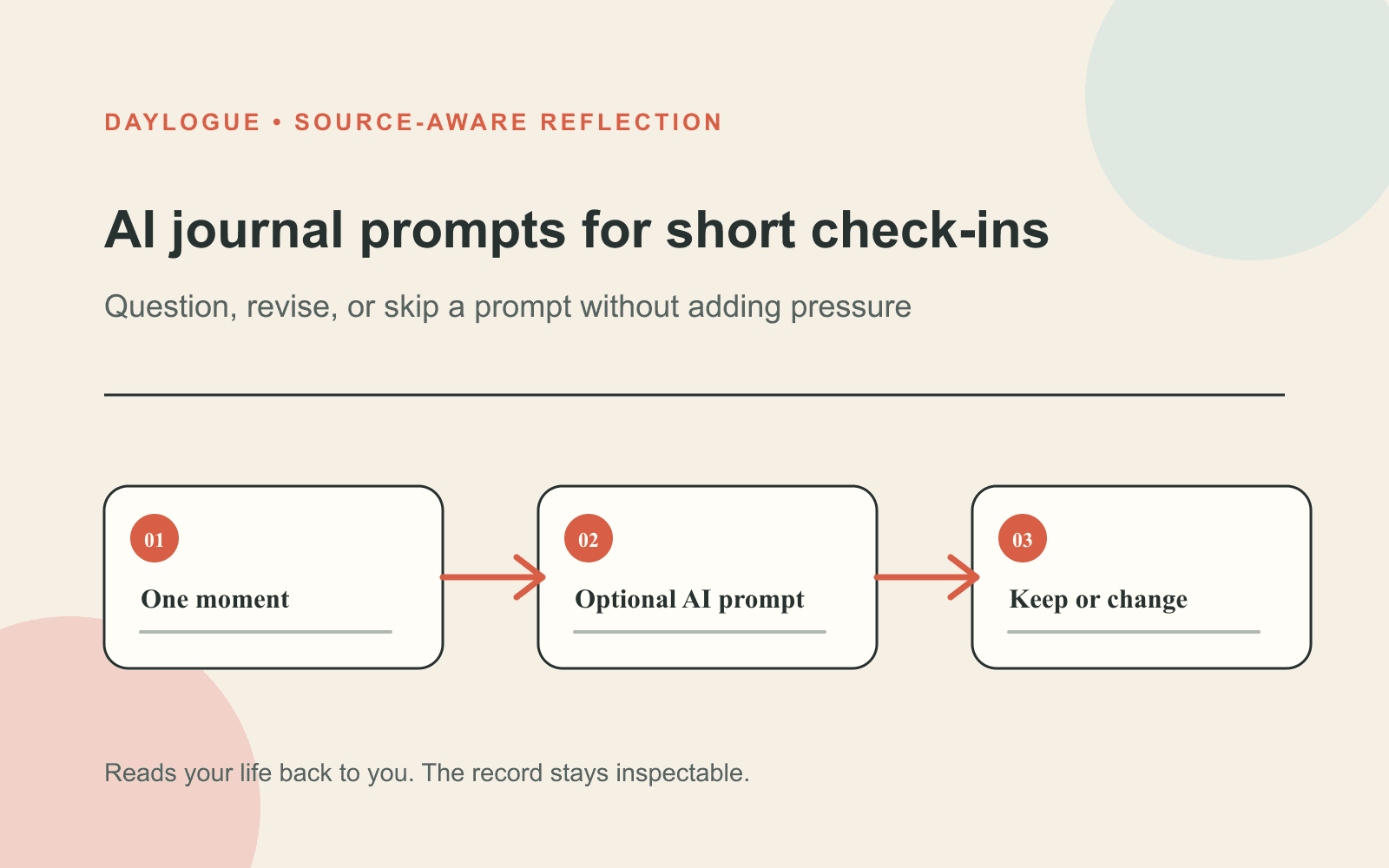
01
Name the moment
Record one event, choice, conversation, or shift in attention that you can place in the day.
02
Use your words
Describe how it landed without forcing a feeling label or making the sentence sound polished.
03
Leave a question open
Write one thing you might want to notice again, then stop without demanding an answer.
Let the prompt start the entry, not interpret it
A generated prompt can help with the blank page, but it should not tell you why you acted a certain way or what your response proves about you. Rewrite any question that assumes a motive. "Why do I always avoid conflict?" can become "What happened before I decided not to respond?"
Daylogue says its observations are designed for reflection, not diagnosis, prediction, treatment, or clinical decision-making. It is not therapy and is not a replacement for professional care. The same boundary is useful for prompts. A question should help you look closer while leaving conclusions open.
- Prefer what, when, and which questions.
- Remove words such as always and never.
- Keep causes as questions, not answers.
- Skip prompts that feel too personal.
Compare short entries without turning them into a verdict
After several check-ins, look for repeated situations and the entries that do not fit. You might notice the same weekly slot beside feeling rushed, or the same phrase appearing around a certain kind of choice. Write what appeared and where. Watch for a small record hardening into a fixed label.
Daylogue states that a recurring overlap does not show that one thing caused another. Keep the source entries close, check exceptions, and use tentative language. "This came up in three entries" stays inspectable. "This is just who I am" closes the question too early.
- Return to the exact entries behind an observation.
- Count comparable moments, not a score about yourself.
- Look for exceptions and missing context.
- Keep the interpretation open to revision.
Check what the journal can read and store
Short entries can still contain names, work details, and private thoughts. Before using an online journal, read what its servers can access, which providers process the content, whether entries train models, and how export and deletion work. Turn off notification previews on a shared device.
Daylogue says most journal entries and check-in notes are stored in readable form on its servers so it can write narratives and surface patterns. It is not end-to-end encrypted. Daylogue says it does not sell personal data, use entries for advertising, or train AI models on personal entries. Decide whether those terms fit what you want to record.
- Read storage and server-access terms.
- Check model-training and advertising language.
- Find export and deletion controls.
- Use broad descriptions when names are unnecessary.
Keep expectations grounded
A 2025 systematic review examined 51 positive expressive writing studies in non-clinical populations, and the authors rated the included studies poor or fair in quality. The methods and writing formats varied. That evidence does not make any single prompt a guaranteed route to feeling better.
Use a prompt because it helps you notice, remember, or put words around a moment. Change the question, shorten the answer, or stop when the format is not useful. Your check-in remains yours, including the choice not to complete it.
Test the prompt system before private writing
Start with an ordinary event that carries little personal risk. Ask the journal for one short question about a meal, a commute, a study block, or a small decision. Notice whether the prompt stays with the event you named. A useful question should narrow the starting point without adding a motive, a feeling, or a backstory you did not provide.
Try the same request twice with different limits. Ask for a one-sentence check-in, then ask for three optional questions. Compare whether the journal respects the size you requested. If it keeps adding follow-ups after you have answered, look for a clear end control or use a simpler mode. Short should describe the interaction, not just the first prompt.
Read the saved entry after the exchange. Separate your words from generated questions and summaries. Correct anything that changed the meaning, and check whether deleting the conversation also removes its saved outputs. This small test shows how the tool behaves before you trust it with names, relationships, work details, or anything else you would rather keep tightly controlled.
Repeat the test after changing one setting, such as conversation mode, saved history, or prompt length. Confirm that the next check-in follows the new choice. A setting only helps when its effect is visible in the experience and in the record you can inspect afterward.
- Begin with a low-stakes event.
- Request a specific answer length.
- Check whether follow-ups are optional.
- Inspect what becomes part of the saved record.
- Test correction, export, and deletion controls.
Prompt Pack
Twelve prompts for short journal check-ins
Pick one question, answer in one to three lines, and keep the meaning open until later context gives you more to compare.
- What took most of my attention?
- Which choice felt harder than expected?
- What detail do I want to remember?
- When did my energy change?
- What felt easier this time?
- What did I postpone even though it was small?
- What did I say clearly?
- What stayed unsaid?
- What surprised me today?
- What competing priorities showed up?
- What can remain unanswered today?
- What am I curious to notice again?
Common questions
What is a good AI journal prompt for a short check-in?
Ask about one observable moment, such as what took your attention, what changed, or what detail you want to remember. Answer in one to three lines.
Can a one-sentence entry still be useful?
Yes. One specific sentence can preserve a moment you may want to revisit. It does not need a lesson, summary, or polished ending.
Should an AI journal explain what my entry means?
No. A prompt can help you begin, but the interpretation should remain yours. Rewrite questions that assume motives, causes, or fixed traits.
Do I need to answer the same prompt every day?
No. Use a small menu and pick what fits the moment. Repetition can support comparison, but it should not become an attendance rule.
What if a prompt feels too personal?
Skip it, change the wording, or write in broad terms. You decide what to record and whether you ever reread, export, or share it.
Sources
Sources were checked on the dates shown. Product details and policies can change.
- Daylogue evidence and methods · Daylogue · checked August 14, 2026
- Daylogue privacy policy · Daylogue · checked August 14, 2026
- Positive expressive writing systematic review · PLOS One · checked August 14, 2026
Keep exploring
Daylogue Knowledge Center
Browse practical guides for reflection, journaling, patterns, and privacy.
Read moreHow Daylogue shows patterns
See how candidate patterns stay connected to evidence and correction.
Read moreWhy Daylogue exists
Read the principles behind a system for self-understanding.
Read moreDaylogue is not therapy and is not a replacement for professional care.