Written by Daylogue Editorial Team. Published August 12, 2026. Reviewed and updated August 12, 2026.
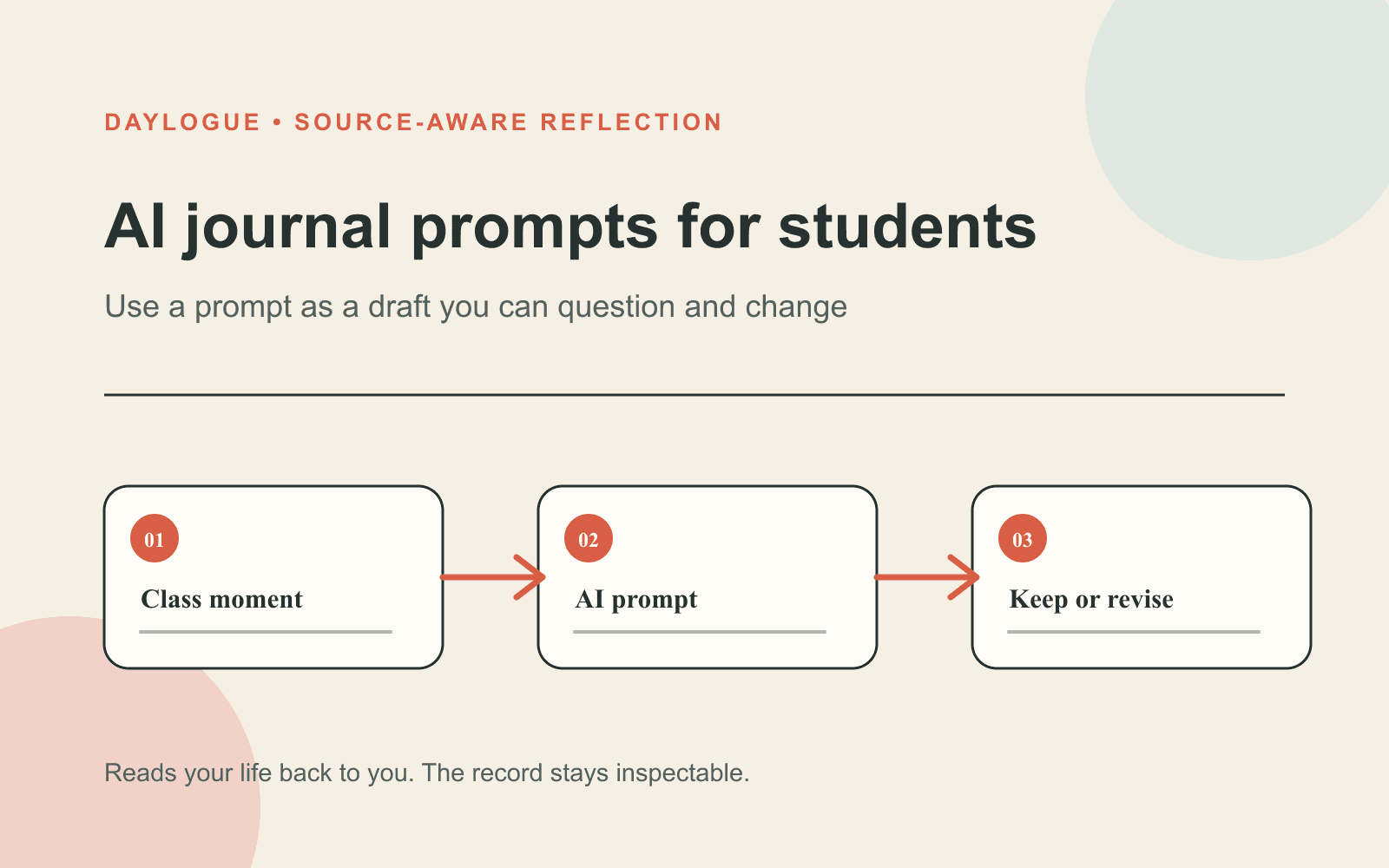
AI journal prompts can help students start writing by asking one focused question and adapting to the detail they choose to share. They can fit a class moment, friendship, decision, transition, or week that feels hard to sort. A useful prompt asks what happened, what stood out, and what context matters. It does not tell you what a feeling means for your health, predict your grades, read emotion from your face or voice tone, or decide what another person meant. Entries can stay as short as needed, any question is optional, and the service's storage and processing terms show what happens to what you share.
One moment, not your whole life
The hardest prompt is often “How are you?” because the honest answer contains class, money, sleep, family, friendships, work, and whatever happened five minutes ago. A narrower frame can help. The moment still following you might be the silence after you answered in class, the relief when a deadline moved, a text you keep rereading, or the walk back from a shift. One scene gives the entry somewhere real to begin.
What happened can come before what it might say about you. “I opened the assignment three times and switched tabs” is an event you can examine. “I am lazy” is a verdict. The event leaves room for missing instructions, fear of starting, exhaustion, distraction, or a task that was simply boring. Specificity creates room to understand the moment without excusing or judging it.
- What happened in one scene?
- What detail keeps replaying?
- What else was happening around it?
- What do I know, and what am I assuming?
What an AI prompt adds
A fixed journal prompt gives everyone the same question. An AI prompt can respond to what you write and ask about the part you emphasized. If you mention that a group project felt strange, a follow-up might ask what changed. If you mention a good conversation, it might ask what made it feel different. That responsiveness can reduce blank-page pressure and make a short entry feel less generic.
The tradeoff is influence. A follow-up can make one detail seem more important than it was, assume the wrong cause, or use language that does not sound like you. The question is a suggestion. A different question, a corrected frame, “that is not the point,” or ending the entry are all available choices. The prompt does not have authority over your memory or the meaning of the day.
| Prompt style | Useful when | Watch for |
|---|---|---|
| Fixed question | You want a predictable routine | The question may not fit today |
| Adaptive AI prompt | You want a relevant follow-up | The follow-up may steer the story |
| Blank page | You already know what to say | Starting can take more energy |
| Quick check-in fields | You have less than a minute | Numbers can lose the context |
Class prompts can examine the work without grading you
After class, a prompt might ask what became clearer, what is still fuzzy, and what example would help. Before studying, it might ask what feels hard to begin and what would make the first ten minutes smaller. After an exam, the record can hold what surprised you about the preparation or conditions before the result arrives. These questions show how the work happened without pretending one score explains your ability.
Academic reflection stays grounded when it remains close to observable choices. “I remember more when I explain the concept aloud” is a useful note. “I am a visual learner” may be too broad if it came from one session. “The library was quieter than my room tonight” names a condition worth testing again. Your journal can hold experiments and exceptions without becoming another gradebook.
- What part of this topic can I explain without notes?
- Where did I lose the thread, exactly?
- What condition helped me begin today?
- What would make the next study block easier to enter?
- What surprised me about how I prepared?
Relationships without deciding what others meant
A friendship prompt can separate the message you received from the story that followed. The exact event, your reaction, and what remains unknown can sit beside each other. “They left before I arrived and did not reply until later” is different from “They do not want me there.” The second may be the fear that showed up, and it belongs in the entry as a fear, not as a fact about their intent.
Before a conversation, a prompt can ask what you want the other person to understand and what you genuinely want to know. One request or question may be enough. A private case built from selected moments can leave out too much context. When a situation repeats, examples and exceptions can remain visible before a pattern gets a name. A recurring overlap does not show that one thing caused another. It gives you a clearer question, not a verdict on the friendship.
Decision prompts can preserve your reasoning
Course choices, housing, jobs, money, clubs, and relationships can all arrive at once. A decision entry does not need to produce the answer. The choice, what matters most, missing information, and what could reopen the decision can stay in the record. This gives your future self the context that disappears once the outcome is known.
Preference and pressure can appear as separate parts of the entry. A prompt might ask what you would choose without an immediate explanation, whose expectations are present, and which constraint is real today. AI cannot decide the tradeoff. The prompt can make your own reasoning easier to see and discuss with someone you trust. It cannot live with the tradeoff, know every consequence, or tell which value should win.
01
The actual choice
The options can stay in plain language without expanding into a judgment about your future.
02
Values and constraints
What matters to you can sit apart from deadlines, costs, obligations, and expectations that shape the choice.
03
Missing information
Missing information may point to a question for an advisor, teacher, employer, or trusted person.
04
A revisit point
A later review point can support the decision without keeping it open every hour.
Hard-week prompts can stay direct and small
When everything feels mixed together, three lines may be enough: what happened, what is hardest right now, and what would make the next hour more manageable. The answer might be food, quiet, a clearer deadline, a message to someone, or simply ending the entry. The prompt should not force gratitude, a solution, or a lesson while the moment is still happening.
A later entry can notice what changed and what did not. The feeling can stay a feeling without becoming a health conclusion. Daylogue is not therapy and is not a replacement for professional care. If you may be in immediate danger or need urgent support, emergency or crisis resources and a trusted person matter more than the journal. A journal is not an emergency response channel.
Privacy before the most specific version
A student entry can include roommates, classmates, instructors, family, employers, health information, immigration details, financial records, or school processes. Only what the reflection needs may belong there. Roles can replace names. Account numbers, addresses, access details, and information you are responsible for protecting can stay out. A private thought can stay accurate without becoming a complete record of everyone involved.
Daylogue says its servers read entries to write narratives and surface patterns. It is not end-to-end encrypted. Most entries, structured metrics, and generated outputs remain readable on the server because the product uses them over time. Your content is not used to train AI models. The current storage, processor, export, and deletion details appear at /privacy and can inform what feels appropriate to share.
Your words are the input, not your face or vocal tone
Some students prefer speaking while walking because typing makes every sentence feel edited. With voice, nearby listeners and the service's saved outputs both matter. Audio, transcripts, structured fields, and generated summaries are different records. The product's documentation should explain which remain, which can be corrected, and what deletion covers. A discarded recording can still leave a transcript, structured fields, or generated output.
Daylogue does not run emotion recognition on your face or on the tone of your voice. It works from what you choose to share. There is no need to perform calmness, sadness, confidence, or certainty. An accent, pause, fast pace, or flat delivery should not become a claim about your emotional state. Any wording that changes your meaning is open to correction.
A practice that fits real student life
Prompts can fit three kinds of space: a sixty-second version between classes, a five-minute version after something important, and a longer review when several entries raise the same question. All three are optional. The small version protects a detail. The event version adds context. The review compares examples and exceptions once there is enough material.
Days can pass without a catch-up entry. A gap means the record is incomplete, not that you failed. The current moment can be enough whenever you return. If the app feels watchful or graded, available choices include changing settings, reducing detail, moving to paper, or stopping. The practice belongs to you. Its job is to leave you a little clearer, not to become another assignment.
| Moment | Time | Prompt |
|---|---|---|
| Between classes | One minute | What is taking up the most space in my head? |
| After an event | Five minutes | What happened, what stood out, and what context matters? |
| Before a decision | Five minutes | What matters, what is missing, and who could help? |
| Occasional review | Ten minutes | What repeated, what did not, and what remains unknown? |
Patterns are questions you can inspect
When several entries exist, a narrow situation is easier to compare. Maybe Sunday planning appears beside higher self-reported stress, or group work keeps showing up in notes about unclear roles. The entries can show whether the situations are actually similar, which example does not fit, and which days are missing. Missing data can change the story, and one intense week can dominate a small record.
Daylogue is a system for self-understanding. A note that group work keeps appearing beside unclear roles stays linked to the entries behind it. Pattern journaling is how it reads you. The useful observation leaves room for correction. It does not predict grades, label your personality, rank your relationships, or decide what you should do. The pattern remains yours to accept, question, or turn into another question.
Prompt Pack
Twenty student prompts for real days
One prompt can fit the moment you are in. Any question is optional, and one useful sentence can stand on its own.
- What moment is still taking up space in my head?
- What became clearer in class today?
- Where did I lose the thread, exactly?
- What condition helped me begin a task?
- What am I calling laziness that may need more context?
- What did I hear, and what am I assuming it meant?
- What do I want a friend to understand about my side?
- What question could I ask instead of guessing?
- Which decision is actually in front of me?
- What value matters most in that choice?
- What information is still missing?
- Whose expectation am I carrying?
- What feels hardest in the next hour?
- What would make that hour more manageable?
- What ordinary detail do I want to remember?
- What context would keep me from judging today too quickly?
- What repeated situation deserves a closer look?
- Which example does not fit my first explanation?
- What can I leave out to protect someone’s privacy?
- What is one honest sentence, with no lesson attached?
Common questions
What is a good first AI journal prompt for a student?
“What moment is still taking up space in my head, and what context would help me understand it later?” is one option. One scene can be enough without covering the whole week.
Can AI journal prompts help with studying?
They can help you record where you lost the thread, what condition helped you start, and which question remains. They cannot determine your ability or replace instruction and academic support.
Can I use AI prompts for friendship problems?
They can describe your experience, separate facts from assumptions, and preserve one question. A generated response is not proof of another person's intent or character.
Is my student journal private from my school?
That depends on the product and account arrangement. For a personal Daylogue account, the current privacy policy explains the boundary, and school or other protected details that do not belong in the service can stay out.
Does Daylogue analyze my face or voice tone?
No. Daylogue says it does not run emotion recognition on faces or voice tone and works from the words and information you choose to share.
What happens if I stop journaling during exams?
Nothing is broken. The current moment can be enough whenever you have room. The gap does not need to be reconstructed.
Sources
Sources were checked on the dates shown. Product details and policies can change.
- Daylogue evidence and methods · Daylogue · checked August 12, 2026
- Daylogue privacy policy · Daylogue · checked August 12, 2026
- Positive expressive writing systematic review · PLOS One · checked August 12, 2026
- Narrative identity and psychological well-being research · Frontiers in Psychology via PubMed Central · checked August 12, 2026
Keep exploring
Daylogue Knowledge Center
Browse practical guides for reflection, journaling, patterns, and privacy.
Read moreHow Daylogue shows patterns
See how candidate patterns stay connected to evidence and correction.
Read moreWhy Daylogue exists
Read the principles behind a system for self-understanding.
Read moreDaylogue is not therapy and is not a replacement for professional care.