Written by Daylogue Editorial Team. Published August 29, 2026. Reviewed and updated August 29, 2026.
A private daily reflection can begin with one ordinary detail: what held your attention, what took effort, what surprised you, or what remains unclear. Choose one prompt and answer only as far as useful. Keep names broad when they are not needed. A day does not need a moral, and a private entry does not need to sound impressive.
Start with one question you can actually answer
A long plain reflection question can feel like another assignment. A small plain reflection question feels more like a place to begin. Ask, "What took most of my attention today?" or "What ordinary daily detail do I keep replaying?" Both questions point to something concrete without demanding a polished explanation. You can answer with a sentence, a list, or a few unedited thoughts. The point is to leave a clear trace of the day while it is still close enough to remember.
Choose the question that matches the ordinary daily detail you have. After a conversation, you might note what surprised you. Before bed, you might name what you want to set down for the night. After an appointment or a shift, you might record what drained you and what helped. If nothing dramatic happened, write about the ordinary part that stayed with you. Reflection gets more useful when it includes normal Tuesdays, not only major wins or rough days.
| ordinary daily detail | plain reflection question | Short answer format |
|---|---|---|
| Between appointments | What is still taking up space in my head? | Three quick phrases |
| After a shift | What felt heavier or lighter than expected? | Two sentences |
| Before bed | What do I want to remember from today? | One specific ordinary daily detail |
| After practice | When did my energy change? | A simple timeline |
Turn a vague answer into something you can revisit
A broad line such as "a lot happened today" gives future you little to work with. Add one observable detail: "The appointment ran late, and I arrived at dinner still watching the clock." The added detail does not need to explain why anything happened. It simply records the sequence. Names, locations, and private specifics are optional. You can write "a shared task" instead of identifying the people involved. Keep the private daily note tied to the ordinary daily detail rather than a fixed identity.
A useful private daily note often contains three pieces: the ordinary daily detail, your own words for how it landed, and one open question. For example: "I kept checking the time during the conversation. I felt scattered. Was I tired, worried about the deadline, or simply done for the day?" Leave the question open. Reflection is allowed to preserve uncertainty. You can notice what happened without turning one day into a verdict about who you are. Keep the private daily note tied to the ordinary daily detail rather than a fixed identity.
01
Name the ordinary daily detail
Record one event, choice, or change in attention that you can place in the day.
02
Use your own words
Describe how it landed without reaching for a label that does not feel like yours.
03
Leave one question open
Write what you are curious about, then let a later private daily note add context if it ever does.
Keep daily reflection expectations modest and inspectable
A 2025 systematic review examined 51 positive expressive writing studies, and the authors rated the included studies poor or fair in quality. The formats, topics, comparisons, and outcomes varied. Use that evidence as a reason to keep expectations modest, not as a promise that one question, schedule, or writing style will create a particular result.
Daylogue says its observations are designed for reflection, not diagnosis, prediction, treatment, or clinical decision-making. For this daily reflection guide, the useful standard is simpler: does the private daily note preserve an ordinary daily detail, show what remains unknown, and leave the interpretation open to revision? If not, shorten or change the plain reflection question.
Choose a starting point that fits the day you have
A practical private daily note can be three lines long. Line one records the scene. Line two names what stood out. Line three leaves one question open. This structure reduces the pressure to summarize everything and gives future you a direct source to inspect. For people who prefer private writing, the workable line is to notice the scene without demanding a lesson or a polished verdict. That limit is part of the way of working, not a sign that the reflection was incomplete.
Decide where you will stop before opening the starter: one plain reflection question, five minutes, or one paragraph. An ending point prevents the private daily note from expanding into a work item you did not choose. If the initial plain reflection question does not fit, rewrite it. If the scene belongs partly to someone else, remove names and identifying facts. If nothing feels useful today, stopping remains a sound choice and it creates no debt for tomorrow.
- What happened in one ordinary part of the day?
- Which fact is easiest to describe without explaining it?
- What do I know directly, and what am I filling in?
- What could a separate case change about this reading?
Use plain reflection questions as options, not obligations
A question can offer an opening, not push you through it. Cues that start with what, when, or which tend to keep the reflection close to an occasion. Questions that assume a driver, use “always,” or tell you what you must feel may settle the story too soon. Change “Why do I always do this?” to “What happened before I made that choice today?” That rewrite preserves more room for setting. Keep the private daily note tied to the ordinary daily detail rather than a fixed identity.
For this private writing task, let “Use plain reflection questions as options, not obligations” have a narrow job. Use one plain reflection question, answer with a dated action or phrase, and stop before the answer turns into a verdict. If the first explanation feels certain, list one missing fact and one counterexample you would need to check before keeping it.
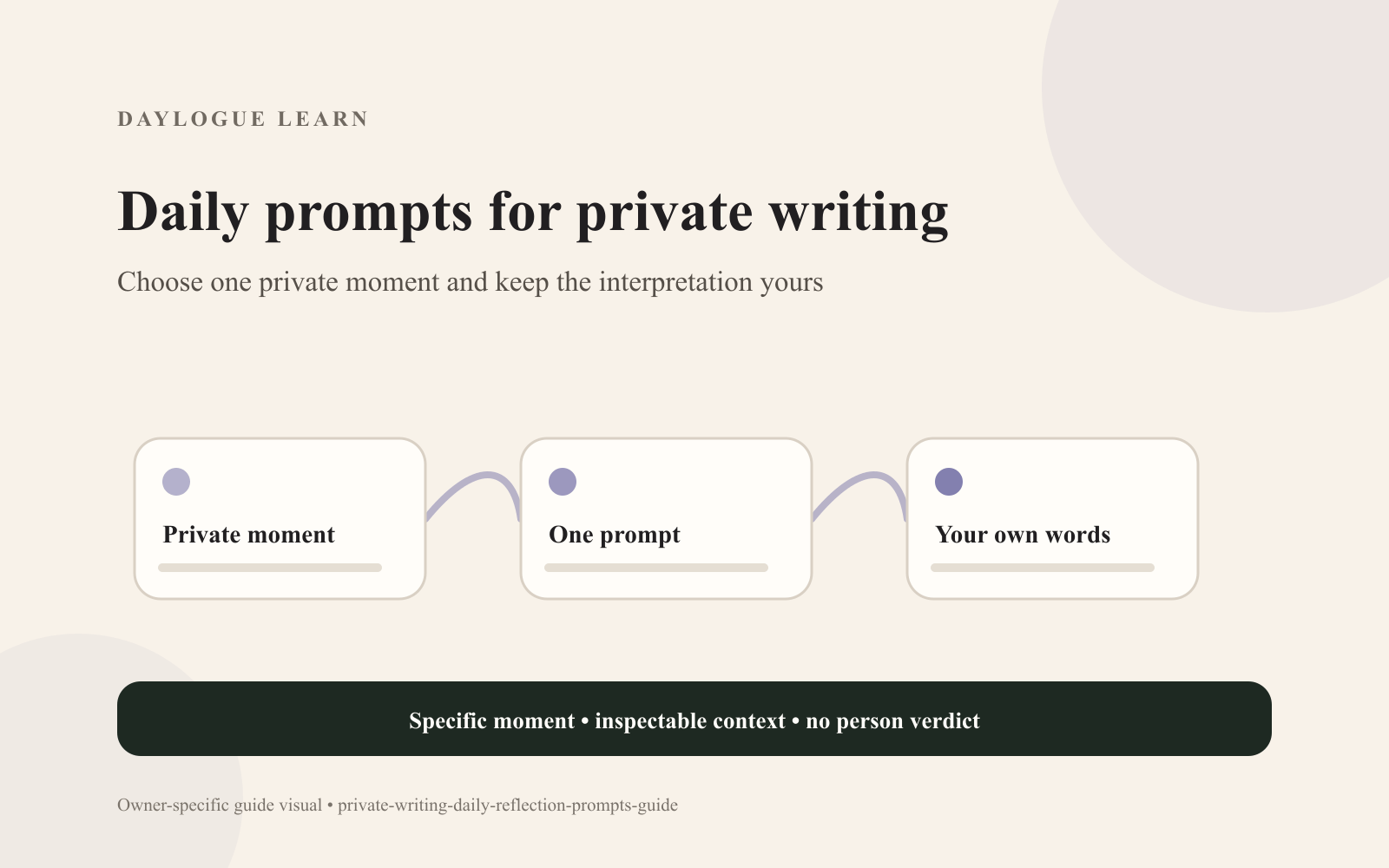
01
Name one scene
Choose one ordinary moment that you can locate in time, even if you remember only the rough part of the day.
02
Write what you noticed
Use your own words for the fact that stood out, without assigning a permanent label to yourself or someone else.
03
Leave one thing open
End with a question, missing detail, or counterexample that could change the first explanation later.
A repeatable sequence of daily reflection questions
Start with one ordinary daily detail from one ordinary part of the day. Record the event in plain language, answer one optional starter, and mark any inference you cannot verify. Finish by deciding whether there is a concrete ask, guardrail, or question worth carrying forward. This sequence may take a few minutes because its purpose is a usable record, rather than polished prose or a complete written version of the day. Leave one plain reflection question open when the available context is incomplete.
During a future review, read it in the background of nearby days instead of reading it as a final verdict. Notice what changed, what remained similar, and what evidence is missing. If another instance changes the picture, revise the interpretation while preserving the original source case. A diary becomes more trustworthy when correction is expected and when stopping remains available every time. Leave one plain reflection question open when the available context is incomplete.
Questions for an ordinary day
Private reflection does not need a dramatic event. You can write about a quiet pause, a choice that took more effort than expected, a detail you nearly forgot, or a conversation that stayed with you. A small scene often gives you a clearer starting point than a request to summarize the whole day.
Keep the answer in your own language. One line can name what happened. A second can say what stood out. A third can hold what you do not know yet. Stop there if the record already feels useful.
- What detail would I otherwise forget?
- When did my attention change?
- What took more effort than it looked?
- What felt unexpectedly simple?
- What can remain unfinished?
Build a routine that survives a busy week
Attach reflection to an ordinary daily detail that already exists rather than a perfect time you hope to create. Open your notes after you plug in your phone, while waiting for the bus, or after closing your laptop. Keep the private daily note short enough that you can finish before the next thing begins. If you have more to say, continue. If you do not, one honest line is still a complete private daily note. The routine should fit your life instead of asking your life to fit it. Keep the private daily note tied to the ordinary daily detail rather than a fixed identity.
Skip days without turning the gap into a problem. When you return, leave the unrecorded days unrecorded. Start with now: "What is most noticeable today?" A flexible practice gives you a record over time without making attendance the goal. You are collecting ordinary daily details because they may become useful to you, not earning credit for consistency. If reminders help, make them neutral and easy to dismiss. Keep the private daily note tied to the ordinary daily detail rather than a fixed identity.
- Pick one anchor that already happens most days.
- Set a two-to-five-minute stopping point before you begin.
- Keep a one-line version for crowded days.
- Return with today's plain reflection question instead of filling every gap.
A seven-day plain reflection question plan you can bend
Use this sequence as a menu, not a challenge. Day one: What took my attention? Day two: What felt easier than expected? Day three: What did I keep putting off? Day four: When did I feel most present? Day five: What conversation stayed with me? Day six: What gave me room to breathe? Day seven: What repeated, and what was different? If a plain reflection question does not fit, replace it. After any gap, pick up with the question for the day you return. Leave one plain reflection question open when the available context is incomplete.
For this private writing task, let “A seven-day plain reflection question plan you can bend” have a narrow job. Use one plain reflection question, answer with a dated action or phrase, and stop before the answer turns into a verdict. If the first explanation feels certain, list one missing fact and one counterexample you would need to check before keeping it.
Prompt Pack
Daily Reflection Prompts for Private Writing: twelve prompts
Choose one question for a specific daily reflection moment, answer in your own words, and leave the interpretation open to later context.
- What detail from today would I otherwise lose?
- When did my attention settle?
- What took more effort than it looked?
- What felt unexpectedly simple?
- What did I postpone without judging it?
- Which conversation stayed with me?
- What did I choose not to explain?
- What deserves a more precise word?
- What can stay unnamed?
- What changed between morning and evening?
- What am I curious to compare later?
- What does not need a lesson?
Common questions
What detail from today would I otherwise lose?
Use this as a plain reflection question about ten quiet minutes after an errand ended earlier than expected. Answer with one observable detail first, then add your current reading only if it helps. You can stop after the record is clear.
What took more effort than it looked?
Keep the answer inside one ordinary daily detail. Write what changed, what stayed fixed, and which fact is missing. That structure prevents a limited private daily note from becoming a verdict about a person or an entire period.
Which conversation stayed with me?
Put the direct answer in your own words and remove names that add nothing to the task. If the question assumes a motive or outcome, rewrite it so the missing context remains visible.
What can stay unnamed?
Return to dated source lines before calling this a repeat. Look for an exception and an unrecorded gap. A repetition can support another question, but it cannot prove a cause by itself.
What does not need a lesson?
Leave this unanswered when the available record is too thin. A useful private writing practice allows an open question, a visible gap, and a clean stopping point without inventing completion.
Sources
Sources were checked on the dates shown. Product details and policies can change.
- Daylogue evidence and methods · Daylogue · checked August 29, 2026
- Positive expressive writing systematic review · PLOS One · checked August 29, 2026
Keep exploring
Daylogue Knowledge Center
Browse practical guides for reflection, journaling, patterns, and privacy.
Read moreHow Daylogue shows patterns
See how candidate patterns stay connected to evidence and correction.
Read moreWhy Daylogue exists
Read the principles behind a system for self-understanding.
Read moreDaylogue is not therapy and is not a replacement for professional care.