Written by Daylogue Editorial Team. Published August 14, 2026. Reviewed and updated August 14, 2026.
The best daily reflection prompts for students are narrow enough to answer on an ordinary day. Start with what took your attention, what felt easier or harder than expected, and what you want to remember tomorrow. Choose one question, write a few honest lines, and stop when you have said enough. A useful reflection practice can be brief, private, and flexible. You do not need a streak or a perfect conclusion for the entry to be useful.
Start with one question you can actually answer
A long prompt can feel like another assignment. A small prompt feels more like a place to begin. Ask, "What took most of my attention today?" or "What moment do I keep replaying?" Both questions point to something concrete without demanding a polished explanation. You can answer with a sentence, a list, or a few unedited thoughts. The point is to leave a clear trace of the day while it is still close enough to remember.
Choose the question that matches the moment you have. After class, you might note what surprised you. Before bed, you might name what you want to set down for the night. After practice or a shift, you might record what drained you and what helped. If nothing dramatic happened, write about the ordinary part that stayed with you. Reflection gets more useful when it includes normal Tuesdays, not only major wins or rough days.
| Moment | Prompt | Short answer format |
|---|---|---|
| Between classes | What is still taking up space in my head? | Three quick phrases |
| After a shift | What felt heavier or lighter than expected? | Two sentences |
| Before bed | What do I want to remember from today? | One specific moment |
| After practice | When did my energy change? | A simple timeline |
Prompts for an ordinary school day
Ordinary-day prompts help you record the texture of your week. Try: What conversation changed my mood? Where did I feel most like myself? What did I avoid even though it was small? What was easier than I expected? What needed more energy than it deserved? Which part of today would be hard to remember in a month? These questions stay close to events, choices, and attention. They make room for your interpretation instead of assigning one for you.
You do not need to answer every question. Read the list once and notice which prompt creates an immediate response. That is usually enough direction. If two questions seem useful, save the second for another day. A journal can become harder to return to when every entry turns into a full review of your life. Keeping the scope small protects the practice from becoming homework and makes it easier to write honestly.
- What did I notice today that I usually rush past?
- What choice felt easy, and what choice took effort?
- Where did my attention keep returning?
- What would I tell a friend about this day?
- What do I want tomorrow me to know?
- What can stay unfinished tonight?
Turn a vague answer into something you can revisit
A sentence such as "school was stressful" may be true, but it gives future you little to work with. Add one observable detail: "I felt rushed after the lab ran late, and I carried that feeling into dinner." The added detail does not need to explain why anything happened. It simply records the sequence. Names, locations, and private specifics are optional. You can write "a group project" instead of identifying the people involved.
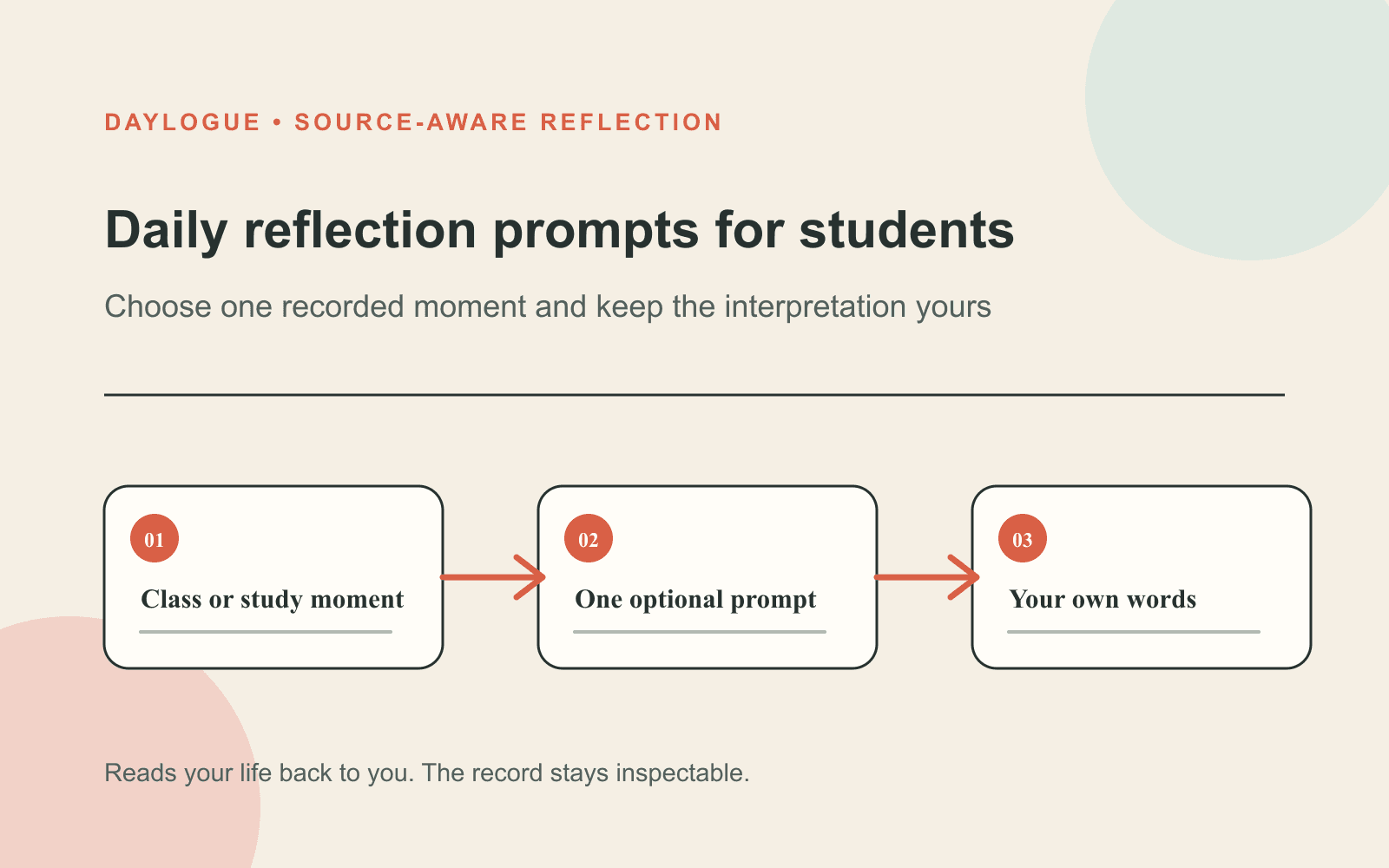
A useful entry often contains three pieces: the moment, your own words for how it landed, and one open question. For example: "I kept checking the time during the study session. I felt scattered. Was I tired, worried about the exam, or simply done for the day?" Leave the question open. Reflection is allowed to preserve uncertainty. You can notice what happened without turning one day into a verdict about who you are.
01
Name the moment
Record one event, choice, or change in attention that you can place in the day.
02
Use your own words
Describe how it landed without reaching for a label that does not feel like yours.
03
Leave one question open
Write what you are curious about, then let a later entry add context if it ever does.
Build a routine that survives a busy week
Attach reflection to a moment that already exists rather than a perfect time you hope to create. Open your notes after you plug in your phone, while waiting for the bus, or after closing your laptop. Keep the entry short enough that you can finish before the next thing begins. If you have more to say, continue. If you do not, one honest line is still a complete entry. The routine should fit your life instead of asking your life to fit it.
Skip days without turning the gap into a problem. When you return, leave the unrecorded days unrecorded. Start with now: "What is most noticeable today?" A flexible practice gives you a record over time without making attendance the goal. You are collecting moments because they may become useful to you, not earning credit for consistency. If reminders help, make them neutral and easy to dismiss.
- Pick one anchor that already happens most days.
- Set a two-to-five-minute stopping point before you begin.
- Keep a one-line version for crowded days.
- Return with today's prompt instead of filling every gap.
Read old entries for context, not a verdict
After several entries, look for repeated situations rather than fixed labels. Maybe Sunday planning keeps appearing beside a sense of calm. Maybe the same class shows up in entries where you felt rushed. Three similar notes are a reason to get curious, not proof of a cause. Ask what else was happening, what changed on exceptions, and whether the wording still feels accurate. Your record should support questions, not close them.
Research can offer context without promising an outcome. A 2025 systematic review of 51 positive expressive writing studies found the most consistent benefits for wellbeing and positive affect, while effects for stress and physical health were less consistent and the included studies were rated poor or fair in quality. That is a useful reminder to keep claims modest. Writing can be a personal practice worth trying, and results will not be identical for every person or every prompt.
Decide where your reflections should live
Student life often means shared rooms, borrowed devices, family plans, and notifications appearing where other people can see them. Before you write, check the practical privacy details. Can someone open the app from your unlocked phone? Does a preview repeat journal content on the lock screen? Can you export or delete your entries? Does the service explain what its servers can read and whether your writing is used to train models? Clear answers matter more than a vague promise that an app is private.
Daylogue stores most journal entries and check-in notes in readable form on its servers so it can write narratives and surface patterns. It says it does not sell personal data, use entries for advertising, or train AI models on personal entries. Daylogue is not end-to-end encrypted. Those details may or may not fit what you want. Review them before choosing the space. Paper, a local note, and an online journal each create different tradeoffs.
- Check whether entry text appears in notification previews.
- Read what the service stores and what its servers can access.
- Look for clear deletion and export controls.
- Use broad descriptions when identifying details are unnecessary.
A seven-day prompt plan you can bend
Use this sequence as a menu, not a challenge. Day one: What took my attention? Day two: What felt easier than expected? Day three: What did I keep putting off? Day four: When did I feel most present? Day five: What conversation stayed with me? Day six: What gave me room to breathe? Day seven: What repeated, and what was different? If a prompt does not fit, replace it. After any gap, pick up with the question for the day you return.
At the end, read only what you feel comfortable rereading. Underline repeated words or situations, then write one sentence beginning with "I am curious about..." You do not need to solve the theme or act on it immediately. The useful outcome may be a clearer question, a detail you want to remember, or a better way to describe the week. That is enough. Daylogue is not therapy and is not a replacement for professional care.
Prompt Pack
Twelve small prompts for real student days
Pick one question that fits the moment, answer in your own words, and stop without turning reflection into another assignment.
- What took most of my attention today?
- What felt easier than I expected?
- What took more energy than it deserved?
- Which conversation stayed with me?
- Where did I feel most present?
- What did I avoid even though it was small?
- What did I notice that I usually rush past?
- What part of today might I forget in a month?
- When did my energy change?
- What can stay unfinished tonight?
- What do I want tomorrow me to know?
- What am I curious to notice again?
Common questions
How long should a student daily reflection take?
Two to five minutes is a practical starting point, but there is no required length. Stop after one honest sentence if that is all you have. Continue when a prompt opens something you want to record.
What if I do not know how I feel today?
Start with something easier to observe. Note where your attention went, what changed during the day, or which moment you remember most clearly. You do not have to force an emotion label.
Do I need to reflect every day for it to be useful?
No. A daily prompt is an available question, not an attendance rule. Write when it helps, skip when it does not, and return without trying to repair the gap.
How can I keep student journal entries private?
Review device locks, notification previews, server access, model-training policies, deletion controls, and export options. Avoid identifying details when they are not needed, especially on shared devices.
When should I reread my reflections?
Try after several entries or at the end of a week. Look for recurring situations and exceptions, not permanent labels. Stop if rereading does not feel useful right now.
Sources
Sources were checked on the dates shown. Product details and policies can change.
- Daylogue privacy policy · Daylogue · checked August 14, 2026
- Positive expressive writing systematic review · PLOS One · checked August 14, 2026
Keep exploring
Daylogue Knowledge Center
Browse practical guides for reflection, journaling, patterns, and privacy.
Read moreHow Daylogue shows patterns
See how candidate patterns stay connected to evidence and correction.
Read moreWhy Daylogue exists
Read the principles behind a system for self-understanding.
Read moreDaylogue is not therapy and is not a replacement for professional care.