Written by Daylogue Editorial Team. Published September 1, 2026. Reviewed and updated September 1, 2026.
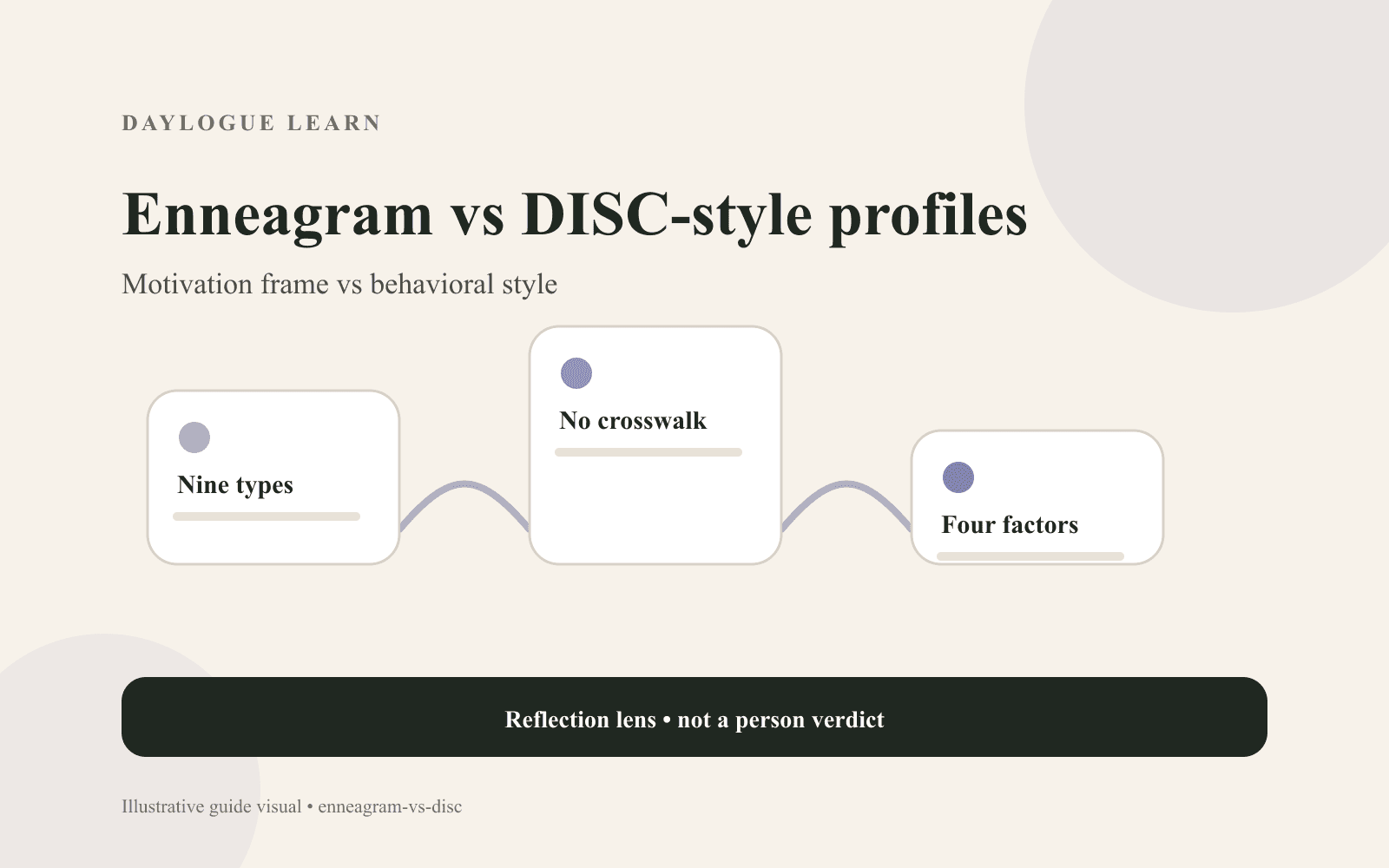
The Enneagram and DISC-style profiles differ in depth and in appropriate venue. Four-factor behavioral profiles describe observable working style: pace, directness, sociability, structure. The nine-type model reaches for the motivation underneath behaviour, which makes it more intimate and correspondingly less appropriate for workplace circulation. Results do not convert between them, since one driving style can serve several different engines. The practical split: behavioral-style vocabulary can work as opt-in shared language on teams, while motivation frameworks belong to the individual, and Daylogue draws exactly that line, keeping nine-type results out of every workplace surface by design.
Surface and engine
Watch a colleague who moves fast, decides quickly, and talks directly. A four-factor profile records that style and stops, which is its discipline: it describes the driving, not the driver. The nine-type model asks what powers the speed, and different engines produce identical dashboards. The fast decider might be moving toward a win, taking control so nobody controls them, or escaping a boredom that feels like confinement. Same behaviour, three different patterns, three different costs accumulating underneath.
Neither layer is the truer one; they answer different needs. Coordinating a project needs the surface, and the surface is enough: knowing a teammate prefers direct brief messages requires no theory of their childhood or their fears. Understanding a recurring personal pattern needs the engine, and the engine is private in a way the surface is not.
The venue difference follows from the depth difference, and it is worth stating before any feature comparison: style descriptions are calibrated for circulation, motivation descriptions are calibrated for privacy, and most of the damage done with personality frameworks at work comes from moving material built for the second venue into the first one.
The structures, mechanically
Four-factor profiles descend from a 1920s model of behavioral style and typically report a blend across dimensions of dominance-like assertiveness, influence-like sociability, steadiness-like pace, and conscientious-like structure. Branded instruments in this family are commercial products with their own item sets and norms; the underlying four-factor idea itself is old and unowned. Reports usually come as a primary style with secondary shadings, tuned for quick workplace consumption.
The nine-type model is structurally richer and evidentially thinner: nine patterns with wings, a vocabulary of costs and avoidances, and a research base a systematic review characterised as limited with uneven instrument quality. Richness of description and strength of evidence are independent axes, and this pair of frameworks makes the independence vivid: the four-factor model claims less and supports the claims better; the nine-type model describes more and proves less.
| Dimension | Nine-type model | Four-factor profiles |
|---|---|---|
| Describes | Motivation, avoidance, characteristic costs | Observable working style |
| Depth | Intimate; reaches beneath behaviour | Deliberately surface-level |
| Structure | Nine patterns plus wings | Blend across four factors |
| Ownership | Numbers and circle free; type names authored | Concept unowned; branded instruments proprietary |
| Workplace fit | Individual reflection only | Workable as opt-in shared vocabulary |
Why one does not convert into the other
Because several engines can drive one style, the mapping from nine types to four factors is many-to-many, and published pairings between them are guesswork wearing a chart's clothing. The direct, fast-paced style alone plausibly hosts three different nine-type patterns, and a single nine-type pattern can present as different styles in different jobs, since style flexes with context far more than motivation does.
Daylogue once derived style-profile codes from its own reflection dimensions and displayed them as results, and removed the feature after concluding that a derived framework result misrepresents both frameworks. The lesson generalises: hold each framework's output in its own vocabulary or do not hold it at all. Conversion is where honest description quietly becomes fabrication.
- One driving style can serve several engines; the mapping is many-to-many.
- Style flexes with context; motivation is the slower-moving layer.
- Derived cross-framework results misrepresent both sources at once.
The workplace line, drawn precisely
Here the comparison stops being academic. Behavioral-style vocabulary, adopted voluntarily as team shorthand, sits at the shallow end of disclosure: saying a colleague prefers directness reveals roughly what working beside them for a week reveals. Motivation frameworks disclose a different order of material, fears, avoidances, the shape of what someone protects, and that material in an employer's hands is exposure, however warmly the workshop that collected it was run.
The test for any framework at work is what the information could do in a decision about a person. Style preferences barely move that needle. Motivation patterns move it considerably, which is why the nine-type model belongs to the individual, and why Daylogue enforces the line structurally: nine-type results have no organisational surface at all, appear in no team view, and cannot be reached by any workplace report.
01
Team coordination: style vocabulary, opt-in
Shared language about pace and directness helps meetings and handoffs, provided joining the vocabulary is genuinely voluntary and the labels stay self-descriptions rather than assignments.
02
Personal patterns: nine types, private
The motivation layer rewards attention and belongs in a journal, not a directory. Its value comes precisely from the candour that circulation would make unwise.
03
Any personnel decision: neither framework
Hiring, promotion, and team composition require validated measurement neither family provides. A styles workshop is culture-building; a styles-based staffing decision is a liability wearing culture's badge.
04
Mixed settings: keep the layers separate
A team can share style vocabulary while members privately use motivation frameworks. Trouble starts when one layer is asked to justify the other, so decline the crossover in both directions.
Choosing, if you are choosing
For most individual users the choice resolves by venue and question. Curious what your working style broadcasts to colleagues? A four-factor lens sketches it quickly, and its shallowness is a feature. Trying to understand why the same conflict keeps finding you, or what your pattern charges for its gifts? That is engine work, and the nine-type vocabulary, held as reflection rather than measurement, is the more precise instrument.
The nine-type model's research base remains limited across instruments, and Daylogue's own nine-type questionnaire is a reflection exercise, not a validated test, stating its confidence with every result and keeping every result private to the person who produced it. Whichever framework you pick up, the reflective register, hypotheses about yourself, tested against your own weeks, is the register both actually support.
A last practical note on cost: the branded four-factor instruments are commercial products priced per seat, while the four-factor concept itself is freely described everywhere, and the nine-type ecosystem runs from free quizzes to expensive certification programs with no correlation between price and evidence anywhere in the range. Paying more buys facilitation and report polish in both families. It does not buy validity, which neither family sells at any price.
Framework
The two-layer sorting rule
A pocket rule for keeping style frameworks and motivation frameworks in their correct venues, applied to five common situations.
- Name the layer: is this question about how someone works, or why? How is surface; why is engine.
- Surface questions in team settings: style vocabulary, opt-in, self-described, revisable.
- Engine questions anywhere: private reflection tools, held by the person, shared only by their explicit choice.
- Any question that could feed a decision about a person: neither layer, full stop; the evidence carries neither that far.
- When a workshop asks the engine layer in a workplace room, the sorting rule says decline, whatever the facilitation promises.
- When in doubt, ask what the answer could do in the wrong hands; the venue assigns itself.
Common questions
What is the main difference between the Enneagram and DISC-style profiles?
Depth. Four-factor profiles describe observable working style and deliberately stop there; the nine-type model reaches for the motivation underneath. One reads the driving, the other the engine, and several engines can produce the same driving.
Can my DISC style predict my Enneagram type?
No. The mapping is many-to-many in both directions: one style hosts several motivation patterns, and one pattern presents as different styles across contexts. Published pairings between the frameworks are invented rather than measured.
Which is better for team building?
Style vocabulary suits teams better precisely because it discloses less: pace and directness preferences are shallow, useful, and safe to share when opt-in. Motivation material is intimate, and collecting it in a workplace setting creates exposure whatever the intent.
Why does Daylogue keep Enneagram results away from workplace surfaces?
Because motivation patterns in an employer's context could inform decisions about people, and neither this model's evidence nor basic fairness supports that. The boundary is structural: nine-type results simply have no organisational surface to appear on.
Is DISC more scientific than the Enneagram?
The four-factor family claims less and supports it somewhat better, with more instrument development behind the major commercial versions. The nine-type model describes more and proves less. Neither clears the bar for decisions about people, which is the comparison that matters.
Sources
Sources were checked on the dates shown. Product details and policies can change.
- Enneagram systematic review of evidence · Journal of Clinical Psychology · checked September 1, 2026
- APA Dictionary: Barnum effect · American Psychological Association · checked September 1, 2026
Keep exploring
Enneagram vs Myers-Briggs style types
The other common pairing, and the same no-translation rule.
Read moreDISC vs MBTI
The two workplace favourites compared directly.
Read moreIs the Enneagram scientific?
The evidence question this comparison keeps raising.
Read moreWorkplace assessment types
The wider map of what belongs at work and what does not.
Read moreDaylogue is not therapy and is not a replacement for professional care.