Written by Daylogue Editorial Team. Published September 1, 2026. Reviewed and updated September 1, 2026.
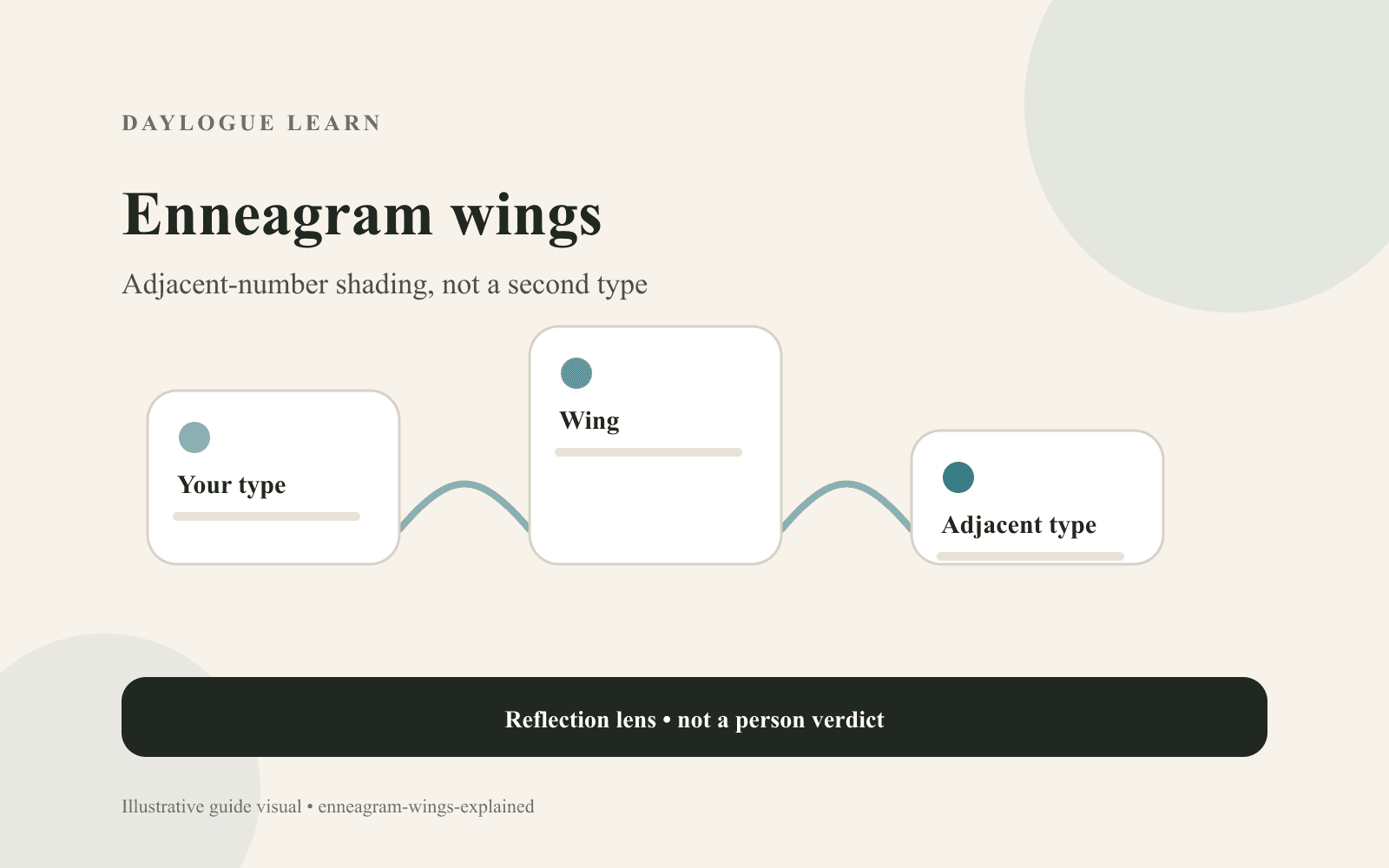
An Enneagram wing is one of the two numbers adjacent to your type on the nine-point circle, used to describe which neighbour colours your pattern more. A person whose main pattern is 4 can lean toward 3 or toward 5, and the lean changes the flavour without changing the type. That is the entire load a wing can carry: shading. It is not a second type, not half your personality, and not a growth stage. Wing notation is worth using because it is expressive shorthand; it is worth holding loosely because the questionnaire evidence behind any specific wing call is thinner than the evidence behind the type itself, which is already thin.
What the circle geometry does and does not mean
The nine types are conventionally drawn around a circle, and wings are simply the two positions touching yours. A 1 can wing 9 or 2; a 5 can wing 4 or 6. The geometry is a mnemonic, not a discovery about the mind: nothing in psychological research establishes that the patterns adjacent on the diagram are adjacent in people. The convention persists because it is useful notation, the way alphabetical seating persists without implying the alphabet seated anyone by temperament.
It is worth knowing that the diagram, the numbers, the wings, and the connecting arrows are free for anyone to use. A federal appeals court examined the question in 1992 and found these structural elements unprotectable, which is why every site can print the circle. The familiar marketing names attached to each type by particular authors are another matter, which is one reason careful sources, this one included, describe types by number.
Shading, worked through a real example
Take the type 6 vigilance pattern and its two available leans. Toward 5, the hazard-scan turns inward and quiet: more research before trusting, more privacy while deciding, threats handled by understanding them exhaustively. Toward 7, the same scan turns outward and social: threats handled by keeping options open and allies close, worry wearing a buoyant face. Same engine, different wardrobe, and the difference is real enough that the two can look like different people at a party.
That is the correct scale of a wing claim: wardrobe, not engine. When a description says your wing explains your career, your relationships, and your childhood, it has promoted shading into architecture, and the promotion is where wing talk leaves what even the model's own logic supports.
Run the same exercise on any type you know well and the pattern holds. A 9 leaning 8 banks force behind its calm and digs in harder than its peaceable surface suggests; a 9 leaning 1 attaches the merge to order and resists through quiet correctness instead. Both remain unmistakably the merging pattern underneath. If a wing description ever seems to describe a different person rather than a different finish on the same person, the description has overreached, and the overreach is the tell to stop reading that source's wing material.
- A wing modifies expression; the core question of the type stays the same.
- Both wings are available to everyone; most people lean one way most of the time.
- Leans can shift across life phases without the type changing underneath.
Why questionnaire wing assignments are weak evidence
A wing call compares two adjacent scale scores, and adjacent scales are exactly where nine-type questionnaires discriminate worst. When Daylogue measured its own instrument against eight documented profiles, margins between neighbouring scales ran from zero to four points on forty-point scales, and a wing assignment rides on differences smaller still. A one-point edge between your 3 and your 5 scales is the whole basis of a reported 4w3 over a 4w5, and one reconsidered answer reverses it.
So the practical rule: take the type as a hypothesis worth testing and the wing as a hypothesis about the hypothesis. If a reported wing never rang true, discard it without ceremony; nothing in the arithmetic behind it deserves loyalty. The check that actually settles a wing is behavioural, and it takes ten minutes.
01
Read both wing sketches for your type
Every type page here describes its two leans in a few sentences. Read both cold, before looking at what any test assigned you.
02
Identify the price, not the portrait
Each lean carries a characteristic cost. Ask which price you recognisably pay; costs discriminate better than flattering traits.
03
Poll one close observer
Ask someone who knows you which sketch predicts you. Outside observers are not filtered through your preferred self-image.
04
Let no-lean be an answer
Some people sit balanced between wings or shift by context. Recording that honestly beats forcing a choice the evidence cannot support.
Wing inflation, and the systems to skip
Around the simple wing idea has grown an aftermarket of elaborations: proprietary multi-type combinations, numbered development levels, subtype stacks with their own vocabularies. Some are trademarked commercial systems, and none has independent research support beyond what the base model has, which a systematic review found limited. The elaborations mostly add surface area for the recognition reflex to grip, which feels like precision while adding none.
A reasonable rule for any nine-type add-on: if the base model's evidence cannot carry a claim, a paid elaboration of the base model cannot either. Number plus lean says everything the notation can honestly say, and it has the advantage of being free, unowned, and short.
The elaborations also complicate the one thing the base notation does well, which is being checkable. A number and a lean can be tested against a year of your behaviour in an afternoon. A stacked multi-part designation with development levels attached resists testing by design, since any contrary evidence can be absorbed by another moving part. Preferring the checkable version is not austerity; it is keeping the tool in the condition where your own life can still argue with it.
| Notation | What it claims | Worth adopting? |
|---|---|---|
| Type number alone | Your leading pattern | Yes, as a tested hypothesis |
| Number plus wing | The neighbouring shade of it | Yes, held loosely |
| Balanced or no wing | No consistent lean | Yes, when true it is the accurate call |
| Multi-type stacks and levels | Architecture beyond the evidence | Skip; recognition is doing the work |
What wings are actually good for
Used at their correct weight, wings earn their keep in two places. First, precision of self-description: two people sharing a type and differing in lean genuinely do run their pattern differently, and the notation names that compactly. Second, explaining near-miss recognition: when your type page reads eighty percent true, the wing sketches often account for the remainder, which beats concluding you were mistyped.
Daylogue's own nine-type questionnaire reports a wing alongside any type it names, derived from which adjacent scale scored higher, and holds it to this page's standard: it is presented as a lean in how you answered, the underlying scores stay visible, and a reflection exercise, not a validated test, is what the whole reading remains.
Checklist
The ten-minute wing check
A behavioural check that outperforms any wing quiz, because it compares prices paid rather than one-point score gaps.
- Write your type's two possible leans side by side, one line each.
- Under each, write its characteristic cost as this site's type pages describe it.
- Circle the cost you have recognisably paid in the last year.
- Ask one person who knows you well which lean predicts you; note where they land.
- If you and your observer agree, adopt the lean loosely. If not, or if neither cost rings true, record no clear wing and lose nothing.
- Revisit after any major life change; leans move more often than types do.
Common questions
What is an Enneagram wing in one sentence?
It is the number adjacent to your type that colours how the pattern shows up, shading its expression without changing the core question the type is organised around.
Can my wing be any type, or only a neighbour?
Only the two neighbours on the circle. A strong resemblance to a non-adjacent type is a different situation, usually a close second scale worth reading in its own right rather than wing material.
Can wings change over time?
Leans commonly shift with life phases and contexts while the type stays put. A career demanding outward energy can pull one lean forward for years; retirement can hand the other one back.
Is having no clear wing a problem?
No. Balanced leaning is a legitimate reading, and forcing a wing onto evidence that shows none trades accuracy for notation. Some people also lean differently in different domains, which is worth recording as exactly that.
Why do wing tests keep giving me different answers?
Because a wing call rides on the difference between two adjacent scale scores, which is routinely a point or less. That gap flips between sittings easily. The behavioural check, which price you pay and which sketch observers say predicts you, is more stable than any retake.
Sources
Sources were checked on the dates shown. Product details and policies can change.
- Arica Institute, Inc. v. Palmer, 970 F.2d 1067 (2d Cir. 1992) · United States Court of Appeals, Second Circuit · checked September 1, 2026
- Enneagram systematic review of evidence · Journal of Clinical Psychology · checked September 1, 2026
Keep exploring
Tied between two types
When the close pair is not adjacent, it is not a wing question.
Read moreWhy results change
The narrow-margin arithmetic behind flipping wing calls.
Read moreType 6
The worked example above, in full.
Read moreEnneagram uses and limits
The base model this notation decorates.
Read moreDaylogue is not therapy and is not a replacement for professional care.