Written by Daylogue Editorial Team. Published August 28, 2026. Reviewed and updated August 28, 2026.
An evening journal practice for a parent or caregiver can be brief: pick one moment from the day, record what happened before explaining it, and answer one question that fits your available attention. You do not need to summarize every responsibility or find a lesson. End with one detail you want to remember, one open question, or a clear decision to stop.
Make the evening entry smaller than the day
Care days rarely end at a clean boundary. A child may need one more thing, a relative may call, or tomorrow may already be asking for attention. A useful evening entry does not compete with that reality. Give it one scene and one stopping point. The scene might be the quiet minute after dishes, the handoff after an appointment, or the moment you noticed you were still carrying a work conversation into family time.
Write the event in plain language before deciding what it meant. Include enough context to recognize it later: roughly when it happened, who was present without naming anyone unnecessarily, and what changed. This keeps the note useful without demanding a polished story. If the only honest line is “I do not have room to unpack this tonight,” that line can be the whole entry.
Choose one question that matches your remaining attention
A prompt should reduce the effort needed to begin. It should not require you to prove gratitude, solve a relationship, or organize the entire day. Questions beginning with what, when, or which usually stay closer to a recordable moment. Try “What took more attention than I expected?” or “Which part of today do I want to remember accurately?” Skip any question that assumes you should feel differently.
Use the list as a menu. A tired evening may call for a concrete detail, while a calmer one may leave room for a second sentence about context. You can leave prompts unanswered when they do not fit. A short entry is not an incomplete long entry. It is a deliberate record sized to the time and privacy you have tonight.
- What moment followed me into the evening?
- What care task was easier or harder than expected?
- What did I need that I did not name today?
- What can remain unresolved until tomorrow?
Separate the event from your first reading of it
Caregiving can compress many roles into one hour. When the day feels heavy, broad statements arrive quickly: “I handled nothing well” or “everyone needed me.” Put the observable event beside that first interpretation. “Two plans changed after dinner” is a source moment. “I cannot keep up” is a reading of it. The reading may express something real, but it is not the only wording the event permits.
This separation is not about arguing with yourself. It preserves enough evidence for a later read. Another evening might show the same strain, a different strain, or a clear exception. Daylogue states that a recurring overlap does not show that one thing caused another. Keep the conclusion narrow enough to change when a later entry adds context.
| Fast verdict | Source moment | Open ending |
|---|---|---|
| The day disappeared | Three care tasks replaced my planned break | Which interruption mattered most? |
| I was impatient all evening | I answered sharply during one rushed handoff | What was happening just before it? |
| Nothing got finished | One work task moved to tomorrow | What did I choose to protect instead? |
A five-minute caregiver evening example
Imagine the entry begins after a care appointment ran late. The first line records the sequence: the appointment ended after the planned time, dinner shifted, and one email remained unanswered. The second line names what stood out: the transition between roles felt abrupt. The third line stays open: “Would ten quiet minutes between the appointment and dinner change how the handoff feels?”
That note does not declare a permanent pattern or prescribe a solution. It gives a future entry something specific to compare. If the next late appointment feels different, preserve the contrast. If several entries mention rushed transitions, describe only the overlap in the recorded days. Missing evenings remain missing data, not proof that nothing happened or that something got worse.
Keep a digital readback inside clear boundaries
A journal tool can organize dates, locate repeated words, and place related entries beside one another. It cannot know the full family context, another person’s intent, or every demand you chose not to record. Daylogue does not infer emotion from faces, voice tone, or physiology. It works from the words and context people choose to share. A concise readback should remain a suggestion you can inspect and revise.
Daylogue does not use personal entries to train its own models. Provider handling follows current written terms, configuration, and subprocessor disclosures. Daylogue reads the entries you choose to sync to create narratives and surface patterns. Entries are not end-to-end encrypted. Before adding names, health details, school information, or another person’s story, decide whether those specifics belong in a synced service.
Close the page without scoring the day
Avoid ending with a grade for the day or a verdict about yourself as a caregiver. A number can hide the exact moment you may want later. Close with a factual line, an optional request, or a boundary for tomorrow. “Ask for a clearer pickup time” preserves a possible action. “Leave this here” preserves a stopping decision. Neither turns care into a test you must pass.
Daylogue is not therapy and is not a replacement for professional care. Evening prompts are a way to keep a personal record, not a response plan for urgent or professional needs. When a prompt feels too large, too exposing, or simply unhelpful, stop. The practice should remain available to you, not become one more obligation competing with sleep or care.
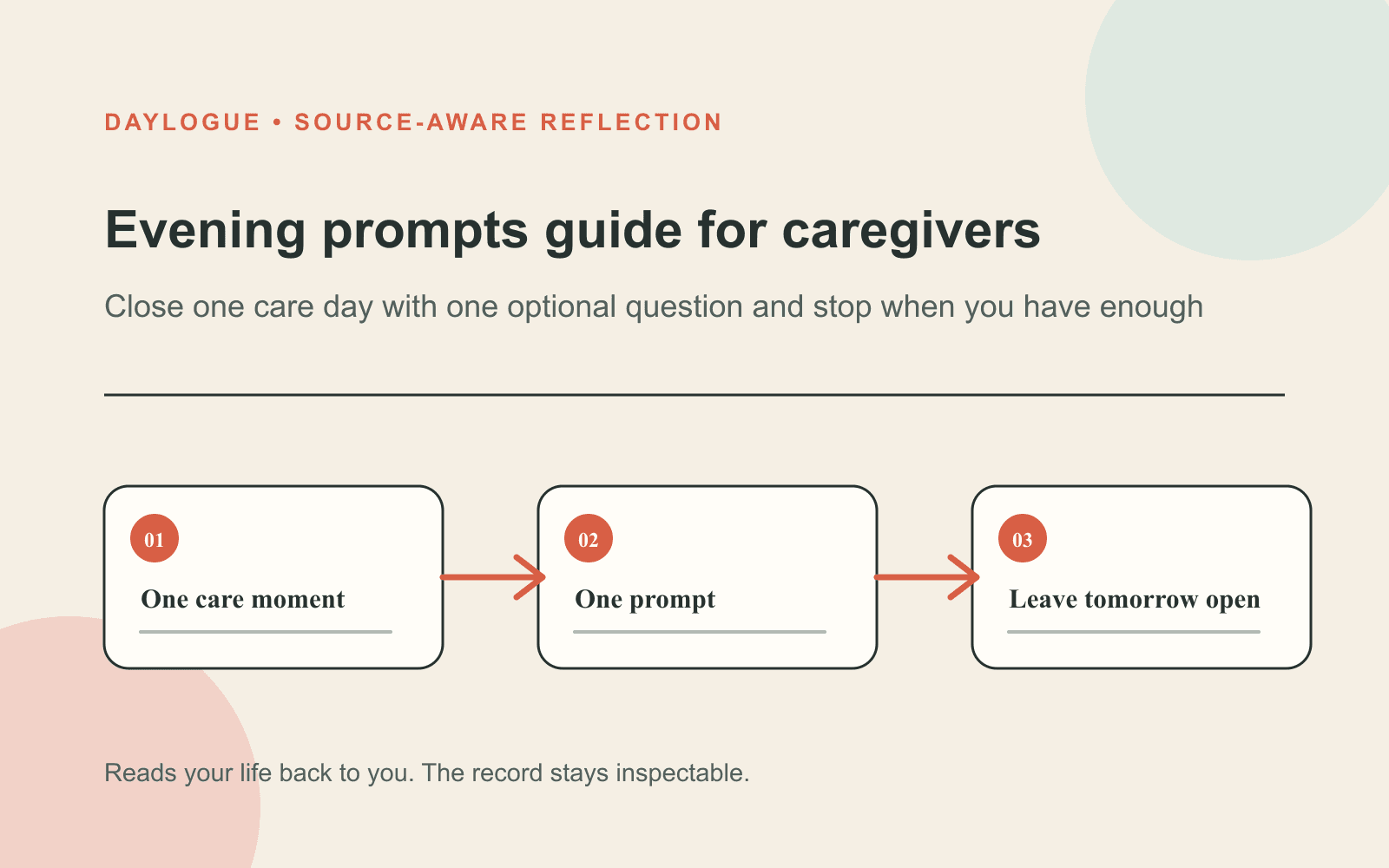
01
Locate one scene
Choose one moment from the evening that you can describe without reconstructing the whole day.
02
Record before interpreting
Write what happened, then mark any explanation as a reading that may change with more context.
03
Choose an ending
Keep one question, name one next step, or close the page without carrying a completion debt.
Choose an evening format that fits the setting
A sentence is useful when your hands and attention are free for only a minute. A short list works when several details are competing and you do not want to turn them into a story yet. A reviewed voice transcript may fit a private walk from the car or a quiet kitchen reset. The format can change from night to night without making the record inconsistent. Dates and source moments provide continuity, not a rigid entry shape.
Match the format to privacy as well as time. A spoken note may be wrong for a shared room, while a role-labeled list may protect another person better than a detailed narrative. Review any transcript before saving because names, dates, and homophones can be wrong. The practical question is which format preserves one useful detail with the least extra demand, not which method produces the longest or most polished reflection.
Build a repeatable close that can flex
Anchor the practice to a transition you already notice rather than an ideal schedule. It might happen after the final medication reminder, when the kitchen light turns off, or once a child is settled. Keep the materials easy to reach and choose a default limit such as one prompt or five minutes. On crowded days, reduce the entry instead of abandoning the method.
Review several entries only when the review serves a real question. Look for dated examples, counterexamples, and gaps. If a summary sounds broader than the pages support, rewrite it in your own words. A useful evening record remains specific enough to recognize, light enough to repeat, and open enough for tomorrow to differ.
Prompt Pack
A five-minute caregiver evening prompt pack
A compact set of optional questions for closing one care-filled day without grading it or writing a complete diary entry.
- What moment from today deserves an accurate record?
- What took more attention than I expected?
- Which transition felt especially abrupt?
- What can remain unresolved tonight?
- What detail should tomorrow not erase?
Common questions
How long should an evening caregiver journal entry be?
One to five minutes can be enough. Choose one moment and one optional question, then stop when the detail you wanted to preserve is clear.
What if I am too tired to answer a prompt?
Write one factual line, save a voice note you can review, or skip the entry. Missing a night does not create a debt to reconstruct later.
Should I rate the day or my caregiving?
A specific scene is usually more useful than a grade. Record what happened, what changed, and what remains open without reducing yourself to a score.
Can software explain why the evening felt difficult?
Software can organize what you shared and suggest a possible overlap, but it cannot establish cause or know the context you did not record.
Sources
Sources were checked on the dates shown. Product details and policies can change.
- Daylogue evidence and methods · Daylogue · checked August 28, 2026
- Daylogue privacy policy · Daylogue · checked August 28, 2026
Keep exploring
Daylogue Knowledge Center
Browse practical guides for reflection, journaling, patterns, and privacy.
Read moreHow Daylogue shows patterns
See how candidate patterns stay connected to evidence and correction.
Read moreWhy Daylogue exists
Read the principles behind a system for self-understanding.
Read moreDaylogue is not therapy and is not a replacement for professional care.