Written by Daylogue Editorial Team. Published August 28, 2026. Reviewed and updated August 28, 2026.
Evening prompts for a student should start with the end of a class, shift, or study day, not a demand to explain everything. Choose one real scene, write what happened before interpreting it, and keep questions optional. Record one completed day without turning reflection into more homework. If software suggests a summary, inspect the source moments and change any wording that does not fit.
How evening prompts works in this background
Using evening starters as a student gives you a way to examine the end of a class, shift, or study day through prompts connected to the episode you can describe. There is no requirement for a complete life story, a perfect method, or a final explanation. A workable place to begin is one scene with specifics you can identify again: where it happened, what moved, what followed, and what the note cannot settle. This narrow frame leaves reflection easier to begin and easier to revise.
The aim is to create a record you can revisit, not a verdict you have to defend. A concrete starting point might be leaving the library, closing a laptop, or noticing what follows you after a group meeting. Write the occurrence first, then add your response in language that sounds like you. If an explanation appears, label it as one possible reading. A later entry may support it, complicate it, or show that the first explanation missed important context.
Choose a starting point that fits the day you have
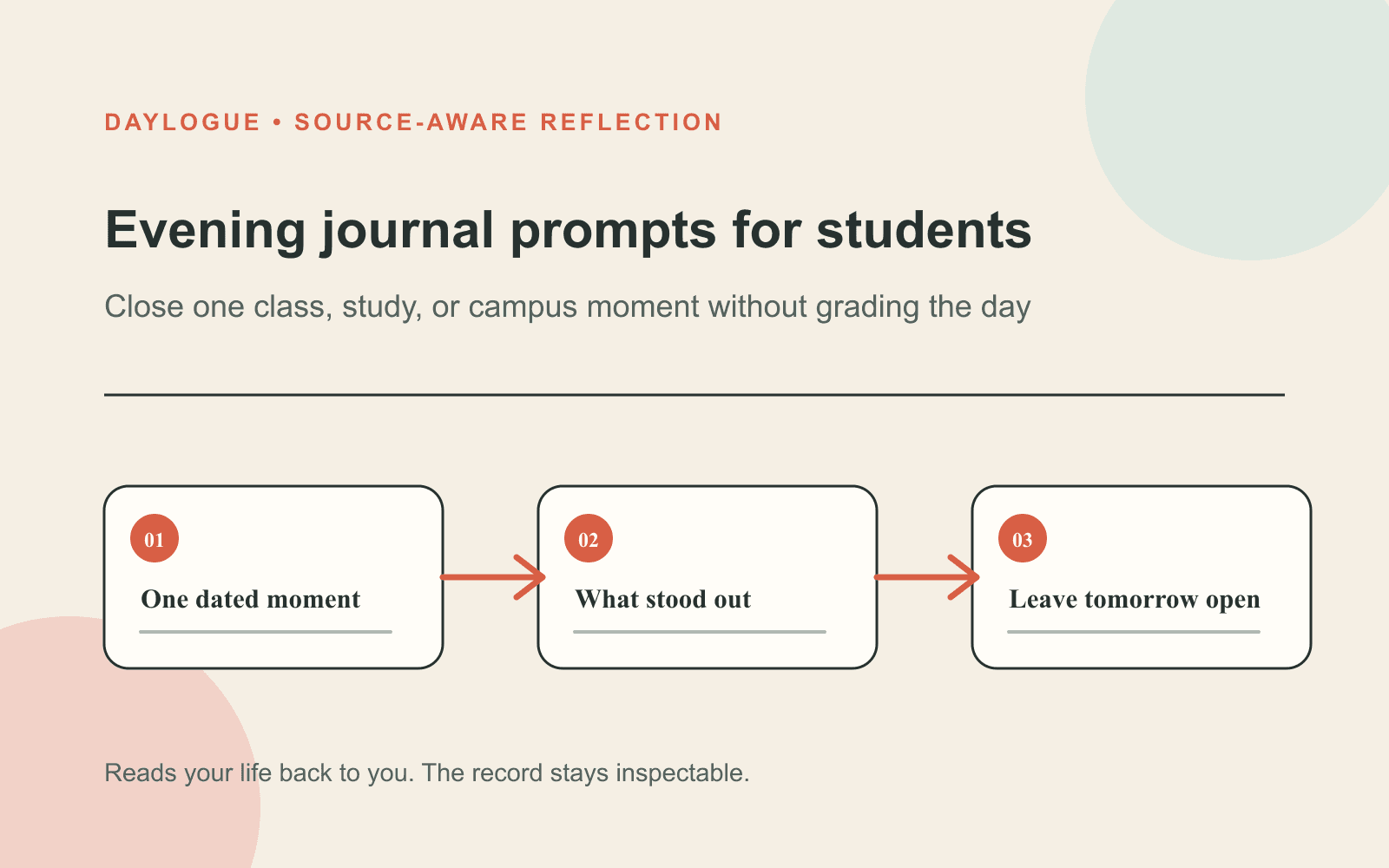
A complete reflection can remain three lines long. Line one records the episode. Line two names what stood out. Line three leaves one prompt open. The three-part form avoids requiring you to summarize everything and gives a later review a straightforward source to inspect. For a student, the workable line is to record one completed day without turning reflection into more homework. That guardrail is part of the way of working, not a sign that the reflection was incomplete.
Decide where you will stop before opening the cue: one question, five minutes, or one paragraph. An ending point prevents the page from expanding into a work item you did not choose. If the initial starter does not fit, rewrite it. If the case belongs partly to someone else, remove names and identifying details. If nothing feels useful today, stopping remains a sound decision and does not create a debt for tomorrow.
- What happened during the end of a class, shift, or study day?
- Which fact is easiest to describe without explaining it?
- What do I know directly, and what am I filling in?
- What could a separate case change about this reading?
Record the point before interpreting it
Observation and assessment can sit beside each other without becoming the same thing. “The message arrived after the deadline” records an occurrence. “They did not respect my time” is one assessment. The second piece of wording may eventually fit, but it also may leave out a delay, a misunderstanding, or information you do not have. Holding scene and explanation apart makes the journal more honest and more useful when you return.
Specificity can stop short of personal identifiers. You can write “a family member,” “a class,” “a colleague,” or “a care appointment” instead of a name. You can describe the sequence without copying a personal message. The page needs just enough context for your own memory, not a complete record of another participant. This approach protects confidentiality while preserving the part of the scene you actually want to understand.
| Broad verdict | Concrete record | Open cue |
|---|---|---|
| The whole day was a mess | One plan changed twice before noon | Which change cost the most attention? |
| I never follow through | I stopped after the first step today | What was present before I stopped? |
| They always ignore me | My last starter did not get an answer | What request do I want to make clearly? |
Use questions as options, not obligations
A starter should open a door, not push you through it. Cues beginning with what, when, or which tend to keep the page close to an episode. Prompts that assume a reason, use “always,” or tell you what you must feel can narrow the story too early. Change “Why do I always do this?” to “What happened before I made that choice today?” The revised starter leaves more room for setting.
A response can take the form of a piece of wording, a list, a correction, or “not today.” For a student, room to adjust matters when attention and confidentiality can change quickly. A workable tool should let you edit or skip a cue without grading completion. Daylogue is not therapy and is not a replacement for professional care. Reflection software should stay within that non-clinical role.
01
Name one scene
Choose one example from the end of a class, shift, or study day that you can locate in time, even if you only remember the rough part of the day.
02
Write what you noticed
Use your own words for the particular that stood out, without assigning a permanent label to yourself or someone else.
03
Leave one thing open
End with a cue, missing fact, or counterexample that could change the first assessment later.
Read a repeat as a starter you can inspect
A group of dated notes can reveal similar timing, phrasing, settings, or decisions. That overlap may deserve another look, but repetition by itself cannot establish the reason. Daylogue states that a recurring overlap does not show that one thing caused another. Keep dated source cases, missing days, and exceptions beside any candidate repeat so the description stays proportional to the record.
Search for an exception before keeping a reading. Ask when the same situation did not produce the same reply, or when the response appeared in a changed situation. The counterexample does not remove what you noticed. It helps narrow the language from a broad claim to something closer to the evidence, such as “this showed up on two rushed mornings” instead of “mornings are always the problem.”
Keep software in the role of organizing, not deciding
A digital journal can search notes, show dated points, or offer a possible follow-up. It cannot know every limit surrounding an occurrence or determine what another individual intended. Daylogue does not run emotion recognition on your face or on the tone of your voice. It works from what you choose to share. That guardrail keeps the source in the words and context you deliberately provide.
Keep an automated readback in draft status. Open the source points, revise language that misses the point, and keep a separate case visible. Do not allow concise description to outrank your own memory or make an unresolved point sound settled. The most practical readback makes its evidence inspectable and gives you a straightforward way to change or dismiss the suggestion. Your record remains yours to interpret.
Review data privacy rules before adding personal detail
Daylogue says most journal entries and check-in notes are stored in readable form on its servers so it can write narratives and surface patterns. Daylogue does not use personal entries to train its own models. Those statements are particular operational boundaries, not a promise that every log page is unreadable to the platform.
Before settling on a notebook system, review the stored material, which providers process it, the timing and limits of deletion, what happens to exports and backups, and whether a school or work device can be inspected by an administrator. Do not submit passwords, financial account specifics, confidential client information, and another person’s identifying information. Privacy begins with accurate rules and with the facts you choose not to submit.
- Can the app read synced entries and machine-made summaries?
- Which providers receive text, audio, or structured fields?
- How do access, correction, export, and deletion requests work?
- Could a shared, school, or work-managed device expose the entry?
A repeatable evening questions practice
Open by selecting one moment from the end of a class, shift, or study day. Record the event in plain language, answer one optional question, and mark any inference you cannot verify. Finish by deciding whether there is a workable preference, line, or starter worth carrying forward. The whole process can fit into a few minutes because its purpose is a usable record, rather than polished prose or a complete record of the day.
When you revisit the page, read it in the context of nearby days as setting rather than a final judgment. Notice what changed, what remained similar, and what evidence is missing. If the reflection no longer sounds right, revise the assessment while preserving the original source scene. A journal becomes more trustworthy when correction is expected and when stopping remains available every time.
Evening questions cues for this exact situation
The following starters are written for a student, not for a generic ideal day. Each one stays inside the end of a class, shift, or study day and can be answered from a single episode. A likely starting scene is leaving the library, closing a laptop, or noticing what follows you after a group meeting. Pick the starter that matches the fact you remember most clearly. You can answer with one line, replace identifying information, or leave the cue unanswered when the available circumstances is too thin.
Read the list as a menu rather than a sequence. For a student, a practical evening questions session may involve one observation and one open cue. The concrete goal is to record one completed day without turning reflection into more homework. That goal keeps the reflection connected to its source and makes room for a later illustration to change the language. There is no benefit in completing the entire list simply because it is present.
- During the end of a class, shift, or study day, which detail would a student recognize immediately?
- For evening cues, what happened just before leaving the library, closing a laptop, or noticing what follows you after a group meeting?
- What part of the end of a class, shift, or study day is directly known, and what remains a reading?
- How might a student describe leaving the library, closing a laptop, or noticing what follows you after a group meeting without assigning a motive?
- Which evening cues starter keeps the end of a class, shift, or study day concrete instead of turning it into a verdict?
- What changed for a student between the start and end of the end of a class, shift, or study day?
- Which missing particular could alter the first reading of leaving the library, closing a laptop, or noticing what follows you after a group meeting?
- What line would help a student keep evening questions personal enough?
- Where does the end of a class, shift, or study day contain a counterexample to the broadest explanation?
- What request or next step, if any, follows from leaving the library, closing a laptop, or noticing what follows you after a group meeting?
- Which words in this evening starters page sound like a student, and which do not?
- What would let a student stop this evening prompts check-in with enough recorded?
A worked evening cues case for a student
Suppose a student chooses leaving the library, closing a laptop, or noticing what follows you after a group meeting as the occasion. The first line should state only what happened and when it happened. The second can name the fact that drew attention. The third can hold a prompt about the end of a class, shift, or study day without deciding the answer. This shape is deliberately modest. It gives the source point a date and a sequence while preventing one entry from becoming a claim about every similar day.
On a later read, a student can compare that note with another instance of the end of a class, shift, or study day. If the second example differs, the phrasing should narrow. If it resembles the first, the overlap can remain a candidate observation rather than a cause claim. In both cases, evening questions stay useful because the page preserves what was observed, what was inferred, and which part still lacks evidence.
The case is complete when a student has enough circumstances to recognize the happening and enough uncertainty to revise it. It does not need a lesson, a score, or a final written version of the end of a class, shift, or study day. The intended boundary is to record one completed day without turning reflection into more homework. Ending at that limit keeps the practice proportionate to the scene and leaves the next note free to begin somewhere else.
A second version could begin from another part of leaving the library, closing a laptop, or noticing what follows you after a group meeting. For a student, that contrast matters because the end of a class, shift, or study day can look separate when timing, available attention, or other people’s needs change. Put both source scenes beside the explanation. If the language fits only one of them, keep it local to that scene instead of expanding it into a general rule about evening starters.
This worked illustration also shows where to stop. Once a student has recorded the occasion, separated observation from inference, and named a possible evening prompts question, more words may not add better evidence. Close the note, protect details that do not belong to you, and return only if a future moment offers relevant circumstances. The record can remain unfinished without becoming inaccurate.
Decisions that matter for a student using evening starters
For a student, evening questions begins with a selection about scope. The chosen scope here is the end of a class, shift, or study day, illustrated by leaving the library, closing a laptop, or noticing what follows you after a group meeting. That is narrower than a readback of the week or a claim about identity. It gives the entry a clear place, sequence, and stopping point. The narrower selection also makes it easier to remove names or contextual details that do not belong in the log.
The next selection is whether the question matches the situation. A evening starters question for a student should make it easier to describe the end of a class, shift, or study day, not redirect the note toward a presumed reason. If the prompt assumes why something happened, replace it with one about sequence, available evidence, or a possible request. Keep the original occurrence visible beside every interpretation.
The final choice is when to stop. In this evening cues background, a student can stop after one situation, one reaction, and one unresolved point. The intended limit is to record one completed day without turning reflection into more homework. More writing is optional. Ending there preserves attention for the rest of the day and prevents the page from becoming a requirement that competes with the situation it was meant to record.
- Scope evening questions to the end of a class, shift, or study day, not the whole life of a student.
- Use leaving the library, closing a laptop, or noticing what follows you after a group meeting as an occasion, not as proof of a permanent pattern.
- Let a student skip a evening starters question that assumes a reason.
- Keep the source for the end of a class, shift, or study day beside any later assessment.
- Remove identifying particulars before a student saves the reflection.
- Check whether evening starters description sounds like the participant who wrote it.
- Name missing evidence from the end of a class, shift, or study day instead of filling it in.
- Look for an exception before broadening the evening questions conclusion.
- Keep another party’s motive unresolved in the a student note.
- End the evening prompts check-in when the chosen episode is documented.
- Reopen the end of a class, shift, or study day only when another dated example adds setting.
- Apply this limit: record one completed day without turning reflection into more homework.
Quality check for this evening cues note
Read the entry once as a student and ask whether a stranger could distinguish observation from explanation. The observation should point to the end of a class, shift, or study day; the explanation should remain marked as provisional. A reference to leaving the library, closing a laptop, or noticing what follows you after a group meeting is workable only when it helps locate the occurrence. It should not expose another participant, confidential material, or details that are unnecessary for the reflection.
Then check whether the evening questions language stays proportional. Words such as always, never, everyone, and no one usually outrun a single reflection. Replace them with the date, setting, or number of instances actually present. For a student, this keeps the end of a class, shift, or study day from becoming a broad statement about character, competence, or the future.
Finish by checking the stopping boundary: record one completed day without turning reflection into more homework. If the page meets that guardrail, it is complete enough for now. If journal software adds a condensed account, compare each statement with the source scene and revise anything that exceeds the record. The quality test is not polish. It is whether a student can tell what happened, what was inferred, and what remains open.
Prompt Pack
Evening Journal Prompts for Students prompt pack
A compact set of optional questions for a student to examine the end of a class, shift, or study day without forcing a verdict or a complete account.
- What happened during the end of a class, shift, or study day?
- Which detail is easiest to describe without explaining it?
- What do I know directly, and what am I assuming?
- What changed just before this moment?
- What would a different example change about my first reading?
- Is there a request, boundary, or practical next step I want to name?
Common questions
How should a student start with evening prompts?
Choose one moment from the end of a class, shift, or study day, record what happened, and answer one optional question. A short entry is complete when it preserves the detail you wanted to remember.
How many evening prompts questions should I answer?
One can be enough. Skip, rewrite, or stop whenever a question does not fit the moment, your available time, or the level of privacy you want.
Can a journal tool tell me what the entry means?
It can organize what you shared or suggest a possible reading, but it cannot know every circumstance. Keep the source visible and read interpretation as revisable.
What privacy details should I check first?
Check readable storage, provider processing, device access, correction, export, and deletion terms before adding personal or identifying material.
What if I miss days or stop again?
Restart with the present. A gap is part of the record, not a score to repair, and you do not need to reconstruct days you chose not to document.
Sources
Sources were checked on the dates shown. Product details and policies can change.
- Daylogue evidence and methods · Daylogue · checked August 28, 2026
- Daylogue privacy policy · Daylogue · checked August 28, 2026
Keep exploring
Daylogue Knowledge Center
Browse practical guides for reflection, journaling, patterns, and privacy.
Read moreHow Daylogue shows patterns
See how candidate patterns stay connected to evidence and correction.
Read moreWhy Daylogue exists
Read the principles behind a system for self-understanding.
Read moreDaylogue is not therapy and is not a replacement for professional care.