Written by Daylogue Editorial Team. Published August 28, 2026. Reviewed and updated August 28, 2026.
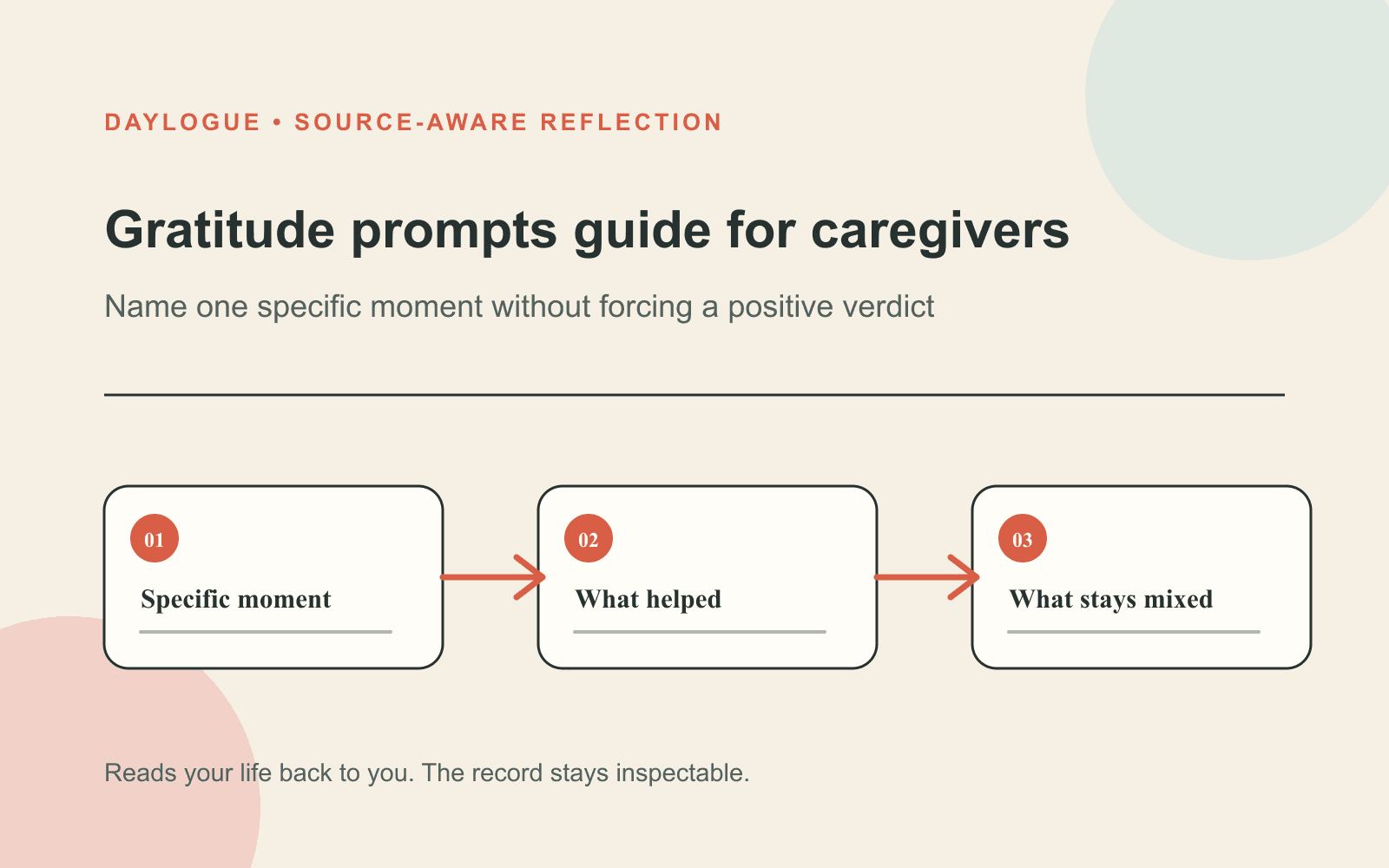
A useful gratitude prompt for a parent or caregiver asks for one specific moment, not a positive summary of the whole day. Name what happened, what or who helped, and what remains mixed. Appreciation can sit beside fatigue, frustration, or uncertainty. You never need to turn a difficult care day into a lesson or pretend that noticing help cancels the cost of the day.
Start with a specific contribution, not a cheerful summary
“I am grateful for my family” may be true, but it gives a future reader little context. Narrow the frame to something observable: a neighbor brought groceries, a child waited while you finished a call, or a sibling handled one appointment. Specificity keeps appreciation connected to real support rather than turning it into a demand to declare the day good.
Include what the help changed. Perhaps it protected ten quiet minutes, removed one decision, or made a handoff less confusing. That detail matters because gratitude is not only a list of people or objects. It can be a record of the conditions that made a care day more workable. The entry can end there without making a claim about how you should feel next.
Let appreciation and difficulty appear in the same entry
A useful prompt does not require gratitude to replace strain. You can write, “I appreciated the ride, and the appointment was still exhausting.” Both clauses belong to the record. Removing the second may make the entry feel less honest; removing the first may erase a concrete form of support. Keeping both prevents one emotion word from summarizing a layered event.
Try a two-column note when the day feels complicated. One side names what helped. The other names what the help did not solve. This is not a balance sheet and the columns do not need equal length. They simply protect the full context from a prompt that might otherwise steer you toward a cleaner, less accurate story.
| What happened | What helped | What remains true |
|---|---|---|
| A school pickup changed | A friend covered the first half hour | The schedule was still stressful |
| A care call ran long | The coordinator sent written notes | I still need time to understand them |
| Dinner was interrupted | Someone else cleaned up | I was still tired and frustrated |
Read gratitude research with its limits attached
A 2025 systematic review examined positive expressive writing studies in non-clinical populations and reported that the studies varied widely in topic, schedule, comparison group, and outcome. The review also rated the included evidence as poor or fair quality. That makes the research relevant background, but not a promise that a gratitude journal will produce a particular result for a caregiver.
Use the practice because the entry itself is useful to you, not because a page predicts an outcome. A dated record can help you remember who helped, what conditions reduced friction, or which forms of support were actually usable. Those are modest purposes. They do not require a wellness claim, a fixed routine, or pressure to continue when the exercise no longer fits.
Inspect repeated supports without claiming a cause
After several entries, you may notice that certain handoffs, written instructions, or short breaks appear beside easier moments. Keep the source entries open and check for days that do not fit. Daylogue states that a recurring overlap does not show that one thing caused another. A repeat can suggest a question worth asking, but it cannot settle why a day unfolded as it did.
Phrase the observation in the scale of the record. “Written notes helped after two appointments this month” is more useful than “written notes always reduce stress.” Record missing details and changes in context. A careful summary should make it easy to return to the original moments, correct the wording, and preserve an exception rather than hiding it.
Keep private stories and automated summaries in bounds
Gratitude entries often involve other people. You can preserve the contribution without copying a private conversation or naming a child, client, patient, teacher, or relative. Use role labels and include only the details needed for your own memory. If a synced tool is involved, review its storage, processing, correction, export, and deletion terms before adding sensitive context.
Daylogue does not infer emotion from faces, voice tone, or physiology. It works from the words and context people choose to share. Daylogue does not use personal entries to train its own models. Provider handling follows current written terms, configuration, and subprocessor disclosures. Daylogue reads the entries you choose to sync to create narratives and surface patterns. Entries are not end-to-end encrypted. Keep generated summaries provisional and remove identifying details that the note does not need.
Notice the shape of support, not only its source
Two helpful moments can come from the same person and still work differently. One may remove a task, another may provide information, and a third may simply protect a pause. Naming the form of support makes the entry more useful than repeating a person’s name. It can show what was usable in that setting without converting appreciation into an obligation to repay or perform a particular feeling.
You can also record support that came from structure: a prepared bag, a clear calendar note, an accessible entrance, or a policy that allowed flexibility. These details keep the practice grounded in conditions rather than personality. When a support was offered but not usable, write that too. “The offer came after I had already rearranged the day” preserves appreciation for the offer and an accurate account of timing.
Create a gratitude practice that can survive an uneven week
Choose a small trigger such as closing a calendar, putting away a care bag, or waiting for the kettle. Write one moment and stop. On a day with no answer, use a neutral prompt: “What did I need that was unavailable?” This keeps the record honest and may clarify the kind of support that would matter without forcing appreciation where none is present.
Daylogue is not therapy and is not a replacement for professional care. A gratitude prompt is a reflection option, not a requirement for coping with difficult circumstances. Make skipping visible and acceptable. The practice is sustainable when it respects privacy, preserves mixed feelings, and remains small enough that choosing not to write carries no penalty.
01
Name the source moment
Record one dated event and the concrete contribution you noticed in it.
02
Say what changed
Describe the task, decision, or transition that became easier without declaring the entire day positive.
03
Keep the remainder
Add what stayed difficult or uncertain, then stop without trying to resolve the contrast.
Prompt Pack
Caregiver gratitude prompts that leave room for reality
Optional prompts for recording specific support while keeping effort, fatigue, and uncertainty in the same honest account.
- What made one care task easier today?
- Whose unseen effort did I notice?
- What support helped without solving everything?
- What did I prepare that my later self could use?
- What stays mixed alongside this appreciation?
Common questions
What is a realistic gratitude prompt for a caregiver?
Ask what made one task easier, whose effort you noticed, or what resource was available. Keep the answer tied to a real moment.
Can I write gratitude and frustration together?
Yes. Appreciation does not cancel difficulty. Recording both can preserve a more accurate account of what the support changed and what it did not.
What if no gratitude answer feels honest today?
Write that no answer is available, choose a neutral observation, or skip the entry. The prompt should not require a positive performance.
Do repeated gratitude entries prove what improves my day?
No. Repeated overlap can suggest something to inspect, but it does not establish cause and should stay connected to dated source moments.
Sources
Sources were checked on the dates shown. Product details and policies can change.
- Daylogue evidence and methods · Daylogue · checked August 28, 2026
- Daylogue privacy policy · Daylogue · checked August 28, 2026
Keep exploring
Daylogue Knowledge Center
Browse practical guides for reflection, journaling, patterns, and privacy.
Read moreHow Daylogue shows patterns
See how candidate patterns stay connected to evidence and correction.
Read moreWhy Daylogue exists
Read the principles behind a system for self-understanding.
Read moreDaylogue is not therapy and is not a replacement for professional care.