Written by Daylogue Editorial Team. Published August 29, 2026. Reviewed and updated August 29, 2026.
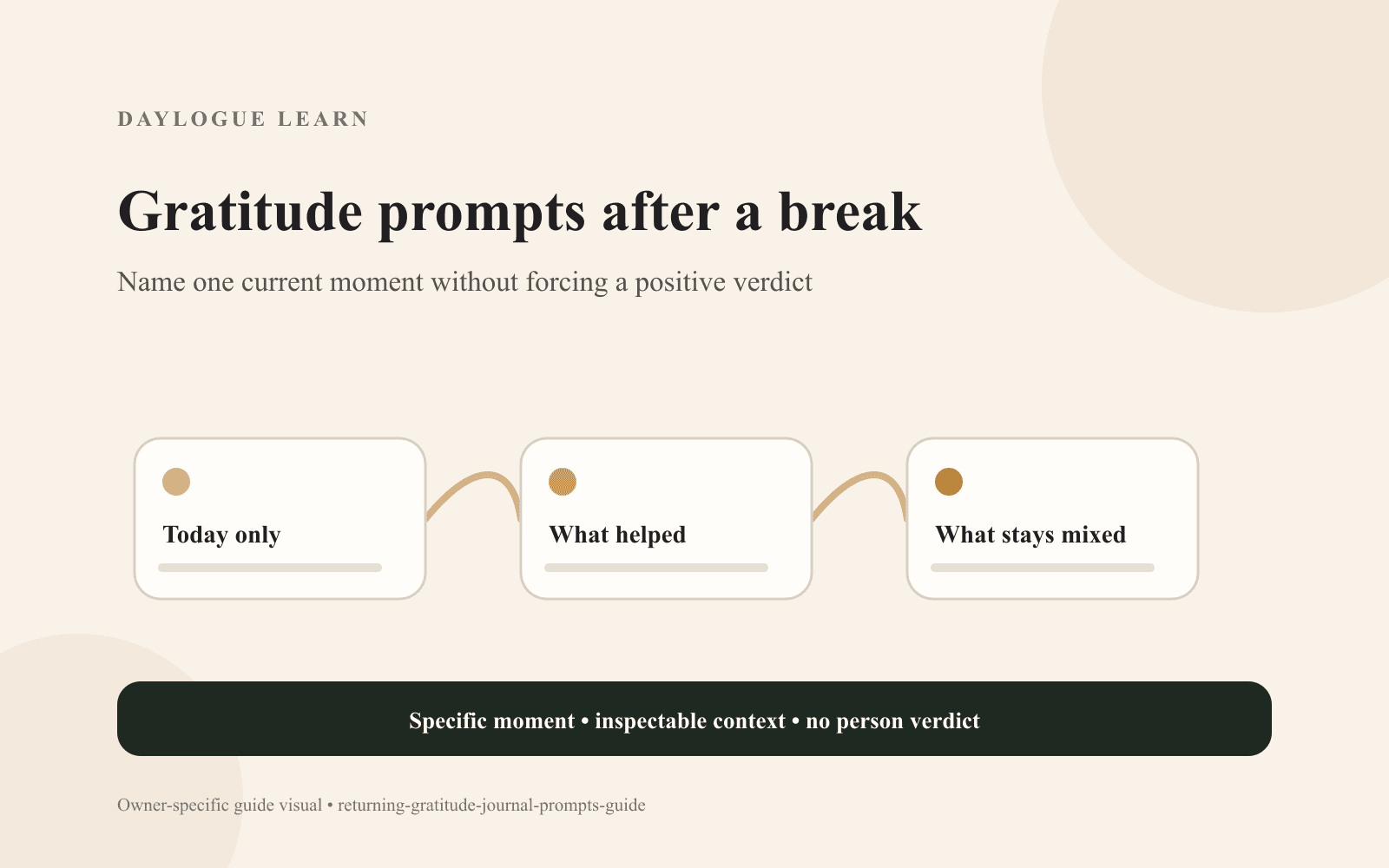
Gratitude journal prompts after a break can begin with one current detail that helped. Name what happened, what it made possible, and what stayed mixed. You do not need to summarize the missed days or produce a positive verdict about the break. Appreciation and difficulty can appear in the same entry without canceling each other.
Stop with one accurate question: gratitude with mixed context
Close this guide by returning to one specific detail without forcing a positive account. Choose between someone covering a small task and sunlight reaching the kitchen table, complete the first two relevant moves, and stop before the note becomes a verdict. Daylogue is not therapy and is not a replacement for professional care. Its observations are designed for reflection, not diagnosis, prediction, treatment, or clinical decision-making. The useful finish is one accurate moment plus a question you are free to leave open.
Choose the first scene: gratitude with mixed context
For someone restarting a gratitude practice, returning to gratitude without forcing a positive account can begin with a friend sending the right address. That scene is narrow enough to place and concrete enough to revise. Compare it with someone covering a small task, which may need a different amount of detail. Name one current detail first, then say what it made possible. The point is to capture what you chose to notice without turning the first new note into an account of every missing day or every person involved.
Keep the frame local: gratitude with mixed context
Build the entry around a contrast between five quiet minutes in a parked car and a meal you did not have to plan. Ask, “What helped in one scene?” before adding an explanation. Then use “What became easier for a moment?” to test whether the detail belongs to this moment or to a broader story you are carrying. Gratitude becomes more believable when it names a detail instead of demanding a positive summary. The useful entry might be a friend sending the exact information you needed, five quiet minutes in the car, a meal someone else prepared, or a boundary that gave you room. Record what helped without claiming that it fixed the rest of the day. Use three questions: What happened? What did it make possible? What stayed mixed? The third question keeps gratitude from erasing frustration, grief, fatigue, or conflict. You can appreciate the covered shift and still wish the situation were different. Both details belong in an honest record. Keep the wording close to the event so a later note can support, narrow, or replace the first interpretation.
Use the page-specific method: gratitude with mixed context
Use this task sequence: keep the scale small, include what stayed difficult, and avoid a moral lesson. Apply it first to a boundary that protected an hour, then imagine how the same sequence would change for a stranger giving clear directions. The two scenes should not produce identical entries because context matters. Ask “Which detail deserves to be remembered?” and write only what the current scene can answer. Mark every other part as missing, uncertain, or outside the scope of this note.
01
Name one current detail
Apply this move to a friend sending the right address. Then ask, “What helped in one scene?” Keep the response specific and leave unsupported conclusions open.
02
Say what it made possible
Apply this move to someone covering a small task. Then ask, “What became easier for a moment?” Keep the response specific and leave unsupported conclusions open.
03
Keep the scale small
Apply this move to five quiet minutes in a parked car. Then ask, “Which detail deserves to be remembered?” Keep the response specific and leave unsupported conclusions open.
04
Include what stayed difficult
Apply this move to a meal you did not have to plan. Then ask, “What support did not erase the difficulty?” Keep the response specific and leave unsupported conclusions open.
05
Avoid a moral lesson
Apply this move to a boundary that protected an hour. Then ask, “What stayed mixed?” Keep the response specific and leave unsupported conclusions open.
06
Skip gratitude on demand
Apply this move to a stranger giving clear directions. Then ask, “Who made one task lighter?” Keep the response specific and leave unsupported conclusions open.
07
Choose an honest thank-you
Apply this move to sunlight reaching the kitchen table. Then ask, “What would I like to acknowledge?” Keep the response specific and leave unsupported conclusions open.
08
End without summarizing the break
Apply this move to a hard conversation that stayed respectful. Then ask, “What positive verdict am I refusing to force?” Keep the response specific and leave unsupported conclusions open.
Ask only the next useful question: gratitude with mixed context
A useful prompt set for this page stays close to returning to gratitude without forcing a positive account. Begin with “What support did not erase the difficulty?” when the first sentence feels too broad. Follow with “What stayed mixed?” only when another question would add inspectable context. If the wording steers toward a person verdict, replace it with “Who made one task lighter?” Prompts are optional tools for attention, and the writer can shorten, correct, skip, or stop at any point.
- What helped in one scene?
- What became easier for a moment?
- Which detail deserves to be remembered?
- What support did not erase the difficulty?
- What stayed mixed?
- Who made one task lighter?
- What would I like to acknowledge?
- What positive verdict am I refusing to force?
Compare broad and grounded notes: gratitude with mixed context
Try a paired example. In the first note, describe sunlight reaching the kitchen table using an absolute conclusion. In the second, name the time, observable change, and one surrounding condition. The grounded version leaves gratitude optional and keeps any possible cause open. Repeat the exercise with a hard conversation that stayed respectful. Different details may matter, and the comparison should preserve those differences instead of flattening them into one theme.
| Scene | Grounding move | Question |
|---|---|---|
| a friend sending the right address | name one current detail | What helped in one scene? |
| someone covering a small task | say what it made possible | What became easier for a moment? |
| five quiet minutes in a parked car | keep the scale small | Which detail deserves to be remembered? |
| a meal you did not have to plan | include what stayed difficult | What support did not erase the difficulty? |
| a boundary that protected an hour | avoid a moral lesson | What stayed mixed? |
| a stranger giving clear directions | skip gratitude on demand | Who made one task lighter? |
| sunlight reaching the kitchen table | choose an honest thank-you | What would I like to acknowledge? |
| a hard conversation that stayed respectful | end without summarizing the break | What positive verdict am I refusing to force? |
Mark causes as unknown: gratitude with mixed context
Gratitude becomes more believable when it names a detail instead of demanding a positive summary. The useful entry might be a friend sending the exact information you needed, five quiet minutes in the car, a meal someone else prepared, or a boundary that gave you room. Record what helped without claiming that it fixed the rest of the day. Use three questions: What happened? What did it make possible? What stayed mixed? The third question keeps gratitude from erasing frustration, grief, fatigue, or conflict. You can appreciate the covered shift and still wish the situation were different. Both details belong in an honest record. Daylogue says a recurring overlap does not show that one thing caused another. Use “What would I like to acknowledge?” to look for an exception or missing influence. A repeated phrase, a missing date, or a confident summary cannot supply the context the source moment lacks. Keep candidate readings provisional, attach them to dated entries, and revise them when a later example does not fit.
Read the source before the summary: gratitude with mixed context
Review this gratitude with mixed context record by opening the source scene rather than reading only its summary. An honest thank-you is available when it fits, and the entry can end without summarizing the break. Then ask, “What positive verdict am I refusing to force?” Keep the note when its language matches the available detail. Narrow it when the scope is too large. Drop it when the interpretation survives only by ignoring exceptions, uncertain timing, or the writer’s correction.
Keep research in its proper role: gratitude with mixed context
A 2025 systematic review reported that positive expressive writing studies used heterogeneous methods and that all included studies were rated poor or fair in quality. Use that source as context for how careful reflection can keep a sequence understandable, not as a promise about this guide or a forecast for one reader. Study findings depend on the population, method, and outcome measured. A journal entry remains a chosen record, and software cannot turn a research result into a conclusion about the person writing.
Reduce identifying detail before syncing: gratitude with mixed context
Before recording a friend sending the right address or a hard conversation that stayed respectful, decide which names, messages, locations, and details are necessary. Daylogue reads the entries you choose to sync to create narratives and surface patterns. Entries are not end-to-end encrypted. That boundary matters more than a one-word privacy promise. Use roles, paraphrases, and fewer identifiers when they preserve enough context for your own reflection.
Read the processing boundary plainly: gratitude with mixed context
Daylogue does not use personal entries to train its own models. Provider handling follows current written terms, configuration, and subprocessor disclosures. Daylogue does not infer emotion from faces, voice tone, or physiology. It works from the words and context people choose to share. Read current terms before choosing what to submit, and keep the interpretation with the person who supplied the words.
Prompt Pack
Name one current detail: a gratitude with mixed context field sheet
Use this field sheet for returning to gratitude without forcing a positive account. Each item pairs a concrete scene with a specific move or question, so the record stays inspectable and open to correction.
- Name one current detail when the scene is a friend sending the right address.
- Say what it made possible when the scene is someone covering a small task.
- Keep the scale small when the scene is five quiet minutes in a parked car.
- Include what stayed difficult when the scene is a meal you did not have to plan.
- Avoid a moral lesson when the scene is a boundary that protected an hour.
- Skip gratitude on demand when the scene is a stranger giving clear directions.
- Choose an honest thank-you when the scene is sunlight reaching the kitchen table.
- End without summarizing the break when the scene is a hard conversation that stayed respectful.
- Write or skip this question: What helped in one scene?
- Write or skip this question: What became easier for a moment?
- Write or skip this question: Which detail deserves to be remembered?
- Write or skip this question: What support did not erase the difficulty?
- Write or skip this question: What stayed mixed?
- Write or skip this question: Who made one task lighter?
- Write or skip this question: What would I like to acknowledge?
- Write or skip this question: What positive verdict am I refusing to force?
Common questions
How do I restart a gratitude journal when I do not feel positive?
Name one useful, kind, beautiful, or relieving detail without asking it to change your opinion of the whole day.
Can gratitude and frustration appear in the same entry?
Yes. Record what helped and what remained hard. Mixed context often makes the appreciation more specific and believable.
What if no gratitude prompt fits today?
Skip it, write a neutral observation, or leave the page blank. Gratitude is not a test of character or effort.
Do I need to list several things?
No. One concrete detail usually gives you more to remember than a rushed list assembled to meet a number.
How should someone restarting a gratitude practice check a possible repeat?
Open the dated source moments, compare a friend sending the right address with a boundary that protected an hour, and look for exceptions before keeping any summary.
What data boundary matters for returning to gratitude without forcing a positive account?
Check whether synced entries are readable to the service, which providers process requested content, how generated outputs are stored, and what deletion covers.
Sources
Sources were checked on the dates shown. Product details and policies can change.
- Daylogue evidence and methods · Daylogue · checked August 29, 2026
- Daylogue privacy policy · Daylogue · checked August 29, 2026
- Positive expressive writing systematic review · PLOS One · checked August 29, 2026
Keep exploring
Daylogue Knowledge Center
Browse practical guides for reflection, journaling, patterns, and privacy.
Read moreHow Daylogue shows patterns
See how candidate patterns stay connected to evidence and correction.
Read moreWhy Daylogue exists
Read the principles behind a system for self-understanding.
Read moreDaylogue is not therapy and is not a replacement for professional care.