Written by Daylogue Editorial Team. Published August 29, 2026. Reviewed and updated August 29, 2026.
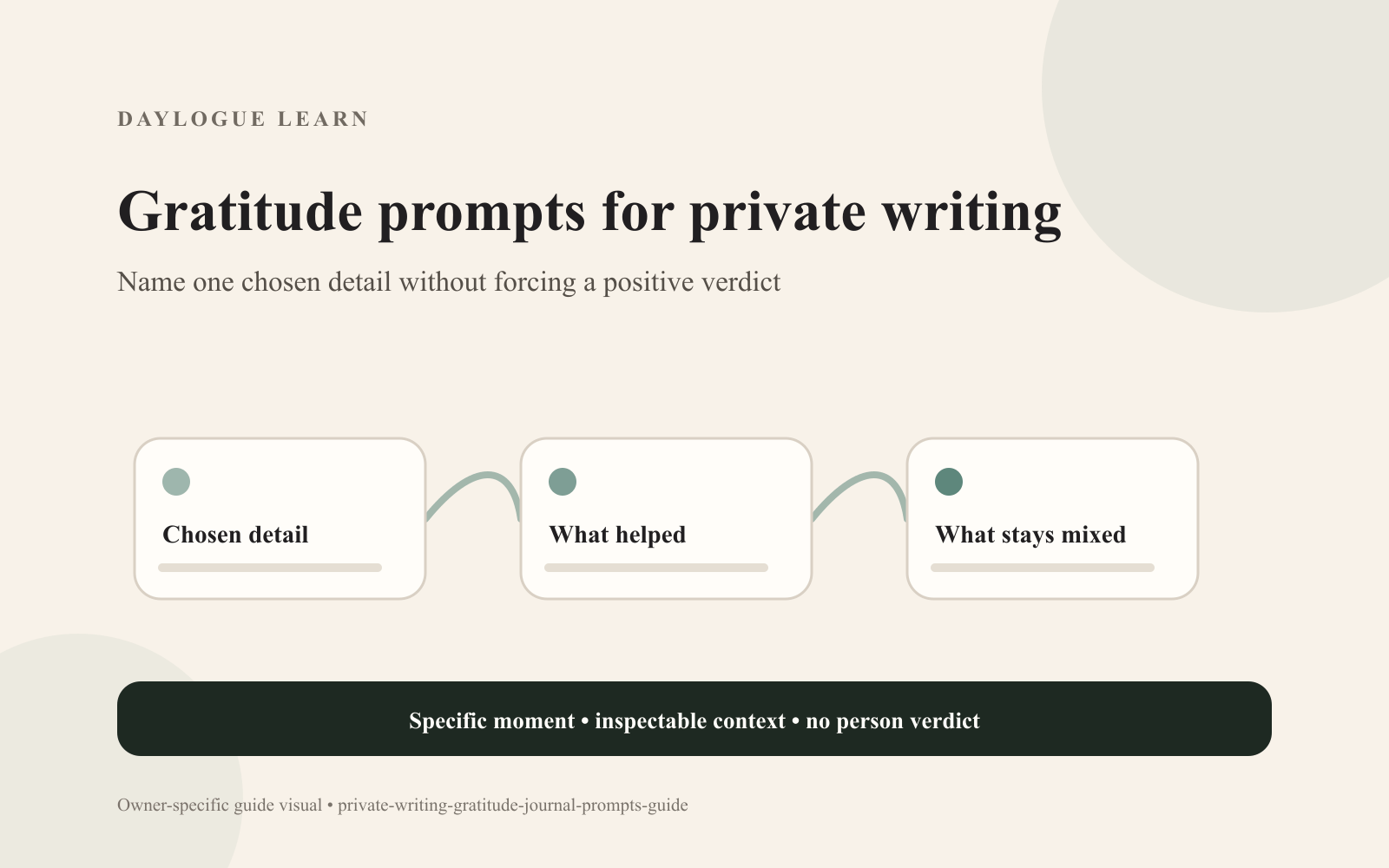
A private gratitude entry works better when it names a specific detail instead of demanding a positive summary. Write what happened, who or what helped, and what remains mixed. “The cashier waited while I found my card” gives you more to remember than “I am grateful for kindness.” Appreciation can share the page with frustration, grief, boredom, or uncertainty.
Choose a question with clear edges
Broad questions can make a short check-in feel bigger than it is. "How is life going?" asks for a summary. "What stayed with me from today?" asks for one helpful detail. A useful gratitude question gives you something concrete to name without deciding what it means.
Questions about attention, effort, choices, and surprises work well because they stay close to what happened. Pick one. If nothing comes to mind, leave it unanswered. The gratitude question is available to you, not an assignment you owe.
- What stayed with me today?
- What took more effort than expected?
- When did my attention shift?
- What felt simpler this time?
- What did I want more space for?
- What can I leave unfinished?
Gratitude questions for an ordinary day
Start with a detail rather than a cheerful summary. Name the person, object, timing, or small action that helped. “Someone held the door while my hands were full” gives you more to remember than a broad statement about kindness.
Let the helpful detail share the page with whatever stayed difficult. Appreciation does not erase frustration, grief, boredom, or uncertainty. A private entry can hold both without asking one feeling to cancel the other.
Notice what your appreciation points toward
Appreciation can point toward what you value without defining you. Ask: What did I make time for even when the week was crowded? Which act of care mattered? What quiet effort did I respect? Which choice would I appreciate even if nobody noticed it? These questions focus on a real scene instead of asking for impressive words from a list. Leave one gratitude question open when the available context is incomplete.
Keep tension visible too. You may appreciate someone’s help and still dislike how the situation unfolded. You may feel relieved by an outcome and frustrated by its cost. Write both sides without forcing them into a tidy answer. A full week contains competing demands, and gratitude does not erase them. Leave one gratitude question open when the available context is incomplete.
- What did I defend when it would have been easier to let it go?
- What did I spend time on without needing recognition?
- Which rule feels useful to me, and which feels borrowed?
- What kind of effort feels worth repeating?
- When did I choose honesty over convenience?
Start with a specific contribution, not a cheerful summary
“I am grateful for my family” may be true, but it gives a future reader little context. Narrow the frame to something observable: a neighbor brought groceries, a child waited while you finished a call, or a sibling handled one appointment. Specificity keeps appreciation connected to real support rather than turning it into a demand to declare the day good.
Include what the help changed. Perhaps it protected ten quiet minutes, removed one decision, or made a handoff less confusing. That detail matters because gratitude is not only a list of people or objects. It can be a record of the conditions that made the day more workable. The specific appreciation note can end there without making a claim about how you should feel next.
Inspect repeated support without claiming a cause
If several notes mention the same kind of help, return to the exact dates and wording. Compare what was happening around each gesture and find the entry that does not fit. Repeated support can be worth noticing without proving why a day felt a certain way.
For example, someone moving a chair near an outlet may have made ten minutes easier during a frustrating delay. Keep the action, the relief, and the continuing frustration together. A specific appreciation note does not need to turn that moment into a broad rule.
Keep gratitude reflection expectations modest and inspectable
A 2025 systematic review examined 51 positive expressive writing studies, and the authors rated the included studies poor or fair in quality. The formats, topics, comparisons, and outcomes varied. Use that evidence as a reason to keep expectations modest, not as a promise that one question, schedule, or writing style will create a particular result.
Daylogue says its observations are designed for reflection, not diagnosis, prediction, treatment, or clinical decision-making. For this gratitude reflection guide, the useful standard is simpler: does the specific appreciation note preserve a helpful detail, show what remains unknown, and leave the interpretation open to revision? If not, shorten or change the gratitude question.
Notice the shape of support, not only its source
Two helpful details can come from the same person and still work differently. One may remove a task, another may provide information, and a third may simply protect a pause. Naming the form of support makes the specific appreciation note more useful than repeating a person’s name. It can show what was usable in that setting without converting appreciation into an obligation to repay or perform a particular feeling. Leave one gratitude question open when the available context is incomplete.
You can also record support that came from structure: a prepared bag, a clear calendar note, an accessible entrance, or a policy that allowed flexibility. These details keep the practice grounded in conditions rather than personality. When a support was offered but not usable, write that too. “The offer came after I had already rearranged the day” preserves appreciation for the offer and an accurate account of timing. Leave one gratitude question open when the available context is incomplete.
Use gratitude questions as options, not obligations
A starter should open a door, not push you through it. Gratitude questions beginning with what, when, or which tend to keep the specific appreciation note close to an occasion. Gratitude questions that assume a cause, use “always,” or tell you what you must feel can narrow the story too early. Change “Why do I always do this?” to “What happened before I made that choice today?” The revised gratitude question leaves more room for context.
For this private writing task, let “Use gratitude questions as options, not obligations” have a narrow job. Use one gratitude question, answer with a dated action or phrase, and stop before the answer turns into a verdict. If the first explanation feels certain, list one missing fact and one counterexample you would need to check before keeping it.
01
Name one episode
Choose one instance from one source of help or steadiness that you can locate in time, even if you only remember the rough part of the day.
02
Write what you noticed
Use your own words for the detail that stood out, without assigning a permanent label to yourself or someone else.
03
Leave one thing open
End with a question, missing particular, or counterexample that could change the first account later.
A gratitude practice that can stay flexible
Keep a small menu of questions and choose only one when you write. Ask what helped, what you nearly overlooked, or what remained mixed beside the helpful detail. Repeating the practice is optional. Missed days do not create a backlog.
When a question starts producing the same generic answer, change it. Ask for a sensory detail, a specific contribution, or an ordinary object that worked well. The goal is an accurate note, not a performance of positivity.
One example with mixed context
Suppose someone moved a chair near an outlet during a delayed trip. Record the action, the moment your phone began charging, and the fact that the delay remained frustrating. The help mattered without changing every part of the situation.
On a later read, keep the observation local unless another comparable entry supports a broader question. One helpful gesture does not prove that the day was good, and one hard day does not make the gesture irrelevant.
Prompt Pack
Gratitude Journal Prompts for Private Writing: twelve prompts
Choose one question for a specific gratitude prompts moment, answer in your own words, and leave the interpretation open to later context.
- What specific detail helped today?
- Who made one thing easier?
- What ordinary object did its job well?
- What did I notice because I slowed down?
- What kindness had clear edges?
- What am I appreciating without idealizing?
- What remains difficult beside this good detail?
- What support did I almost overlook?
- What did I receive without earning?
- What part of the moment belongs to chance?
- What would I like to remember accurately?
- What can stay mixed on the page?
Common questions
What specific detail helped today?
Use this as a gratitude question about someone moving a chair near an outlet during a delay that remained frustrating. Answer with one observable detail first, then add your current reading only if it helps. You can stop after the record is clear.
What ordinary object did its job well?
Keep the answer inside one helpful detail. Write what changed, what stayed fixed, and which fact is missing. That structure prevents a limited specific appreciation note from becoming a verdict about a person or an entire period.
What am I appreciating without idealizing?
Put the direct answer in your own words and remove names that add nothing to the task. If the question assumes a motive or outcome, rewrite it so the missing context remains visible.
What did I receive without earning?
Return to dated source lines before calling this a repeat. Look for an exception and an unrecorded gap. A repetition can support another question, but it cannot prove a cause by itself.
What can stay mixed on the page?
Leave this unanswered when the available record is too thin. A useful private writing practice allows an open question, a visible gap, and a clean stopping point without inventing completion.
Sources
Sources were checked on the dates shown. Product details and policies can change.
- Daylogue evidence and methods · Daylogue · checked August 29, 2026
- Positive expressive writing systematic review · PLOS One · checked August 29, 2026
Keep exploring
Daylogue Knowledge Center
Browse practical guides for reflection, journaling, patterns, and privacy.
Read moreHow Daylogue shows patterns
See how candidate patterns stay connected to evidence and correction.
Read moreWhy Daylogue exists
Read the principles behind a system for self-understanding.
Read moreDaylogue is not therapy and is not a replacement for professional care.