Written by Daylogue Editorial Team. Published August 8, 2026. Reviewed and updated August 8, 2026.
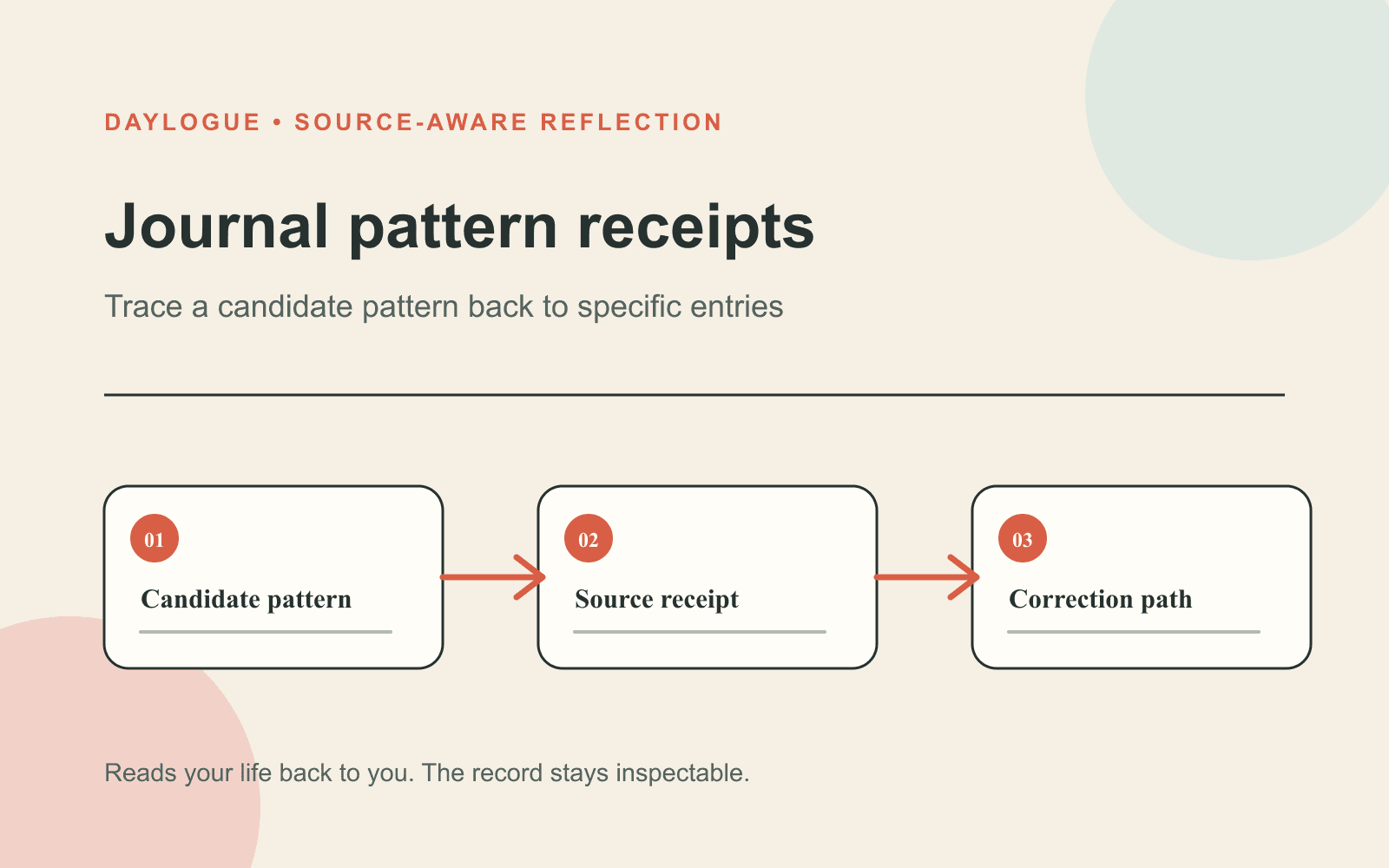
A journal pattern receipt is the evidence trail behind a pattern observation. It should show the time window, the information considered, the recurring overlap, examples that fit, exceptions that do not, and a plain statement of limits. The receipt helps you inspect the observation instead of accepting it as a verdict.
A receipt is evidence, not a verdict
A receipt answers a practical question: what in the record led to this observation? It names the window, inputs, examples, and limits in language a person can inspect. That changes the experience from receiving a polished sentence to following a trail. If a Thursday pattern is suggested, the receipt should point to the Thursdays included and show what was logged, not merely repeat that Thursdays seem hard.
The reader remains the final interpreter. A deadline week, travel day, illness, family visit, or missing check-in may change what an apparent repeat means. A good receipt makes those complications visible. It does not smooth the record into certainty. That small act of showing the work gives you enough context to say yes, no, partly, or not yet.
What belongs in the evidence trail
Start with five parts: the observation, the covered dates, the inputs used, examples that fit, and exceptions that resist the summary. Add a limits note that separates what was recorded from what was inferred. The result can be short. A useful receipt is not a data dump. It is a compact map back to the personal record, with enough detail to retrace the path.
Daylogue tracks four core metrics across every check-in: mood, energy, stress, and sleep hours. Those fields can support a receipt when they were actually present in the selected window. Written themes may add context, but the receipt should label them as words the person chose to share. It should never claim access to an unspoken feeling, hidden motive, or fact outside the record.
Check the window before the pattern
A pattern can look different when a seven-day slice becomes a month. One rough week may dominate a short window, while a long window can blur a recent change. Inspect the start and end dates, the number of represented days, and any long gaps. Ask whether the chosen window matches the question you care about. A work-cycle question may need several cycles, not an arbitrary calendar month.
Daylogue provides weekly and monthly views that let you zoom out across the record. Use those views as two lenses rather than two levels of certainty. Weekly context can preserve the ordinary sequence of events. Monthly context can reveal repetition across several weeks. Moving between them helps you notice when an observation depends on one unusual cluster rather than a stable repeat.
Read the examples and the exceptions together
Examples make an observation concrete. Exceptions keep it honest. Suppose several low-energy entries appear on late-meeting days, but two late-meeting days show steady energy. Those exceptions might point to another factor, or they may show that the proposed pattern is too broad. The receipt should keep both sets visible so you can refine the wording without forcing the record to agree.
A recurring overlap does not show that one thing caused another. The receipt can say two details repeatedly appeared together. It cannot say one produced the other. That distinction matters because a calendar slot, short sleep, workload, food, travel, and family demands can all share the same week. The record opens a question. It does not close the case.
Use bounded language for each receipt part
The strongest wording stays close to what the record contains. Replace “always” with a count. Replace “because” with “showed up alongside.” Replace a prediction with an invitation to watch the next comparable moment. Bounded language is not timid. It is more useful because another person can inspect it and know exactly what would support or weaken it.
Risk frameworks can help teams design this traceability without pretending a framework certifies a particular observation. The NIST AI Risk Management Framework is intended for voluntary use. For a personal journaling product, the practical lesson is simple: make the system’s limits and review points visible, then let the person challenge the output.
| Receipt field | Question it answers | Limit |
|---|---|---|
| Date range | Which part of the record was reviewed? | A window can miss earlier or later context. |
| Inputs | Which fields or written themes were used? | Unshared information is outside the record. |
| Examples | Which entries fit the observation? | Examples alone can be cherry-picked. |
| Exceptions | Which comparable entries do not fit? | An exception may narrow or reject the idea. |
| Limits | What can the evidence not establish? | Cause and prediction remain open. |
How to inspect a receipt in three minutes
First, read the one-sentence observation without deciding whether it is true. Next, scan the date range and the evidence examples. Then look specifically for missing days and counterexamples. Last, rewrite the observation in your own words. If your version is narrower, that is useful. If the evidence feels thin, choose keep watching rather than forcing a decision.
The process should feel like checking your own notes, not auditing yourself. You do not owe the software agreement. A receipt succeeds when it helps you recover context and make a more accurate call. Rejecting a proposed pattern is not a failed interaction. It is the person adding information the record alone could not supply.
01
Read the observation
Hold your decision for a moment and identify the exact statement the evidence trail is asking you to inspect.
02
Check the coordinates
Review dates, eligible fields, fitting examples, exceptions, and missing coverage before interpreting the pattern.
03
Write your response
Choose confirm, reject, reinterpret, or keep watching, then add the ordinary context the record could not know.
Confirm, reject, reinterpret, or keep watching
Four responses cover most cases. Confirm means the observation fits the visible record and your lived context. Reject means the record or context clearly conflicts with it. Reinterpret means the overlap is real but the proposed wording misses what matters. Keep watching means there is not enough coverage yet. Each option leaves room for the pattern to change as new entries arrive.
Keep the receipt attached to the observation so a later version can be compared with the earlier one. If the wording changes, the evidence trail should explain why. That makes the record useful over time without turning an old interpretation into permanent truth. Your days have a story, but the story remains yours to read and revise.
Example: a Thursday pattern receipt
Suppose the observation says, “Stress was logged higher in several Thursday evening check-ins this month.” The receipt names the four covered Thursdays, shows that three included higher stress, and notes that one was lower. It lists the same weekly slot as the shared context and opens the written notes the person chose to connect. One fitting entry mentions an unfinished launch. The lower-stress exception mentions a lighter agenda. The receipt does not claim the agenda caused either result. It simply gives the reader the dates, visible details, and exception needed to judge the observation.
The person may respond that Thursday is not the useful frame. The harder moments were the evenings before a Friday presentation, and one Thursday had no presentation ahead. That reinterpretation adds lived context the fields alone could not supply. The revised receipt can narrow the observation and keep the original evidence trail. This is what checkability looks like in practice: the software offers a candidate reading, the person follows the path, and the wording changes when ordinary context makes a better explanation possible.
When you save the receipt, keep the observation and its limits together. A later reader should not have to remember which caveat belonged to which claim. If new entries change the pattern, add a new version instead of overwriting the old trail. The comparison between versions can reveal something important by itself: the routine changed, coverage improved, or a counterexample exposed a better boundary. Receipts are useful because they preserve the path of interpretation, not because they freeze one interpretation forever.
- Observation stays inside the selected month.
- Every example and exception carries a date.
- The person can add context without turning it into proven cause.
- The revised wording preserves why the change was made.
Framework
Journal pattern receipt checklist
Use this checklist to inspect the evidence trail behind any pattern observation before deciding whether it fits your own record.
- Name the observation in one bounded sentence without turning it into a personal verdict.
- Write the exact date range and count the check-ins represented in that window.
- List the fields used, such as mood, energy, stress, sleep hours, or a repeated theme.
- Pull at least three concrete examples across distinct periods that fit the observation and preserve their dates.
- Pull at least one exception or counterexample instead of hiding inconvenient entries.
- State what the record cannot establish, including cause, motive, or a prediction.
- Choose confirm, reject, reinterpret, or keep watching as your response to the receipt.
Common questions
Is a pattern receipt the same as raw journal data?
No. Raw entries contain the full record. A pattern receipt is a compact trail that identifies the covered dates, relevant inputs, fitting examples, counterexamples, and limits so you can return to the right parts of that record.
How many examples should a receipt include?
A pattern requires at least three data points across distinct periods. Two similar entries are only something that came up a couple of times. Include dated examples plus exceptions that could change the interpretation. Thin or uneven coverage calls for narrower wording or a keep-watching decision.
Can a receipt prove why a pattern happened?
No. It can document that details appeared together in the selected record. It cannot establish cause, recover unshared context, or prove what will happen in the next similar situation.
What if the observation feels wrong?
Reject it or rewrite it. The purpose of a receipt is to make disagreement informed and easy. Your context can correct an observation that looks plausible in the data but misses the ordinary reality behind it.
Should every journal observation have a receipt?
Any observation presented as a recurring pattern benefits from a checkable trail. A simple reflection may need less structure, but the reader should still be able to distinguish recorded facts from interpretation.
Sources
Sources were checked on the dates shown. Product details and policies can change.
- Daylogue pattern features · Daylogue · checked August 8, 2026
- Daylogue evidence and methods · Daylogue · checked August 8, 2026
- NIST AI Risk Management Framework · National Institute of Standards and Technology · checked August 8, 2026
- NIST Privacy Framework · National Institute of Standards and Technology · checked August 8, 2026
Keep exploring
Daylogue Knowledge Center
Browse practical guides for reflection, journaling, patterns, and privacy.
Read moreHow Daylogue shows patterns
See how candidate patterns stay connected to evidence and correction.
Read moreWhy Daylogue exists
Read the principles behind a system for self-understanding.
Read moreDaylogue is not therapy and is not a replacement for professional care.