Written by Daylogue Editorial Team. Published August 26, 2026. Reviewed and updated August 26, 2026.
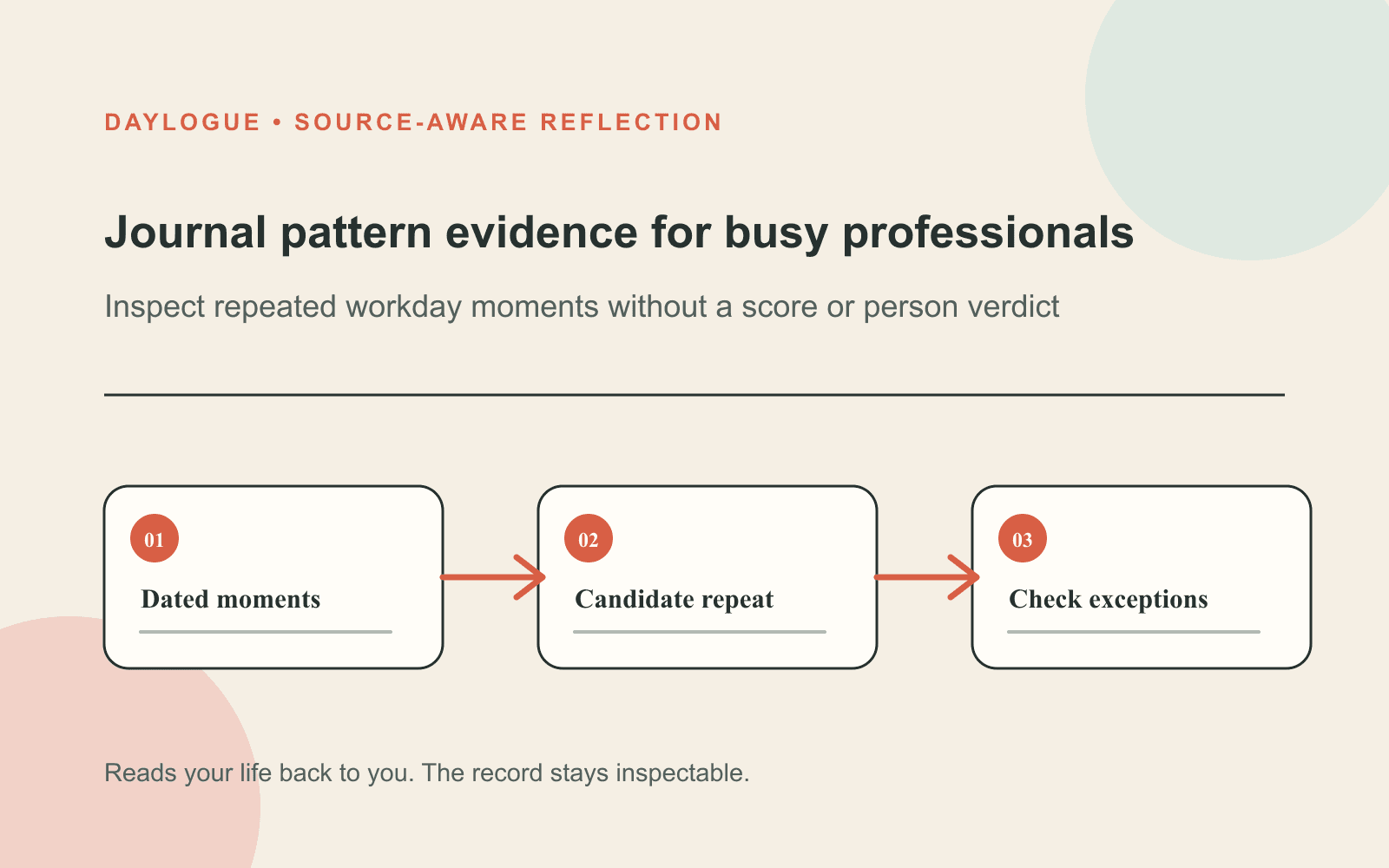
A journal app that finds patterns compares details across dated entries and presents a recurring overlap for you to inspect. For a busy professional, the most useful reads connect to source moments, name the timeframe, show exceptions, and avoid claiming cause. Test an app by recording one comparable detail for two weeks, then open every cited entry before accepting the observation. Keep the result as a question, not a diagnosis, prediction, score, or verdict about you.
Know what a pattern-finding journal should do
Search can recover an entry you already know exists. A timeline can show how a rating changed. A pattern read makes a narrower comparison across several moments and points out a repeat you may want to inspect. Those are different jobs. For example, seeing three entries that mention rushed handoffs before high-stress check-ins can create a question about process. It does not establish that handoffs caused stress or that every handoff will feel the same. The app earns trust by keeping the observation attached to dates, wording, context, and the entries that did not fit.
Record small scenes that can be compared
A pattern system cannot recover context you never recorded. You do not need a full diary, but each entry should preserve a scene, sequence, and a few comparable details. Name the meeting or transition in neutral terms, what changed, the time window, and any self-reported mood, energy, stress, or sleep information you chose to log that day. ‘Bad afternoon’ offers little to compare. ‘The project handoff moved twice, I skipped lunch, stress 8, sleep 5.5 hours’ leaves several testable details without turning the entry into a conclusion.
Keep same-day overlap separate from later-day effects
Daylogue’s public evidence page gives a specific same-check-in example: your stress running higher on the nights you logged under six hours. The sleep number is self-reported in the check-in. It is not a wearable claim, and it does not assert a later-day effect. That distinction matters. A product that finds same-day overlap has not automatically computed a lagged effect, direction, or cause. When an insight uses words such as ‘after,’ ‘because,’ or ‘leads to,’ ask whether the underlying method actually tested that relationship.
Open the source entries before keeping a read
A polished card can make a weak observation feel final. Ignore the visual confidence for a moment and open the cited entries. Confirm the dates, wording, and self-reported fields. Check whether the source includes the scene you remember and whether a transcription or tag needs correction. Then ask how many comparable moments were excluded. A source trail does not make the interpretation automatically right, but it gives you something concrete to challenge. If the app cannot show where the read came from, use it as a prompt at most, never as evidence about your life.
01
Read the exact wording
Open each cited entry and confirm that the visible text supports the summary on the pattern card.
02
Check the timeframe
Verify whether the observation covers days, weeks, or months and whether gaps are visible.
03
Find a counterexample
Look for a comparable situation where the expected detail or response did not appear.
04
Correct the record
Fix a material transcription, tag, or context error before keeping or dismissing the read.
Look for the professional day that did not fit
Suppose late meetings often appear beside entries with low energy. Find the late meeting that felt focused and the low-energy day with no late meeting. Compare preparation, meeting purpose, commute, food, sleep, and workload only when you actually recorded them. The exception may narrow the observation from ‘late meetings drain me’ to ‘unplanned late meetings during deadline weeks keep appearing beside low energy.’ That is less dramatic and more useful. A counterexample does not always erase a repeat. It shows which context may matter and protects you from converting several scenes into a permanent rule.
Compare apps by evidence, control, and correction
Ask whether the app links each read to source entries, states the timeframe, distinguishes self-report from imported context, exposes missing days, and lets you correct or dismiss the observation. Check whether it creates a composite score or person label, which can hide the evidence behind a verdict. Review processing, access, retention, and deletion disclosures before adding intimate work or relationship context. The best fit is not the card with the strongest language. It is the system whose output you can inspect, challenge, and place beside your own memory without surrendering interpretation.
| Question | Strong signal | Pattern to watch |
|---|---|---|
| Where did this come from? | Dated source entries open directly | No visible source trail |
| What period is covered? | Clear timeframe and gaps | Undefined recent history |
| What did not fit? | Comparable exceptions remain visible | Only supporting moments appear |
| Can I correct it? | Edit, dismiss, and feedback controls | Card presented as final |
| What is the output? | Specific recurring overlap | Person label or composite score |
Keep sensitive workplace facts out of the pattern layer
Repeated context becomes more revealing over time, which makes data minimization practical, not abstract. Leave client names, employee records, credentials, private messages, health information, unreleased financial details, and anything your agreements prohibit storing out of a personal journal. Use neutral roles when they preserve enough context. Daylogue reads the entries you choose to sync to create narratives and surface patterns. Entries are not end-to-end encrypted. A pattern feature needs server-readable eligible content to do its requested work, so the decision about what belongs in a synced entry comes before writing.
Use research as context, not a product outcome promise
The assigned narrative-identity research examines context, chronology, and theme in autobiographical narratives and reports a relationship with identity functioning, while finding a more complex picture for wellbeing. The assigned writing review also describes substantial variation across writing topics, protocols, comparison groups, and outcomes. Neither source proves that a particular journal app will improve a professional’s wellbeing or performance. They support a narrower editorial principle: preserve context and sequence, then be cautious about simple conclusions. Evaluate the app by inspectability and usefulness in real reflection, not by a borrowed research halo.
How Daylogue frames a pattern read
Daylogue is a system for self-understanding. Pattern journaling is how it reads you. The useful pattern is a candidate observation attached to what you chose to record, not a hidden assessment of your character. Daylogue does not infer emotion from faces, voice tone, or physiology. It works from the words and context people choose to share. Those observations are designed for reflection, not diagnosis, prediction, treatment, or clinical decision-making. Daylogue is not therapy and is not a replacement for professional care. You remain free to correct, reject, or leave a read unanswered.
- Specific overlap instead of a vague claim about significance
- Same-day wording unless a lagged method actually exists
- Does not produce a person verdict, diagnosis, or composite wellness score
Run a two-week pattern-app test
Choose one recurring work situation, such as a handoff, presentation, commute, or block of focused work. For two weeks, record a brief scene and the same two or three contextual fields. Skip days naturally. Missing values stay missing. At the end, inspect any read against every cited entry and find at least one comparable exception. Write a revised sentence that includes the timeframe and uncertainty. Keep the app only if this process is possible without fighting the interface. The outcome of the test is a sharper question, not proof that one factor controls your days.
Checklist
Two-week journal pattern test card
A compact field test for recording comparable professional moments and checking a pattern read against sources, gaps, and exceptions.
- Choose one recurring work situation
- Record the same two or three contextual fields
- Keep each entry tied to a dated scene
- Leave missed days blank
- Open every source entry behind the read
- Confirm the stated timeframe
- Find at least one comparable exception
- Correct transcription or context errors
- Rewrite the observation with uncertainty
- Keep, dismiss, or continue watching without a person verdict
Common questions
How many entries prove a journal pattern?
No fixed number proves a cause or permanent rule. More comparable entries can support a recurring observation, but timeframe, gaps, context, and counterexamples still matter.
What should a pattern card show?
It should name the recurring detail, timeframe, source entries, missing periods, and relevant exceptions, then offer a way to correct or dismiss the read.
Can a journal app explain why I feel a certain way?
It can show details that appear together in what you recorded. It should not claim cause, infer hidden emotion, diagnose you, or turn the overlap into a person verdict.
Should I track every detail for better patterns?
No. Record only context that serves your question and fits the privacy boundary. More intimate data is not automatically more useful, and sensitive work facts belong elsewhere.
What is a good first test for a busy professional?
Track one recurring situation with the same small set of details for two weeks, then inspect every source entry and at least one comparable exception before keeping the read.
Sources
Sources were checked on the dates shown. Product details and policies can change.
- Daylogue evidence and methods · Daylogue · checked August 26, 2026
- Daylogue privacy policy · Daylogue · checked August 26, 2026
- Positive expressive writing systematic review · PLOS One · checked August 26, 2026
- Narrative identity and psychological well-being research · Frontiers in Psychology · checked August 26, 2026
Keep exploring
Daylogue Knowledge Center
Browse practical guides for reflection, journaling, patterns, and privacy.
Read moreHow Daylogue shows patterns
See how candidate patterns stay connected to evidence and correction.
Read moreWhy Daylogue exists
Read the principles behind a system for self-understanding.
Read moreDaylogue is not therapy and is not a replacement for professional care.