Written by Daylogue Editorial Team. Published August 29, 2026. Reviewed and updated August 29, 2026.
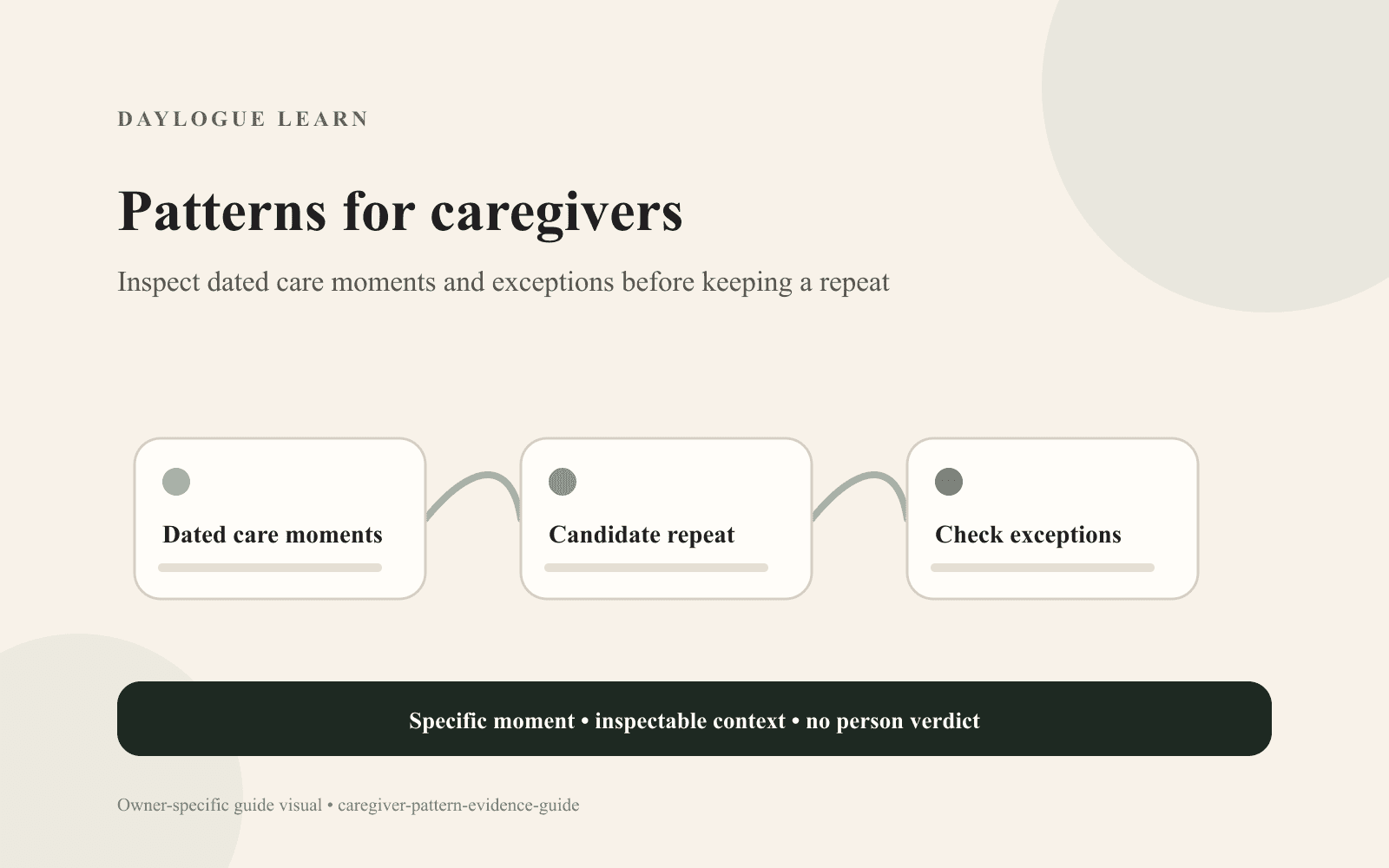
A journal app can help a parent or caregiver collect dated moments and notice a possible repeat across them. Begin with observable details, then open the entries behind any suggested pattern. Check missing days, changes in routine, and moments that do not fit. A repeat is a question to inspect, not proof of cause and never a verdict about you or the person receiving care.
Begin journal pattern evidence with one real moment
Caregiving days rarely arrive in tidy chapters. Meals, messages, appointments, errands, and someone else’s changing needs can crowd out the small details that would help you remember what actually happened. A useful journal guide makes room for one dated care moment at a time. It does not ask you to summarize the person you care for or grade how well you handled the whole day.
For this guide, the starting point is a tense school-morning handoff that seemed to happen more than once. Write the part you can place in time before you explain it. A scene gives later reflection something inspectable. It also makes it easier to correct the entry if memory, a calendar, or another detail changes the first version. The aim is not polished prose. It is an honest record with enough context to revisit.
What this journal pattern evidence practice can hold
The useful unit is a dated event, not a personality label. Record the timing, the demand in front of you, the words or actions you observed, and anything that changed from the usual routine. “We left ten minutes later after the bus schedule changed” can be checked later. “Mornings are always impossible” hides the situations that differ.
Keep the page at the scale of the event. Add a date, rough time, setting, and the change that mattered when those details are useful. Omit any detail you do not want stored. Choose a scene you can place, such as a rushed handoff, a calmer meal, a changed appointment, or the five quiet minutes after everyone settled. Record what happened before you decide what it means. That order protects against a tired memory turning one hard exchange into a conclusion about the relationship, the person receiving care, or you. That balance gives you a record that is specific without pretending it contains the whole story.
Use a three-part entry instead of a verdict
When the app suggests a repeat, open the source entries. Ask which details truly recur and which appeared once. Compare weekdays with weekends, ordinary days with appointment days, and rushed handoffs with slower ones. Keep missing entries visible because an empty day is not evidence that nothing happened or that the same event continued.
The three parts can remain short: what happened, what you noticed, and what stays open. They do not need equal space. A later entry can add context without rewriting the original moment to look more certain than it was. The open space is useful because a journal should preserve questions as well as answers.
01
Name the scene
Place a tense school-morning handoff that seemed to happen more than once in the day using only the details you remember accurately.
02
Add your response
Describe what stood out in language that sounds like you, without assigning a permanent trait or hidden motive.
03
Keep one question open
Write what you may want to notice later, then stop without forcing the entry to resolve the situation.
Prompts for caregivers that keep the meaning open
Choose one question that matches the moment you selected. One prompt can be enough. A useful prompt narrows attention without supplying the conclusion. Questions beginning with what, when, or which usually leave more room than questions that assume why something happened. Change the wording whenever it does not fit your memory or your voice.
Read your answer once for absolute language and borrowed labels. Replace “always” with the dates you actually recorded. Replace a claim about another person’s intent with the words or actions you observed. Replace a broad judgment about yourself with the choice, demand, or context in front of you. These edits make the entry easier to inspect without making it falsely positive.
- Which dated care moment is easiest to verify?
- What detail repeated in more than one entry?
- Which recorded day does not fit the possible repeat?
- What changed in the surrounding routine?
- What information is missing from the record?
- What would make me revise this interpretation?
Add context without inventing a cause
Context can include timing, location, schedule changes, competing demands, sleep you personally recorded, or what happened immediately before the scene. Add only what you know. A detail that sits beside the event may help you compare entries later, but it does not prove that the detail caused what followed. Keep causal language as a question until the record can support more.
A pattern can be useful before it is certain. Use it as a prompt to look closer, not a command to reorganize care. A recurring overlap does not identify what caused the situation. A schedule change, a difficult night, a transportation problem, or your own workload may all sit beside the same moment. Daylogue says a recurring overlap does not show that one thing caused another. That limit applies to your own reading too. It leaves room for missing days, unrecorded influences, coincidence, and the examples that do not fit.
Look for the moment that does not fit
A possible theme becomes more useful when you actively search for a counterexample. If several entries seem alike, open the clearest different one. Ask what changed in the setting, timing, demand, response, or available support. The exception may narrow the pattern, reveal missing context, or show that the first interpretation was too broad.
Keeping an exception visible can make the record more honest, even when the story becomes less tidy. A journal can hold a complicated record without arguing for one side. The different moment can be the most informative part because it shows where the repeat stops. Keep the source date attached so future you can inspect the entry instead of relying on a summary detached from its evidence.
Avoid common journal pattern evidence shortcuts
The first shortcut is reading a missing entry as evidence. The second is turning one repeated phrase into a fixed trait. The third is mistaking a tool’s confident sentence for certainty. None of these moves adds context. Mark the gap, return to the source moment, and use words such as may, seems, or worth checking when the interpretation remains provisional.
Another shortcut is writing for an imaginary reader. You do not need to make the day coherent, admirable, or productive. Keep the details that help you understand the moment and remove the ones added only to defend yourself. The record can stay unfinished. Honest uncertainty gives later entries space to support, complicate, or replace today’s reading.
Use research as context, not a promise
A 2019 study described narrative coherence through context, chronology, and theme, while finding that its relationship with well-being was more complex than a simple rule. That is useful context for reflection, but it does not prove that one prompt, one app, or one way of writing will produce a particular result for you. Research findings describe groups and study conditions. Your entry remains a record of a chosen moment, not a test result.
Use sources to check the limits of a claim as carefully as the headline. Notice the population, method, outcome, and study quality. An association is not a cause, and a mixed finding is not a guarantee. A practical journal guide can borrow the discipline of research by keeping context and uncertainty visible without claiming the authority of a study.
Check the data boundary before you write
Care notes can include another person’s schedule, health details, school information, or family conflict. Remove names and identifying details that are not needed for your own reflection. A phrase such as “the afternoon appointment” may preserve the useful context without copying a diagnosis, address, provider name, or private message into the entry. Daylogue reads the entries you choose to sync to create narratives and surface patterns. Entries are not end-to-end encrypted. Use that plain boundary when deciding what belongs in a synced entry.
Daylogue does not use personal entries to train its own models. Provider handling follows current written terms, configuration, and subprocessor disclosures. Daylogue does not infer emotion from faces, voice tone, or physiology. It works from the words and context people choose to share. Read the current policy and choose the amount of detail that fits the stated terms.
A seven-part journal pattern evidence practice
Use the table as a sequence or choose only the row that helps today. Choose one dated care moment. Write what changed in the situation. Mark one missing detail. Review a possible repeat. Look for an exception. Remove unnecessary identifiers. Keep one question open. The steps are prompts, not requirements. A day with one accurate sentence still belongs in the record, and a day with no entry remains an honest gap rather than a broken streak.
At the end, keep one source moment and one open question. Drop any summary that outruns the entries behind it. If a later note changes the picture, revise the interpretation while leaving the original dated entry intact. That preserves continuity without pretending your first reading was final.
| Pass | Question | Keep in view |
|---|---|---|
| 1 | Choose one dated care moment | Which dated care moment is easiest to verify? |
| 2 | Write what changed in the situation | What detail repeated in more than one entry? |
| 3 | Mark one missing detail | Which recorded day does not fit the possible repeat? |
| 4 | Review a possible repeat | What changed in the surrounding routine? |
| 5 | Look for an exception | What information is missing from the record? |
| 6 | Remove unnecessary identifiers | What would make me revise this interpretation? |
| 7 | Keep one question open | Which question deserves another entry? |
Field practice: journal pattern evidence for caregivers
Put this journal pattern evidence for caregivers practice beside an ordinary part of your routine instead of waiting for an ideal writing session. The cue might be closing the kitchen, returning from a handoff, putting a phone on charge, or sitting down after the last scheduled task. When the cue arrives, select a tense school-morning handoff that seemed to happen more than once. Keep the scene narrow enough that you can name what happened without summarizing everyone involved or explaining the entire day.
The first pass for caregivers is an observation pass. Use a date or time window, then note the visible change in the scene. The second pass is a language check. Circle any word that makes the moment permanent, universal, or certain. The third pass is a context check using this question: What detail repeated in more than one entry? These passes can happen immediately or during a later review, and none requires a polished paragraph.
Try two versions of the same journal pattern evidence note. In the broad version, write the first summary that comes to mind. In the grounded version, replace the summary with a tense school-morning handoff that seemed to happen more than once, one action, and one surrounding condition. Compare which version would let you verify or revise the memory a week later. Keep the grounded version even when it sounds less dramatic because it holds the evidence the broader sentence removed.
Create an exception line specifically for journal pattern evidence for caregivers. Begin with “This might not fit when” and finish it using a recorded difference rather than a hypothetical personality story. You could name a changed schedule, another setting, a clearer request, more time, or a day when the expected repeat did not appear. The line does not cancel the original observation. It marks the edge of what the current entries can support.
Decide which detail from a tense school-morning handoff that seemed to happen more than once belongs only in your memory and which one belongs in the journal. Care notes can include another person’s schedule, health details, school information, or family conflict. Remove names and identifying details that are not needed for your own reflection. A phrase such as “the afternoon appointment” may preserve the useful context without copying a diagnosis, address, provider name, or private message into the entry. Keep the useful structure while removing identifiers that do not help you reflect. If deleting a name makes the scene confusing, use a role or neutral label. If quoting a message adds little, summarize the part that changed your next action and leave the original communication outside the journal.
Use What changed in the surrounding routine? as a revision question after the first draft. Add the missing context if you know it, or write “unknown” if you do not. This small distinction matters for caregivers because an unanswered question can otherwise disappear inside a confident summary. Naming the unknown preserves it for the next recorded moment without pressuring you to solve it before you close the entry.
At the end of this journal pattern evidence for caregivers practice, write a source line that points back to the scene. A source line can be a date plus three words, such as “Tuesday, changed pickup time,” or “Friday night, reply arrived.” It is not a citation for anyone else. It is a trail for you, making it easier to open the original note before you keep, revise, or drop a later interpretation.
Choose the stopping rule that fits this exact guide. Stop when what information is missing from the record? has an honest answer, when the next sentence would repeat the first, or when continuing would require details you do not want stored. Choose a scene you can place, such as a rushed handoff, a calmer meal, a changed appointment, or the five quiet minutes after everyone settled. Record what happened before you decide what it means. That order protects against a tired memory turning one hard exchange into a conclusion about the relationship, the person receiving care, or you. The stopping rule keeps journal pattern evidence voluntary and makes return easier because every entry does not have to become a complete account.
- Source moment: a tense school-morning handoff that seemed to happen more than once
- Audience lens: caregivers can leave the surrounding story unfinished.
- Prompt check: Which dated care moment is easiest to verify?
- Context check: What detail repeated in more than one entry?
- Language check: Which recorded day does not fit the possible repeat?
- Missing-detail check: What changed in the surrounding routine?
- Exception check: What information is missing from the record?
- Revision check: What would make me revise this interpretation?
01
Choose one dated care moment for journal pattern evidence
Apply this pass to a tense school-morning handoff that seemed to happen more than once. Then ask, “Which dated care moment is easiest to verify?” Keep the answer in your own words and leave any unsupported conclusion open.
02
Write what changed in the situation for journal pattern evidence
Apply this pass to a tense school-morning handoff that seemed to happen more than once. Then ask, “What detail repeated in more than one entry?” Keep the answer in your own words and leave any unsupported conclusion open.
03
Mark one missing detail for journal pattern evidence
Apply this pass to a tense school-morning handoff that seemed to happen more than once. Then ask, “Which recorded day does not fit the possible repeat?” Keep the answer in your own words and leave any unsupported conclusion open.
04
Review a possible repeat for journal pattern evidence
Apply this pass to a tense school-morning handoff that seemed to happen more than once. Then ask, “What changed in the surrounding routine?” Keep the answer in your own words and leave any unsupported conclusion open.
05
Look for an exception for journal pattern evidence
Apply this pass to a tense school-morning handoff that seemed to happen more than once. Then ask, “What information is missing from the record?” Keep the answer in your own words and leave any unsupported conclusion open.
06
Remove unnecessary identifiers for journal pattern evidence
Apply this pass to a tense school-morning handoff that seemed to happen more than once. Then ask, “What would make me revise this interpretation?” Keep the answer in your own words and leave any unsupported conclusion open.
07
Keep one question open for journal pattern evidence
Write one open question that could deserve another entry. It can remain unanswered, and repeating the first verification prompt is unnecessary.
Checklist
Caregiver pattern evidence checklist
Use this checklist to inspect the dated moments, surrounding context, missing days, and exceptions behind a possible caregiving pattern.
- Which dated care moment is easiest to verify?
- What detail repeated in more than one entry?
- Which recorded day does not fit the possible repeat?
- What changed in the surrounding routine?
- What information is missing from the record?
- What would make me revise this interpretation?
- Choose one dated care moment before moving to the next part.
- Write what changed in the situation before moving to the next part.
- Mark one missing detail before moving to the next part.
- Review a possible repeat before moving to the next part.
- Look for an exception before moving to the next part.
- Remove unnecessary identifiers before moving to the next part.
Common questions
How long should journal pattern evidence take for caregivers?
One accurate sentence can be enough. Continue only when another detail adds context you want to keep, not because the entry must reach a certain length.
Do I need to make up the days I did not record?
No. Leave missing days visible. If a past event matters, add it later with an honest date or uncertainty note instead of pretending it was recorded at the time.
Can a journal app tell me what a repeated moment means?
It can suggest a possible repeat from the information available, and opening the source entries, missing days, and exceptions can help you decide whether to keep the interpretation.
How do I write about another person carefully?
Record your own experience, paraphrase when exact wording is unnecessary, remove identifying details, and avoid assigning a motive or fixed trait that the observed moment cannot establish.
What privacy terms should I check before using an AI journal?
Check whether synced entries are readable to the service, which providers process content, how generated outputs are stored, what deletion covers, and which account controls are available.
Can Daylogue replace professional care?
No. Daylogue is not therapy and is not a replacement for professional care. Its observations are designed for reflection, not diagnosis, prediction, treatment, or clinical decision-making.
Sources
Sources were checked on the dates shown. Product details and policies can change.
- Daylogue evidence and methods · Daylogue · checked August 29, 2026
- Daylogue privacy policy · Daylogue · checked August 29, 2026
- Narrative identity and psychological well-being research · Frontiers in Psychology · checked August 29, 2026
Keep exploring
Daylogue Knowledge Center
Browse practical guides for reflection, journaling, patterns, and privacy.
Read moreHow Daylogue shows patterns
See how candidate patterns stay connected to evidence and correction.
Read moreWhy Daylogue exists
Read the principles behind a system for self-understanding.
Read moreDaylogue is not therapy and is not a replacement for professional care.